
Contractor vs Contracter: Knowing the right term can set you apart in an industry where details matter. Many people mistakenly interchange these words, risking their professional reputation without realizing it. In this article, we will pinpoint the accurate term and highlight its importance, empowering you to communicate effectively and confidently in your projects. With this knowledge, you’ll be better equipped to navigate the complexities of contracts and industry jargon.
Contractor vs Contracter The Straight Answer
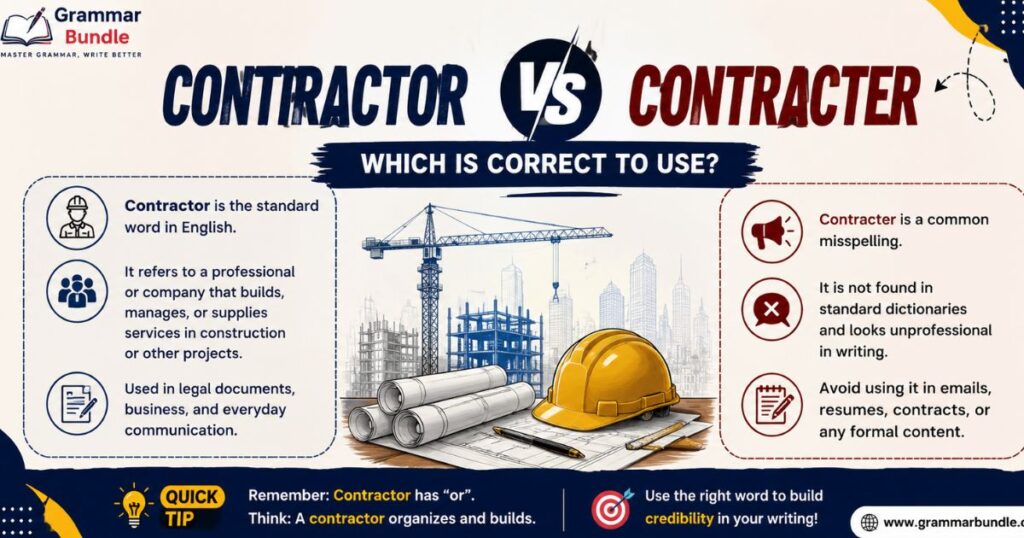
When discussing “contractor” and “contracter,” clarity is key. Here’s what you need to know:
Contractor:
This is the correct term for a person or company that enters into a contract to provide goods or services. Think builders, freelancers, and service providers.
They play a crucial role in managing projects and getting things done efficiently.
Contracter:
This spelling is often seen as a common mistake. While it may seem minor, using the wrong term can impact professionalism.
It’s essential to communicate clearly, especially in business settings where accuracy matters.
For more helpful spelling and grammar tips, explore our related guides on Cheer vs Chear When to Use Each One?
Contractor Meaning in Simple Terms
What is a Contractor?
A contractor is basically a person or a company hired to complete a specific project or job. They often work in construction, but their expertise can span various fields.
The relationship can be quite flexible, as they may be temporary workers or part of long-term partnerships.
Key Points About Contractors
- Self-Employed: Many contractors run their own businesses, allowing for more freedom in how they work.
- Specialized Skills: They usually possess specific skills or knowledge, making them valuable in their area of expertise.
- Project-Based: Unlike regular employees, contractors typically get paid for the job they complete, not a steady salary.
- Varied Work: They can work on different types of projects, from home renovations to larger construction jobs.
Contractors play a pivotal role in the economy, bridging gaps between labor needs and skills available. Their adaptability and specialized knowledge make them essential in getting things done efficiently.
Is Contracter Correct or a Real Word?
Understanding the Term “Contracter”
- Definition: “Contracter” is often viewed as a variation of “contractor.”
- Usage: Commonly used in specific fields, like project management.
- Formal Acceptance: It is not widely accepted in standard dictionaries.
Language Evolution
- Informal Use: Many people use “contracter” in conversation.
- Adaptation: Language evolves; new terms appear regularly.
- Regional Variance: Some regions might recognize it as slang.
Final Thoughts
- Context Matters: The term’s acceptance varies by situation.
- Clarity is Key: Using “contractor” is more universally understood.
- Keep Learning: Language is fluid; always explore new words.
For more helpful spelling and grammar tips, explore our related guides on Sleave or Sleeve? Helpful Spelling Guide
Why People Write Contracter Instead of Contractor
The Common Mix-Up
Many people mistakenly write “contracter” instead of “contractor.” This error isn’t just a slip of the pen; it highlights a few interesting aspects of language and communication.
- Phonetic Confusion: The way “contractor” sounds may lead to people simplifying it, dropping the “o.”
- Spelling Patterns: English has many words with similar structures where consonants get doubled or altered, causing confusion.
Language Evolution
Our language is constantly evolving, and such errors can reflect a more casual approach to writing.
- Digital Communication: With texting and online chats, brevity often takes precedence over accuracy.
- Social Influence: When people see errors frequently online, they may adopt those missteps, believing them to be correct.
Understanding these patterns helps illuminate how language adapts and shifts, reminding us that communication is as much about context as it is about precision.
For more helpful spelling and grammar tips, explore our related guides on Tweek vs Tweak: Essential Guide to Correct Usage
Why “Contractor” Is the Correct Form
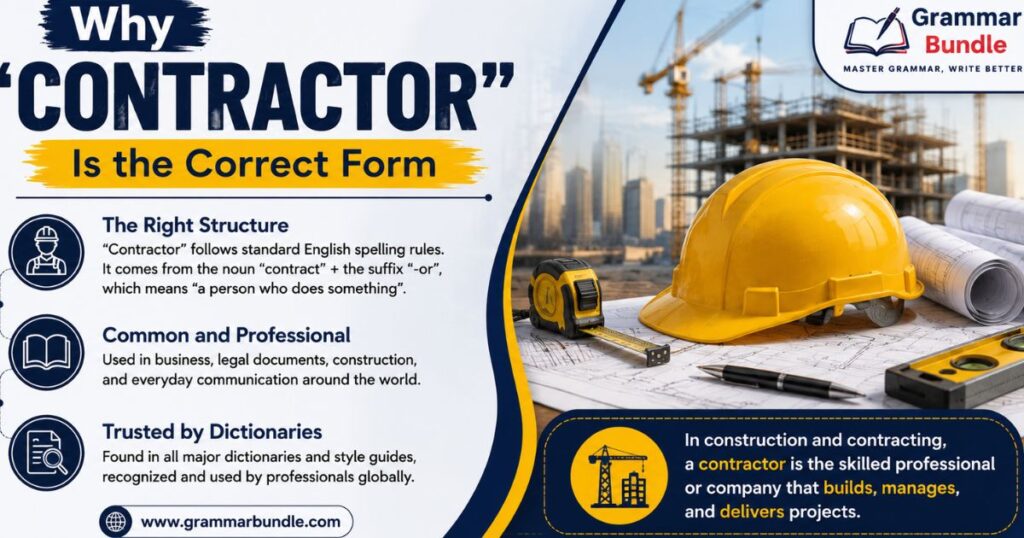
The word “contractor” holds a unique and essential place in the professional landscape.
The word “contractor” is a blend of “contract” and the suffix “-or,” which denotes a person who performs a specific action.
This grammatical construction clearly signifies someone engaged in the business of creating contracts or providing contracted services.
Unlike generic terms, “contractor” specifies a role that carries both responsibility and expertise.
This clarity helps clients understand who they are hiring and what skills they can expect.
- Defined Expertise: A contractor often specializes in a specific field, bringing focused knowledge to projects.
- Accountability: This term implies a commitment to fulfill agreements and maintain quality standards.
Using the term “contractor” also fosters trust in the working relationship. Knowing someone is a contractor creates an expectation of professionalism and reliability that mere labels can lack.
- Clear Expectations: Clients can anticipate a direct line of communication and accountability.
- Professional Reputation: Many contractors build strong reputations based on their work, leading to more business opportunities.
Embracing the term “contractor” elevates discussions in teamwork and negotiations, emphasizing that these professionals are integral to success in various industries.
For more helpful spelling and grammar tips, explore our related guides on Passtime or Pastime:Which Spelling Is Correct?
Contracter vs Contractor Spelling in Real Usage
In the world of construction and legal agreements, the terms “contractor” and “contracter” frequently arise.
However, the correct term is “contractor,” which refers to an individual or company that enters into a contract to perform specific services.
The misspelling “contracter” can lead to confusion and miscommunication in professional contexts.
| Feature | Contractor | Contracter |
|---|---|---|
| Definition | A person or company that undertakes contracts for work | Incorrect spelling of contractor |
| Usage | Widely used in construction, legal, and service industries | Rarely used; often mistaken |
| Compliance | Must comply with regulations and standards | No regulatory significance |
| Professional Image | Enhances credibility and trust | Can undermine professionalism |
| Recognition | Recognized term in contracts and agreements | Not recognized in formal contexts |
Real-World Examples
- Residential Construction: A contractor is hired to renovate a house, ensuring quality and adherence to building codes.
- IT Services: A software contractor develops applications under a clear agreement with a client.
- Commercial Projects: Contractors manage large-scale projects, delivering on time and within budget.
- Freelance Work: Independent contractors often provide specialized services without long-term commitments.
Contractor Definition in English (Real-Life View)
In real life, a contractor is more than just a person who builds; they are the backbone of various projects across industries. Their work shapes our everyday experiences, from the homes we live in to the roads we travel. Contractors manage tasks, resources, and teams to ensure everything runs smoothly and meets high standards.
Types of Contractors
- General Contractors: These oversee the whole project, coordinating different trades and ensuring timelines are met.
- Specialty Contractors: Focus on specific areas like electrical, plumbing, or carpentry.
- Subcontractors: Hired by general contractors to perform specialized tasks, allowing for a more streamlined approach.
- Design-Build Contractors: These entities handle both the design and construction, simplifying communication and speeding up the process.
- Freelance Contractors: Often work on a project basis in fields like writing, design, or software development.
Each type of contractor plays a pivotal role, demonstrating that this profession goes beyond traditional building — it’s about collaboration, creativity, and community impact.
For more helpful spelling and grammar tips, explore our related guides on Scarey or Scary :The Correct Spelling
Contractor vs. Employee
Control and Independence:
- Contractors typically exercise greater control over how they complete their work.
- Employees adhere to company policies and schedules, offering less flexibility.
Financial Responsibility:
- Contractors manage their own taxes, health insurance, and retirement plans.
- Employers often provide benefits such as health insurance and retirement contributions for employees.
Work Commitments:
- Contractors are project-based and may work for multiple clients simultaneously.
- Employees usually have a fixed schedule and a longer-term commitment to one employer.
| Feature | Contractor | Employee |
|---|---|---|
| Control | High; sets own methods | Low; follows company guidelines |
| Tax Responsibilities | Self-managed; pays own taxes | Employer withholds taxes |
| Benefits | Generally none; responsible for own | Typically provided by employer |
| Work Duration | Project-based; flexible | Ongoing; fixed hours |
| Workplace Integration | Relatively independent; minimal integration | Deeply integrated into the company culture |
In practical terms,
A graphic designer working as a contractor might juggle multiple clients while setting their own rates and deadlines.
In contrast, a full-time employee in a similar role could have a stable salary and consistent hours but may find their creative freedom limited by company guidelines.
Common Misspellings of Contractor
- Contrator
A frequent slip that often occurs when typing too quickly, missing the “n” can confuse readers. - Contracter
An alternate spelling that adds an unnecessary “e,” which may come from misremembering the word. - Cotractor
This misspelling switches letters, making it easy to misinterpret the intended meaning. - Contrator
A simple omission; misplacing letters can lead to a loss of professionalism in business communications. - Contracter
This form appears in casual writing, but it’s crucial to stick with the correct spelling in formal contexts. - Contrator
Often mistaken by non-native speakers, it highlights the challenges of English spelling rules. - Contractoer
An uncommon twist that adds an extra “e,” often seen when people try to sound it out phonetically.
Check professional writing guidelines for proper word usage and clarity: https://gramlify.com/contractor-vs-contracter/
How to pronounce Contractor
Why Is Contracter Incorrect? (Simple Grammar Explanation)
The Basics of Contraction Errors
Using “contracter” instead of “contractor” is a common mistake. This slip usually happens when people rely too heavily on pronunciation rather than proper spelling. Here’s why it matters:
- Spelling Matters: Words are tools for communication. Incorrect spelling can confuse readers.
- Trustworthiness: A correctly spelled term builds credibility. Mistakes may lead others to question your professionalism.
Language and Precision
Language is about precision. Misusing terms like “contracter” can alter meaning or intent.
- Clarity: Using the correct form ensures your message is clear and straightforward.
- Respect for Language: Proper spelling shows respect for the language and its usage. It reflects attention to detail.
Focusing on accuracy not only improves communication but also enhances your image. Correct terms create a connection with your audience, leading to better understanding and engagement.
For more helpful spelling and grammar tips, explore our related guides on Sapphire or Saphire Avoid This Common Spelling Mistake
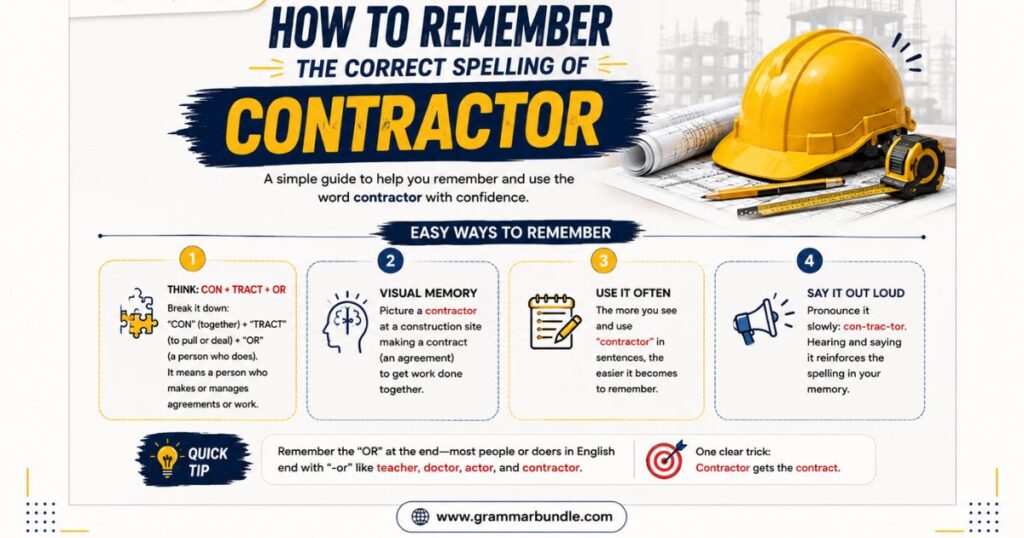
Tips to Remember the Spelling of “Contractor”
To nail the spelling of “contractor,” it helps to break it down into smaller parts. Understanding its roots can make a big difference. Here’s a simple way to do it:
- Root Word: Start with “contract,” which means an agreement. This will remind you that a contractor is someone who works under a contract.
- Suffix Addition: When you add “-or” at the end, think of it as adding a person who does something, like “actor” or “doctor.”
Visual Cues and Mnemonics
Creating visual links or memory aids can also help solidify this spelling in your mind:
- Imagery: Picture a contractor at work, drawing up plans. Visualizing the “contract” part can help reinforce the spelling.
- Phrase Creation: Use a catchy phrase like “The contractor has a contract.” Repeating this can make it stick.
By using these techniques, remembering how to spell “contractor” can be easy and fun!
Real-World Consequences of Misspelling Contractor
A misspelled “contractor” can lead to significant repercussions in various scenarios, affecting not only communication but also project outcomes. Here are a few critical consequences:
- Legal Complications: Contracts with typographical errors may be deemed invalid, complicating enforcement and dispute resolution.
- Miscommunication: Misleading information can result in misaligned expectations between clients and workers, leading to frustration.
- Loss of Professionalism: Spelling mistakes can damage credibility and trust, which are vital for building long-lasting relationships in any industry.
- Delayed Projects: Misspelling can cause confusion in documentation, resulting in delays that can extend deadlines and inflate costs.
- Ineffective Marketing: Poorly written marketing materials may deter potential clients, leading to lost business opportunities.
In the world of contractors, attention to detail is essential. A simple slip can trigger a chain reaction that affects contracts, relationships, and revenue.
For more helpful spelling and grammar tips, explore our related guides on Unkept or Unkempt? Helpful Guide to the Correct Word
Quick Reference Table
When discussing the terms “contractor” and “contracter,” it’s essential to know which is correct and when to use it. Here’s a quick reference table to clarify the differences.
| Feature | Contractor | Contracter |
|---|---|---|
| Definition | A person or business that executes a contract | Incorrect spelling of contractor |
| Usage | Widely used in construction and services | Rarely used and often seen as a typo |
| Grammatical Role | Noun | Noun, incorrect usage |
| Origin | Derived from Latin “contractus” | No recognized origin |
| Common Industries | Building, consulting, IT | Not applicable |
| Recognition | Recognized in dictionaries | Not recognized as a valid word |
Contractor in Professional Writing
- Contractor is the standard spelling in professional English.
- It refers to a person or company hired for specific work.
- It commonly appears in business, construction, and legal documents.
- Use contractor in contracts, reports, emails, and proposals.
- Example: The contractor completed the project on time.
- Example: We hired a contractor for the renovation.
FAQs:
1. What is the correct spelling: contractor or contracter?
The correct spelling is “contractor.” A contractor is someone who carries out work under a contract.
2. What does a contractor do?
A contractor is a person or business that performs work for others. They often handle construction, repairs, or services.
3. Is “contracter” a real word?
No, “contracter” is not a standard word. The correct term is “contractor.”
4. Can I use “contracter” in my writing?
It’s best to avoid “contracter.” Stick to “contractor” to ensure your writing is clear and correct.
5. Why do people confuse these two words?
Some people mix them up because they sound similar. However, only “contractor” is accepted in standard English.
6. Are there different types of contractors?
Yes, there are many types! Some examples include general contractors, electrical contractors, and plumbing contractors.
7. How do I choose the right contractor for my project?
Look for experience, reviews, and licenses. It’s also helpful to get quotes from multiple contractors before deciding.
8. What should I ask a contractor before hiring them?
Ask about their experience, references, and how they handle payments. It’s important to know they’re reliable and trustworthy.
Conclusion
Understanding the difference between “contractor” and “contracter” is essential for clear communication. “Contractor” is the correct spelling and refers to someone who is hired to perform specific tasks, such as construction work. On the other hand, “contracter” is not a recognized word in standard English and should be avoided.