

Affend vs Offend — these seemingly similar words can lead to confusion and miscommunication. While they sound alike, their meanings diverge significantly, impacting how we express feelings and intentions. This minor distinction between “affend” and “offend” is often overlooked but holds significant weight in conversations.
Why This Confusion Even Exists in the First Place
Understanding the Confusion
The words “affend” and “offend” often get mixed up, and their similarities can trip up even the best of us. One key reason for this confusion lies in their similar spelling and sound.
In everyday conversations, it’s easy to slip a letter or two, leading to misunderstandings.
- Common Usage: “Offend” means to hurt someone’s feelings or break rules.
- Non-Standard Use: “Affend” is not a standard word in English, yet some people may mistakenly use it, thinking it fits the context.
This mix-up can happen with other pairs too, like “accept” vs “except” or “affect” vs “effect,” showcasing how a slight change can lead to entirely different meanings.
Why Does It Matter?
Clarifying these terms is essential for effective communication.
When someone says “I was affended by that comment,” it can lead to confusion. Using the correct word showcases your understanding and helps avoid mixed signals in conversation.
- Impact on Messages: The right word can strengthen your point and ensure it’s taken seriously.
- Language Evolution: Language is always changing, but maintaining clarity is crucial for meaningful interactions.
By honing in on the correct spelling, you enhance your communication skills and ensure your message resonates.
What “Offend” Actually Means in Real Life
Offend means to make someone feel upset, hurt, annoyed, or disrespected because of something you say or do.
In real life, it usually happens when a person’s words, actions, or behavior cross another person’s feelings or expectations.
Common real-life situations
- A rude comment:
His rude comment offended his classmate. - An insensitive joke:
The joke offended some people. - Disrespectful behavior:
She was offended by his disrespectful attitude. - Unkind words:
I didn’t mean to offend you with my question.
“Offend” can also mean breaking a rule
The word doesn’t always relate to someone’s feelings. It can also mean to break a law or rule.
Example:
Anyone who offends the law may face legal consequences.
How To Pronounce Offend:
When it comes to pronouncing “offend,” it’s essential to break it down into its syllables: of-fend.
- Syllable Breakdown: Say “of” gently, almost like a whisper, then emphasize “fend” more clearly.
- Stress the Second Syllable: Place a bit more weight on “fend,” as it’s the heart of the word.
- Practice with Context: Use it in a sentence. For example, “I didn’t mean to offend you.”
For further details, visit this trusted English language reference: https://word.tips/spelling/offend-vs-affend/
Where “Affend” Comes From and Why It Feels Real
The Origins of “Affend”
- Cultural Roots: “Affend” originates from a blend of cultural storytelling and communal experiences. Its roots trace back to ancient tales where feelings of conflict and bonding were explored.
- Language Evolution: Over time, the term has shifted in meaning, reflecting changes in society and how we articulate our emotions. This evolution showcases the adaptability of language and its power in shaping our perceptions.
Why “Affend” Feels So Real
- Universal Emotions: The feelings associated with “affending” resonate deeply because they tap into universal human experiences like hurt, betrayal, and connection. Everyone can relate to these emotions at some level.
- Enhanced Connectivity: The concept creates a bridge between personal feelings and shared experiences, fostering a sense of belonging within a community. When people discuss “affend,” it invites reflection and empathy.
- Impactful Storytelling: Stories about “affend” often mix vulnerability with strength, making them relatable. They remind us of our shared imperfections, creating a genuine connection with others.
Learn more about related English spelling and grammar tips in our other articles:Loot vs Lute: Meaning, Spelling Pronunciation
Where “Affend” Comes From and Why It Feels Real
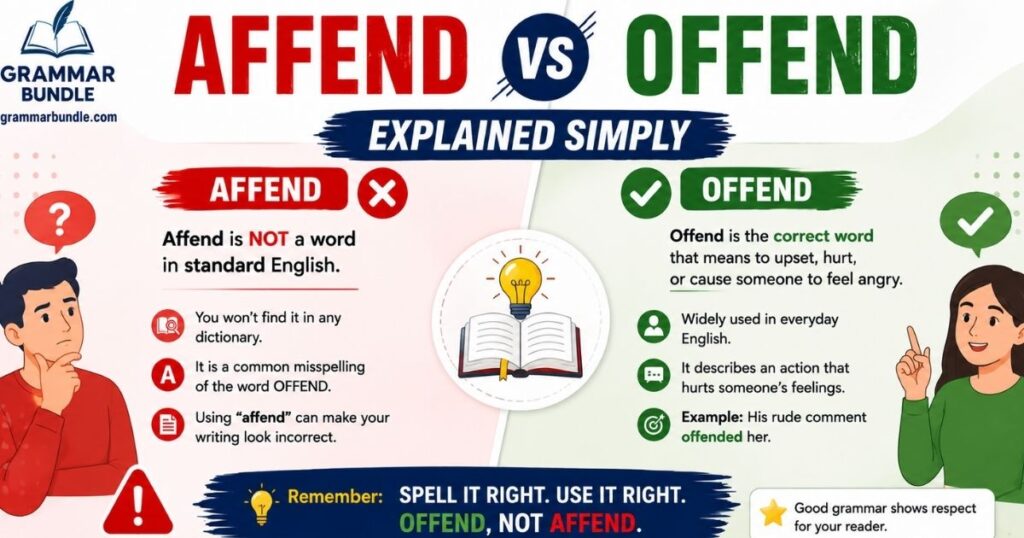
“Affend” is not the standard English spelling of a word. It is mainly a misspelling of “offend.” Still, it can look and sound believable, especially when people spell words based on pronunciation.
Where Does “Affend” Come From?
1. A common misspelling of “Offend”
The most likely source of “affend” is the correct word “offend.” People may accidentally replace the initial o with a.
- Correct: offend
- Incorrect: affend
- Meaning: to upset, hurt, or insult someone
Example:
❌ I didn’t mean to affend you.
✅ I didn’t mean to offend you.
2. Pronunciation-based spelling
People sometimes write a word according to how they think it sounds.
- Offend is pronounced roughly like uh-FEND.
- The first sound can be weak and unclear in normal speech.
- Because of this, someone may mistakenly write affend instead of offend.
3. Confusion with similar English words
English has many words beginning with a, which can make affend look believable.
For example:
- affect
- accept
- appear
- arrive
- attend
The familiar a- beginning may influence someone when they try to spell offend from memory.
Why Does “Affend” Feel Real?
1. It looks like a normal English word
Affend follows a spelling pattern that doesn’t immediately look strange. The combination of a + ff + end can make it seem like a legitimate English word.
2. It sounds close to “Offend”
When spoken quickly, the difference between the beginning sounds may not be obvious to an English learner.
Offend → affend can therefore feel like a small and reasonable spelling change.
3. The word “offend” is familiar
Because offend is a common English verb, people who remember its pronunciation but not its spelling may create the form affend.
4. The spelling “ff” feels familiar
English has many words containing ff, such as:
- offer
- different
- coffee
- suffer
So affend can visually seem believable even though it isn’t the standard spelling.
The Main Reason for the Confusion
The biggest reason is pronunciation + memory. A person may remember the sound of offend but incorrectly recall its first letter as a.
OFFEND is correct. AFFEND is a misspelling.
So, whenever you’re talking about upsetting or hurting someone’s feelings, use offend.
Learn more about related English spelling and grammar tips in our other articles:Scarey or Scary :The Correct Spelling
The Clean Difference Between Affend vs. Offend
Understanding the subtle differences between “affend” and “offend” can enrich your language skills. While both words may seem similar, they serve unique purposes in communication.
| Feature | Affend | Offend |
|---|---|---|
| Part of Speech | Verb | Verb |
| Meaning | To affect positively or honor | To irritate or hurt feelings |
| Example Sentence | “His efforts affend everyone in the community.” | “Her comment did not mean to offend you.” |
| Common Usage | Rare | Common |
| Emotional Tone | Positive | Negative |
| Context | Formal and respectful | Informal and casual |
Why “Offend” Matters More Than Just Spelling
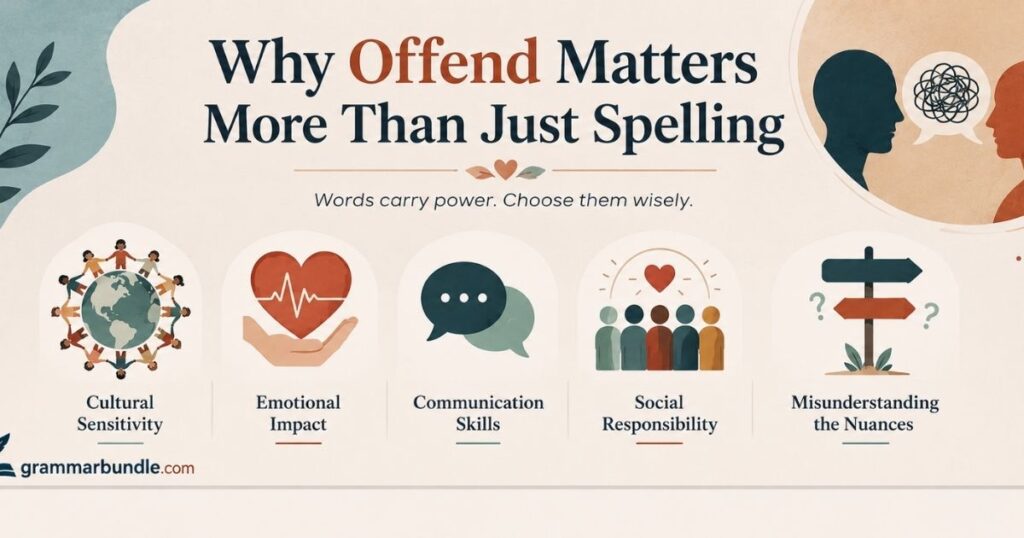
Cultural Sensitivity
Understanding language goes beyond spelling; it reflects societal values. Words like “offend” can carry deep implications about our respect for diverse perspectives.
Emotional Impact
Language shapes feelings. The choice of words can either connect us or divide us. When we consider how our language affects others, we cultivate empathy.
Communication Skills
Mastering language includes recognizing nuances. Misunderstanding the term “offend” can lead to miscommunication, affecting personal and professional relationships.
Social Responsibility
Words hold power. Using them carelessly can perpetuate stereotypes or cause harm. Being mindful about language fosters a more inclusive environment.
Misunderstanding the Nuances
Many people confuse “affend” and “offend,” often using them interchangeably without realizing their distinct meanings. This can lead to unclear conversations and miscommunication.
Learn more about related English spelling and grammar tips in our other articles:Sapphire or Saphire Avoid This Common Spelling Mistake
Real Meaning in Action: How “Offend” Works in Sentences
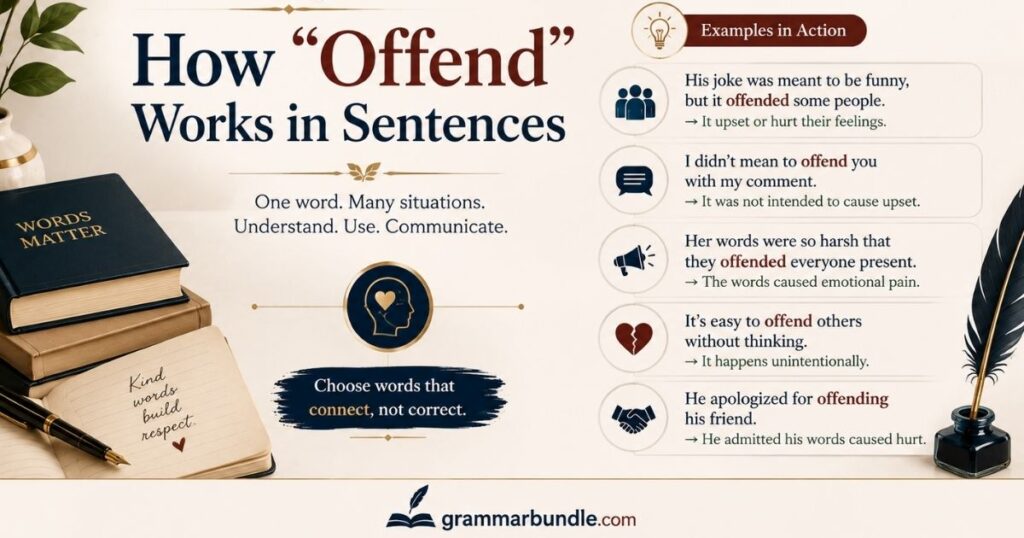
The verb “offend” means to make someone feel upset, hurt, annoyed, or disrespected. It can describe everyday situations where words or actions affect another person’s feelings.
1. Offend someone with words
You can use offend when something someone says hurts another person’s feelings.
Examples:
- I didn’t mean to offend you with my question.
- His rude comment offended his friend.
- Be careful with your words so you don’t offend anyone.
2. Offend someone with actions
Offend can also describe behavior that someone considers disrespectful or inappropriate.
Examples:
- His behavior offended the guests.
- She was offended by the way he spoke to her.
- The student’s disrespectful attitude offended the teacher.
3. Offend someone unintentionally
A person can offend someone without intending to.
Examples:
- I apologized because I didn’t want to offend her.
- He accidentally offended his colleague.
- She didn’t realize that her comment might offend someone.
4. Offend someone intentionally
Sometimes, a person may deliberately say or do something hurtful.
Examples:
- He didn’t apologize because he intended to offend them.
- She knew her remark would offend him.
5. Common sentence patterns with “Offend”
Offend + someone
- That comment offended me.
Offend + someone + with + something
- He offended her with his rude remark.
Be offended + by + something
- They were offended by his behavior.
Offend + against + a rule or principle
In more formal English, offend against can mean to violate a rule, principle, or standard.
- The action offended against basic principles of fairness.
Learn more about related English spelling and grammar tips in our other articles:Leary or Leery? Clear Differences and Real Usage
Where People Commonly Go Wrong
Common Mistakes
- Using “affend” as a verb: There’s no actual word “affend” in English. The correct term is “offend.” The confusion often arises from similar sounds and spellings.
- Ignoring the emotional impact: To “offend” someone usually implies causing hurt or displeasure. In contrast, the term “affend” doesn’t exist, leading to potential misunderstandings about emotional intent.
- Not considering context: The context in which you discuss these terms matters. Clarifying your choice of words can prevent assumptions about what you mean.
By being mindful of these distinctions, conversations become clearer and more respectful.
A Simple Way to Never Mix Them Up Again
Understanding Affend vs. Offend
- Affend is a rare term relating to offense in a historical or literary context.
- Offend refers to causing emotional pain or displeasure.
- It’s the word you’ll use most often in everyday conversation.
Easy Tips to Remember
- Think of “offend” as a “no-go” zone: When you upset someone, you’ve crossed a line.
- Remember “affend” is archaic: Picture Shakespeare or classic literature to keep it in mind.
By linking each word to its context, you’ll never mix them up again. Embrace this simple trick for clear, effective communication!
Why This Confusion Happens in Language Learning
The Language Puzzle: Affend vs. Offend
- Similar Sound: The words “affend” and “offend” sound alike, making it easy to mix them up for language learners.
- Limited Practice: Many learners don’t use these words in conversation often, leading to confusion when they need to apply them.
- Cognitive Load: Juggling new vocabulary can overwhelm learners, causing common errors like this to slip through.
Context Matters
- Cultural Nuances: In different contexts, the impact of offending someone varies, which complicates understanding.
- False Friends: Some languages have similar words that mean different things, leading to confusion when learning English.
- Emotional Weight: “Offend” carries a strong emotional weight, while “affend” (not standard) can cause hesitation in expressing feelings.
Language learning is a journey with many twists and turns, and these mix-ups are just part of the process. Embracing these moments can lead to deeper understanding and growth.
Learn more about related English spelling and grammar tips in our other articles:Holistic or Wholistic the Complete Guide
Quick Clarity: Affend vs. Offend
“Offend” is widely recognized, “affend” is often mistakenly used. Let’s break it down:
| Term | Definition | Usage |
|---|---|---|
| Offend | To cause hurt feelings or displeasure. | “His remark did not mean to offend.” |
| Affend | A less common term, often a typo of offend. | Not typically used; consider it a misusage. |
- Offend: This verb captures the essence of causing emotional discomfort. It’s rooted in the idea of crossing personal boundaries or cultural norms.
- Affend: Rarely seen in proper usage. It may stem from blending words or typographical errors, leading to confusion.
Practice in Real Thinking
Affend vs. Offend: The Art of Precision
- Understanding the Terms:
Affend: A term less commonly used, relating to causing harm.
Offend: More familiar, usually about causing hurt feelings or displeasure. - Real-World Implications:
Using these words mindfully can shift how we approach communication.
Recognizing the difference helps in navigating sensitive topics. - Practice in Clarity:
Think before you speak; choose words that best reflect your intent.
Clear communication reduces misunderstandings and strengthens connections.

Enhancing Communication
- Mindful Conversations:
Take a moment to assess if your words might affend or offend someone.
Fostering empathy can lead to deeper, more respectful dialogues. - Continuous Learning:
Challenge yourself to explore language daily.
Build a richer vocabulary, enhancing your ability to express thoughts accurately.
Learn more about related English spelling and grammar tips in our other articles:Shinning or Shining the Correct Spelling
A Real-World Observation
- Origin of Confusion: Many people mix up “affend” with “offend.”
- Cultural Perception: In social settings, using “offend” feels more common. It’s the go-to term for expressing hurt feelings.
- Language Evolution: Language is always changing. New words sometimes make their way into everyday use, often leading to the accidental creation of terms like “affend.”
Real-World Implications
- Social Interactions: Using the wrong word can lead to misunderstandings in conversation. It’s important to stay aware of what you’re saying.
- Impact on Relationships: Choosing the correct term can affect how others perceive your message. Clarity enhances communication and builds trust.
- Final Thought: While “affend” might pop up occasionally, sticking to “offend” ensures you communicate your feelings effectively. Embracing the richness of language helps us connect better.
FAQs
- What does “affend” mean?
Ans:“Affend” is not a real word in English. You might mean “offend.” - What does “offend” mean?
Ans:“To offend” means to hurt someone’s feelings or break a social rule. - How do I remember the difference?
Ans:Think of “offend” like “off,” which can mean something bad. “Affend” isn’t a word, so just focus on “offend.” - Can I use “affend” in a sentence?
Ans:No, “affend” is incorrect. Stick to “offend” when talking about feelings or rules. - Are there any similar-sounding words?
Ans:Yes, words like “defend” or “pretend” sound similar but mean different things. - Why do people confuse these words?
Ans:Both words sound alike, and some might mistakenly add the “a” sound. It’s an easy mix-up! - Is there a trick to spell “offend” correctly?
Ans:Just remember, it starts with “o” and ends with “end.” Picture “off” and “end” together. - What if I want to learn more about spelling?
Ans:You can find many resources online, like spelling games and guides. Practice makes perfect!
Conclusion:
Understanding the difference between “affend” and “offend” is important for clear communication. “Affend” is not a recognized word, “offend” means to cause someone to feel hurt or upset. Remembering this can help you avoid common spelling mistakes.