
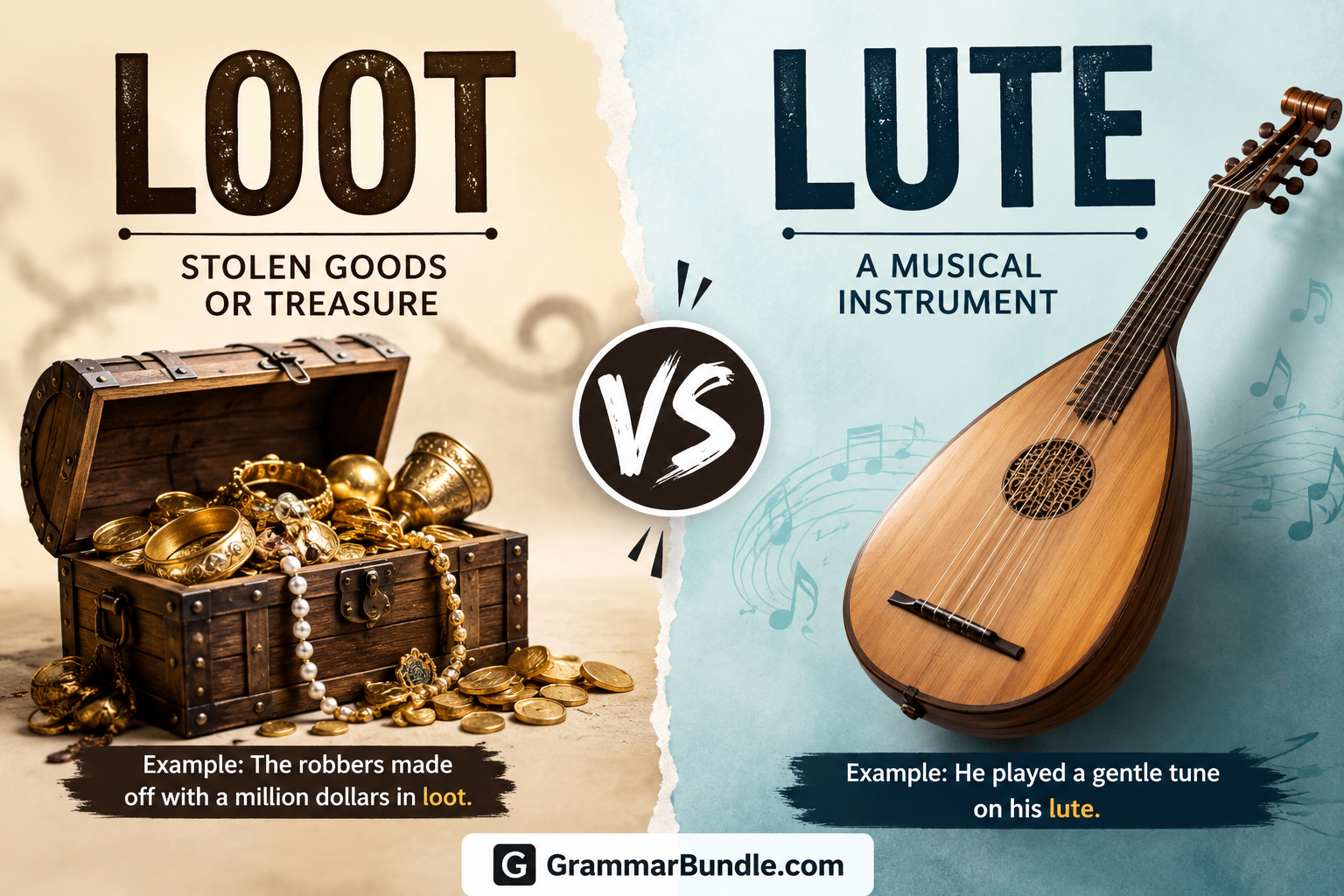
If you’ve ever confused “loot” with “lute,” you’re not alone. These two words can lead to amusing misunderstandings and highlight the richness of the English language. Understanding these differences is essential for effective communication.
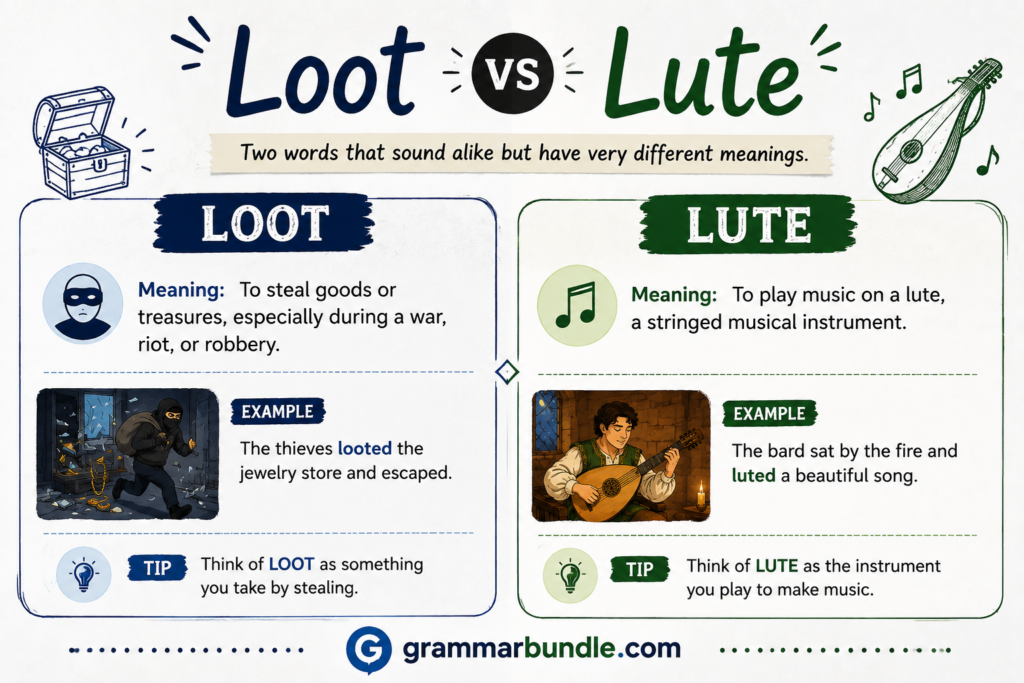
Loot vs Lute: What’s the Real Difference?
“Loot,” has the meaning of tales of adventure and piracy. It refers specifically to stolen goods. While lute refers to a stringed musical instrument.
Are Loot and Lute Homophones?
These two terms sound alike, making them homophones, but their meanings are different.
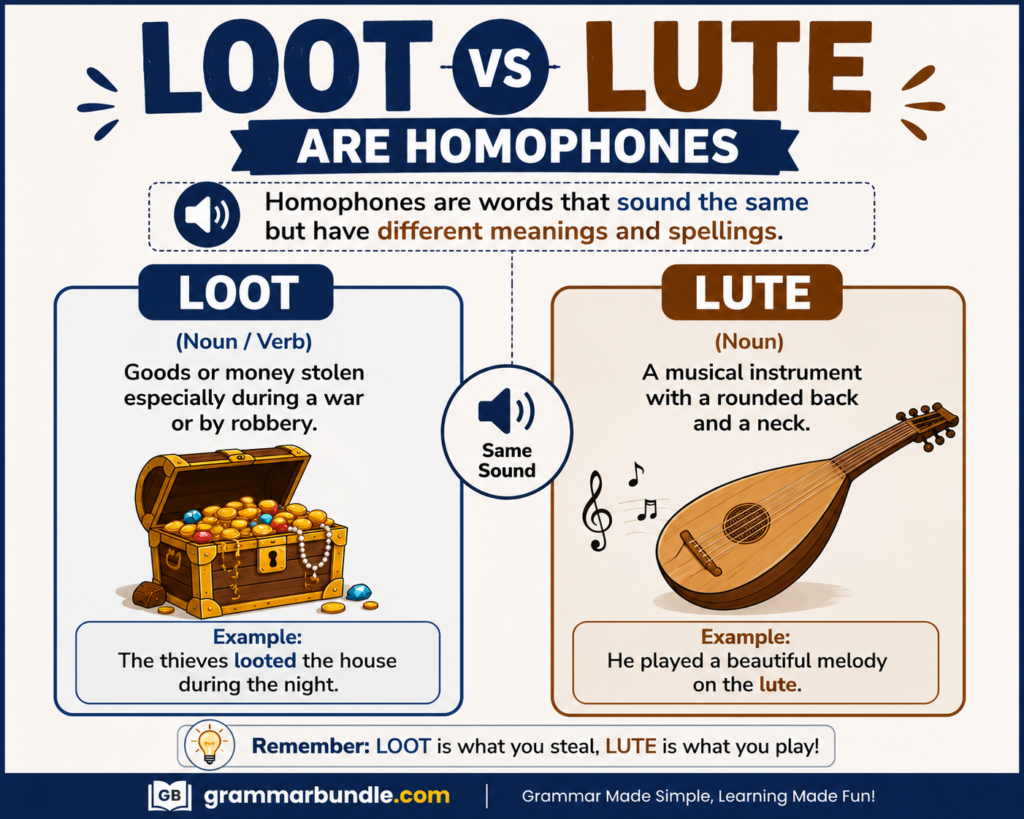
What are homophones?
Words that sound the same but have different meanings and spellings.
For example,
- “bare” and “bear”
- “flour” and “flower”
- “cell” and “sell”
Loot vs Lute Pronunciation Guide:
- “Loot” (rhymes with “boot”)
- “Lute” (sounds like “suit”)
Loot Meaning in English
The word loot means:
- Stolen goods
Loot in English Grammar
Loot act as:
- a noun
- a verb
Loot as a Noun
Example:
“The pirates returned to their ship with the loot.” “The treasure hunters found old coins for their loot.”
Loot as a Verb
Examples:
“The soldiers looted the town.”
“People may loot local shops during a protest.”
Loot Word Origin and Historical Meaning
Loot Word Origin:
“Loot,” derived from the Hindi word “lut.”
Historical Meaning
- It meant spoils taken during war or theft.
- It was used for treasure taken during the old war.
Loot Synonym List
| Synonym | Meaning |
| Plunder | taking things by force in war |
| Booty | Pirate treasure |
| Spoil | Rewards taken after winning battle |
Loot Examples in Everyday Language:
“The robbers made off with a heavy loot from the museum.”
Loot in Video Games
Video games are:
- Destiny 2
- Borderlands

In gaming culture, loot usually includes:
- Armor
- Weapons
- Coins
- Loot boxes
Lute Meaning in English
The word lute means:
- a stringed musical instrument
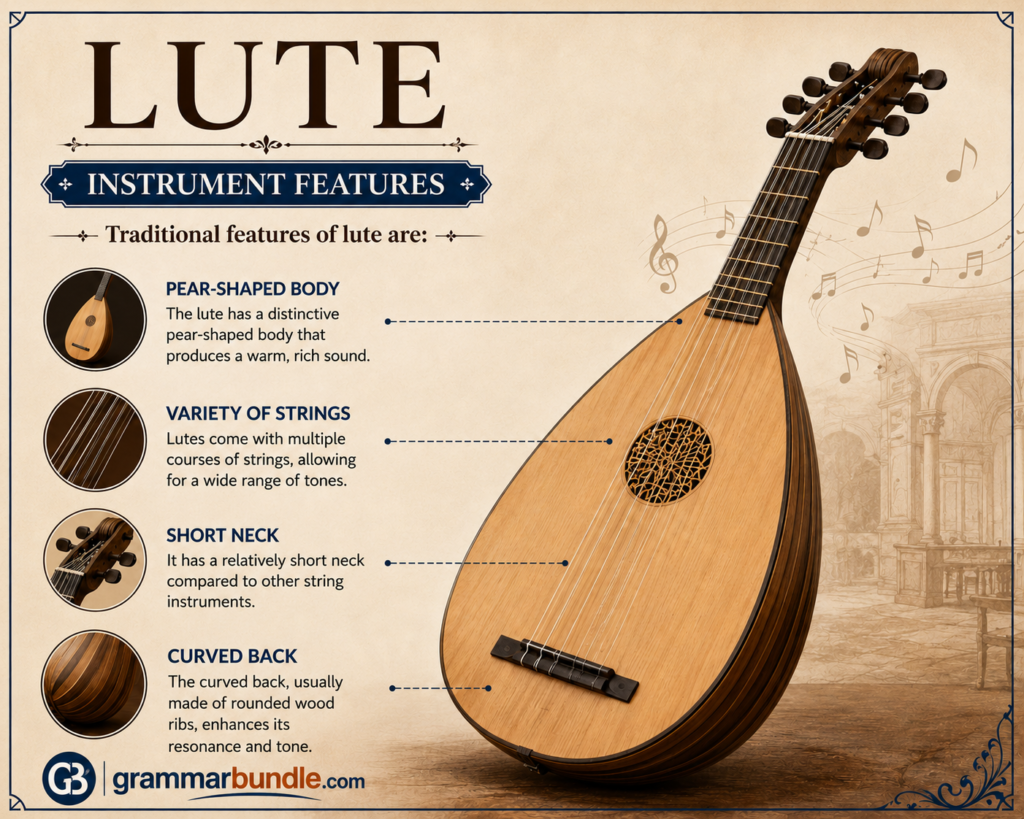
Lute Instrument Features
Traditional features of lute are:
- Pear-shaped body
- Variety of strings
- short neck
- curved back
Lute Word Origin and History
Lute Word Origin:
The word lute comes from the Latin word “luteum,” meaning “yellow.”
Lute History:
The lute came from the Arabic “oud.”
Lute Importance:
The lute holds an important place:
- Renaissance music
- Medieval instrument
- Classical performance history
Role of the Lute in Renaissance:
- The lute was a popular European instrument before pianos.
- It showed education, style, and art.
- It was used for entertainment, poetry, royal events, and religious music.
- It represented good taste and intelligence in Renaissance art.
Interesting Facts About the Lute
| Facts | Detail |
| Popularity | Popular in the 16th and 17th centuries |
| Origin | Originated in the Middle Ages |
| Ancestry | Related to the oud |
How to Remember Loot vs Lute:
Here are memory tricks that actually help.
Memory Trick for Loot:
A useful trick is to associate the letter “o” in “loot” with a treasure chest full of round coins.
Memory Trick for Lute:
A useful trick is to associate the letter “u,” as it stands upright like a musician holding the instrument.
Lute vs loot with example:
Examples are;
Loot in a Sentence:
“The pirates divided the loot after the raid.”
“The thieves shared their loot under the cover of night.”
Lute in a sentence:
“She plays a beautiful tune on her lute.”
The performers gathered around the lute for enjoyment.”
Lute Examples in Everyday Language:
“She smoothly plays the lute, filling the room with magical sound.”
For more guidance https://grammarvisit.com/loot-vs-lute/
How to Use Loot and Lute Correctly:
Use “Loot” When Talking About:
- Theft
- Tangible items
- Treasures
- Physical rewards like weapons, gold.
Use “Lute” When Talking About:
- A musical instrument
- Cultural references
- Classical performances
Quick Usage Chart
| Situation | Correct Word |
| Pirate treasure | Loot |
| Medieval instrument | Lute |
| Stolen things | Loot |
| Music | Lute |
Common Grammar Mistakes With Loot and Lute
- Often confused in English.
- Common mistakes in English vocabulary.
- Homophones with different meanings.
Incorrect Example
“He played his loot at the festival.”
Correct Example
“He played a melody on his lute.”
Another Incorrect Example
“She sang a song about a stolen lute.”
Why English Homophones Confuse Learners
English comes from many different languages; including:
- Germanic languages
- French
- Latin
- Arabic
- Hindi
- Homophones make learning English more challenging.
- Learners often find homophones confusing.
Loot vs Lute in English Grammar
Below is a detailed grammar comparison.
| Feature | Loot | Lute |
| Meaning | The act of stealing | a stringed musical instrument |
| Parts of speech | Noun and Verb | Noun |
| Context | stolen goods, treasure, war | music, musical instruments |
| Pronunciation | /lu:t/ | /lu:t/ |
| Plural form | Uncountable | Lutes |
This chart helps students learn:
- For english grammar
- New grammar words
- English vocabulary
Easy English Homophones Practice:
Choose the Correct Word
The treasure hunters were excited to find the hidden _ in the cave.
- Loot
- Lute
Right answer is: Loot
He played his _ as the sun set over the mountains.
- Loot
- Lute
Right answer is: Lute
The thief stole the _ during the robbery.
- Loot
- Lute
Right answer is: Loot
She played the __ beautifully at the concert.
- Loot
- Lute
Right answer is: Lute
These exercises improve:
- Speaking practice
- Writing practice
- Learning new words
- Language learning help
Loot vs Lute Explained Simply
Need more help:
Here’s a simple explanation.
Loot = Treasure
- pirates
- gold
- stolen items
- valuable things
Lute = Music
- musical instrument
- string music
- medieval performers
- old music history
This is the simple difference between loot and lute.
Quick Reference List: Loot vs Lute
- Meaning: “Loot” refers to valuables taken during theft, while “lute” is a stringed musical instrument popular in the Renaissance.
- Pronunciation: “Loot” rhymes with “boot”; “lute” with “cute.”
- Word Type: “Loot” is a noun/verb; “lute” is a noun.
- Associated With: “Loot” often connects to piracy or heists; “lute” evokes classical music and artistry.
- Spelling Pattern: “Loot” contains double ‘o’; “lute” features a silent ‘e’ at the end.
- Example Sentence (Loot): The adventurers returned with an impressive amount of loot from their quest.
- Example Sentence (Lute): The musician played a beautiful melody on his lute, enchanting everyone in the room.
People may search for https://grammarbundle.com/comming-vs-coming/
FAQs:
What is the difference between “loot” and “lute”?
Ans:“Loot” means stolen goods or treasures, while “lute” is a stringed musical instrument.
How do you pronounce “loot” and “lute”?
Ans:“Loot” and “lute” both are pronounced as /luːt/.
Are “loot” and “lute” homophones?
Ans:Yes, “loot” and “lute” are homophones.
How do you spell “loot” and “lute”?
Ans:“Loot” is spelled L-O-O-T, while “lute” is spelled L-U-T-E.
What is the origin of the word “loot”?
Ans:“Loot” comes from the Hindi word “lūṭ,” meaning ‘to steal’.
Conclusion:
“Loot” creates a picture of adventure and treasure, “lute” takes us into a world of music and art.Both words sound similar but hold unique meanings .