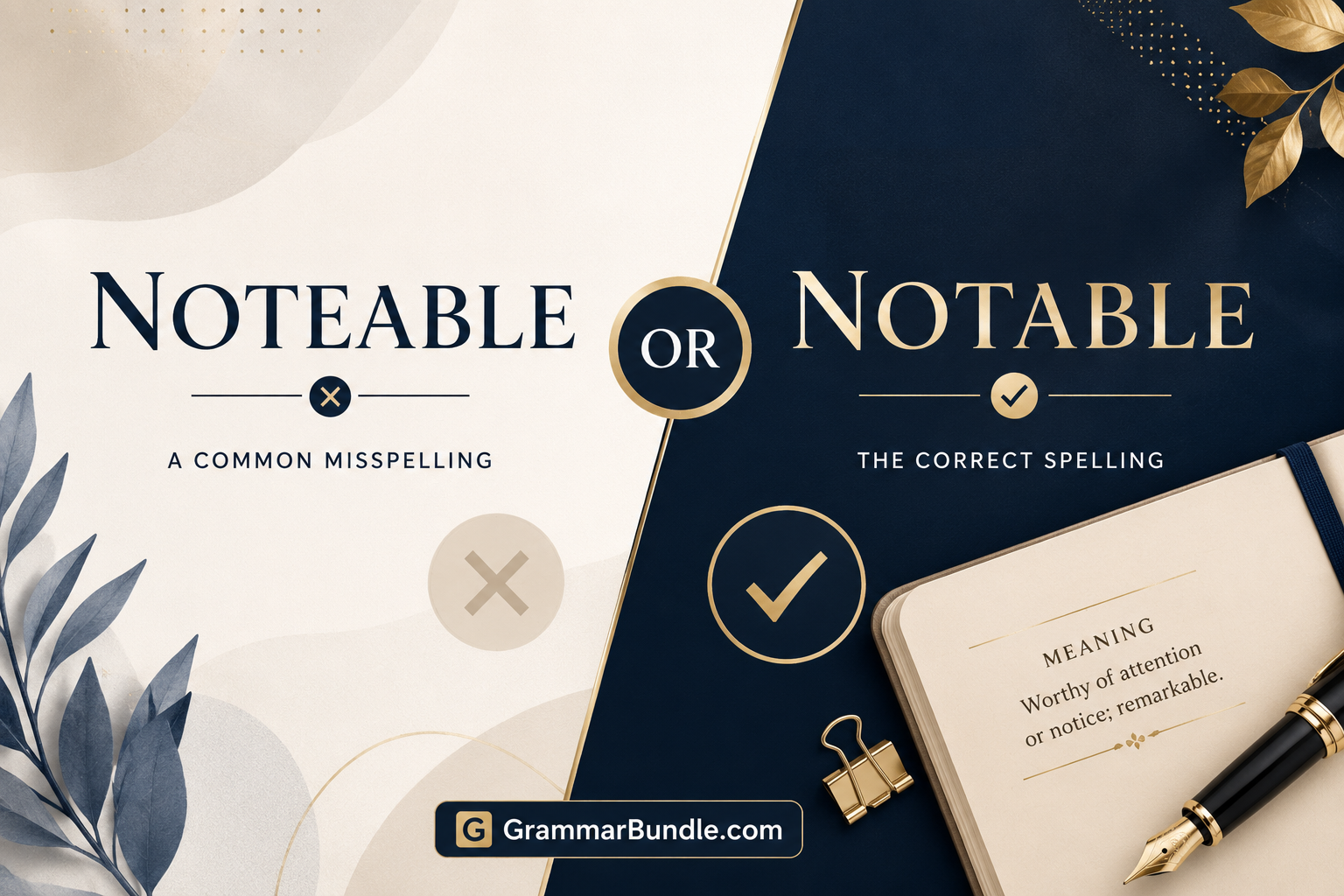
Many people confuse “noteable” and “notable” because they sound alike. However, “notable” is the correct spelling, while “noteable” is a common misspelling. Knowing the difference helps you write more accurately and professionally.
Noteable or Notable Which One Is Correct?
The correct word is “notable.”
“Noteable” is a common misspelling that may seem correct, but it is not a standard English word.
The key differences are below.
| Word | Correct? | Accepted in English? |
| Notable | Yes | Yes |
| Noteable | No | No |
People also search for https://grammarbundle.com/uninclined-vs-disinclined/
What Is the Notable Meaning?
Notable means something important, impressive, or worthy of attention. It describes a person, event, achievement, or thing that stands out from others.
Notable Definition
Notable means worthy of attention or recognition because it stands out or has importance.
Simple Examples
- She made a notable contribution to the project.
- The city has seen a notable increase in tourism.
- He is a notable scientist in his field.
Why Do People Write “Noteable”?
This spelling mistake happens because “noteable” looks like it should be correct.
People often see words such as:
- Noticeable
- Manageable
- Dependable
- Enjoyable
People often think “noteable” follows the same spelling pattern as similar words.
However, “notable” is the correct spelling, and the extra “e” is incorrect.
This is a common spelling mistake made by both English learners and native speakers.
The History Behind the Word “Notable”
The word “notable” has been used for centuries.
It comes from:
| Language | Original Word |
| Latin | notabilis |
| Old French | notable |
| Middle English | notable |

The spelling of “notable” has remained almost the same over the centuries.
The extra “e” was never part of the original word, so modern dictionaries continue to use the correct spelling: “notable.”
British vs American English Spelling
Some English words have different spellings in different countries.
For example:
| American English | British English |
| Color | Colour |
| Favorite | Favourite |
However, “notable” has the same spelling in both British and American English.
You may verify it at https://grammarupdate.com/noteable-vs-notable/
Correct Usage Worldwide
| Country | Correct spelling |
| United States | Notable |
| United Kingdom | Notable |
| Canda | Notable |
| Australia | Notable |
If you think “noteable” is the British spelling, it is not.
Both American and British English use “notable” as the correct spelling.
Notable Pronunciation Explained
Pronunciation of notable is:
NOH-tuh-bul
Phonetic pronunciation:
/ˈnoʊ.tə.bəl/
Syllable Breakdown
- No
- ta
- ble
The pronunciation can make people add an extra “e”, which is why “noteable” is a common spelling mistake.
Notable in a Sentence Examples
Examples are one of the best ways to learn grammar.
Here are some example sentences with “notable” that you can use in everyday writing.
Correct Examples
- A notable recipe shows both the ingredients and the cooking techniques.
- Providing notable examples during training helps explain complex topics.
- The teacher used a notable person from history to teach students not to give up.
- The business leader shared a notable success story to encourage new ideas.
- Notable examples help make difficult ideas easier to understand.
- Small companies use social media in a notable way to connect with customers.
- A small startup used AI in a notable way to improve customer service.
These examples show how to use “notable” correctly in different situations.
Noteable in a Sentence: Incorrect Examples
Now let’s look at incorrect examples.
Incorrect Examples
- He is a noteable member of the committee.
- The scientist made a noteable discovery.
- She received noteable attention for her work.
Each sentence above uses the incorrect spelling “noteable.”
Most grammar and spell-check tools will mark it as a spelling mistake.
Notable vs Noteable Comparison Table
A simple table can make the difference easier to understand.
| Feature | Notable | Noteable |
| Spelling | Correct spelling | Common misspelling |
| Meaning | Worthy of attention | No official meaning |
| Dictionary Status | Listed in dictionaries | Not listed in standard dictionaries |
| Part of Speech | Adjective | Not a standard English word |
| Example | She received a notable award. | He made a noteable mistake. |
The difference between “notable” and “noteable” is easy to understand with this comparison.
Notable Grammar Rules You Should Know
Knowing basic grammar helps you avoid writing mistakes.
Notable Is an Adjective
Notable is an adjective.
It describes a person or thing that is important or worthy of attention.
Examples
- notable discovery
- notable contribution
- notable painting
- notable change
- notable idea
The structure usually follows this pattern:
notable + noun
This pattern is common in everyday English, academic writing, articles, and professional communication.
Notable Synonym and Notable Antonym
Learning related words helps improve your English vocabulary.
Notable Synonym List
| Synonym | Meaning |
| Remarkable | Worth noticing |
| Significant | Important |
| Outstanding | Exceptionally good |
| Prominent | Well-known |
| Exceptional | Unusually good |
| Memorable | Easy to remember |
Using different words makes your writing clearer and more interesting.
Notable Antonym List
| Antonym | Meaning |
| Ordinary | Common and not special |
| Inferior | Lower in quality |
| Unknown | Not known by people |
| Average | Normal |
| Forgettable | Easy to forget |
Learning the antonyms of “notable” helps improve your vocabulary.
Notable vs Noticeable Important Difference
Many people confuse “notable” and “noticeable” because they sound similar.
However, they have different meanings.
Notable Meaning
Notable means important or worthy of attention.
Example:
She made a notable achievement.
Noticeable Meaning
Noticeable means easy to see, notice, or recognize.
Example:
There was a noticeable change in his attitude.
Quick Comparison
| Word | Meaning |
| Notable | Important |
| Noticeable | Easy to see |
A noticeable change is easy to see.
A notable achievement is important and worthy of attention.
They have different meanings.
Common English Errors Similar to “Noteable”
English spelling can be confusing, leading to common mistakes.
Here are some words that are often misspelled, just like “noteable.”
| Incorrect | Correct |
| Noteable | Notable |
| Definately | Definitely |
| Alot | A lot |
| Thier | Their |
| Calender | Calendar |
These spelling mistakes are common because English pronunciation and spelling do not always match.
Why “Noteable” Still Appears Online
Although “noteable” is incorrect, many people still search for it online.
This usually happens because they spell the word based on how it sounds or make a typing mistake.
Common Reasons
- Spelling confusion
- Pronunciation confusion
- Fast typing mistakes
- Weak proofreading habits
- Copying incorrect spellings online
- English learners guessing the spelling
Many incorrect spellings still appear online because people often make spelling mistakes when searching or writing.
Easy Tricks to Remember the Correct Spelling
Grammar rules can be confusing, but memory tricks make learning easier.
Simple Memory Trick
Remember, “Notable” has no extra “e.”
Visual Trick
Break the word into:
NOT + ABLE
This simple trick makes it easier to remember that “notable” is the correct spelling.
Read More Often
Reading books, articles, and blogs regularly helps you learn the correct spelling naturally.
Over time, it also improves your writing skills.
Why Correct Spelling Matters in Professional Writing
- Correct spelling makes your message clear.
- It creates a professional impression.
- It shows attention to detail.
- It builds trust with readers.
- It improves communication.
Correct Spelling Helps With
- Academic writing
- Blog writing
- Business emails
- SEO content
- Professional communication
- Social media posts
- Creative writing
- Job applications
Correct spelling improves clarity and builds trust.
Proofreading Tips to Avoid Grammar Mistakes
Proofreading helps make your writing clear and error-free.
Read Slowly
Writing too fast can make you overlook spelling mistakes.
Read Out Loud
Reading your writing aloud helps you find grammar and spelling mistakes.
Use Grammar Tools Carefully
Spellcheck is helpful, but it cannot find every mistake.
Always check important writing yourself.
Keep a Personal Error List
Keep a list of words you often misspell.
This helps you avoid making the same mistakes again.
Formal English vs Informal English Usage
The word “notable” can be used in both formal and informal writing.
Formal English Examples
- The scientist made notable advancements in cancer research.
- Her efforts led to notable changes in policy.
Informal English Examples
- That movie was notable for its great special effects.
- He has a notable talent for storytelling.
One is more common in formal writing, while the other is often used in everyday conversation. Both are grammatically correct.
Grammar Guide for English Learners
English spelling can be confusing because some words sound alike but are spelled differently.
Learning spelling patterns helps you avoid common mistakes.
Consider these words:
- though
- through
- cough
- tough
- bough
These words look similar, but they are pronounced differently.
English spelling can be confusing, but with regular practice, remembering the correct spelling of “notable” becomes much easier.
Language Learning Tips
- Read English regularly.
- Practice writing sentences.
- Proofread your work.
- Learn words in context.
- Use spellcheck and grammar tools.
- Review commonly misspelled words.
Regular practice helps improve your English and spelling skills.
Quick Cheat Sheet for Notable or Noteable
| Question | Answer |
| Correct spelling | Notable |
| Meaning | Worthy of attention or importance |
| Part of speech | Adjective |
| British vs American English | Same spelling in both varieties |
| Is “Noteable” correct? | No, it is a common misspelling |
| Is noteable a typo? | Yes |
FAQs
What is the correct spelling?
Ans:The correct spelling is “notable.” “Noteable” is a common misspelling.
What does “notable” mean?
Ans:“Notable” means something that is worth noticing or important.
How do you pronounce “notable”?
Ans:“Notable” is pronounced as NOH-tuh-buhl.
What part of speech is “notable”?
Ans:“Notable” is an adjective. It describes something significant.
Is there a difference in British and American English?
Ans:No, “notable” is used the same in both British and American English.
Conclusion
Notable is the correct spelling, while “noteable” is a common misspelling. Using “notable” helps make your writing clear and professional. Practice the correct spelling to avoid common mistakes.