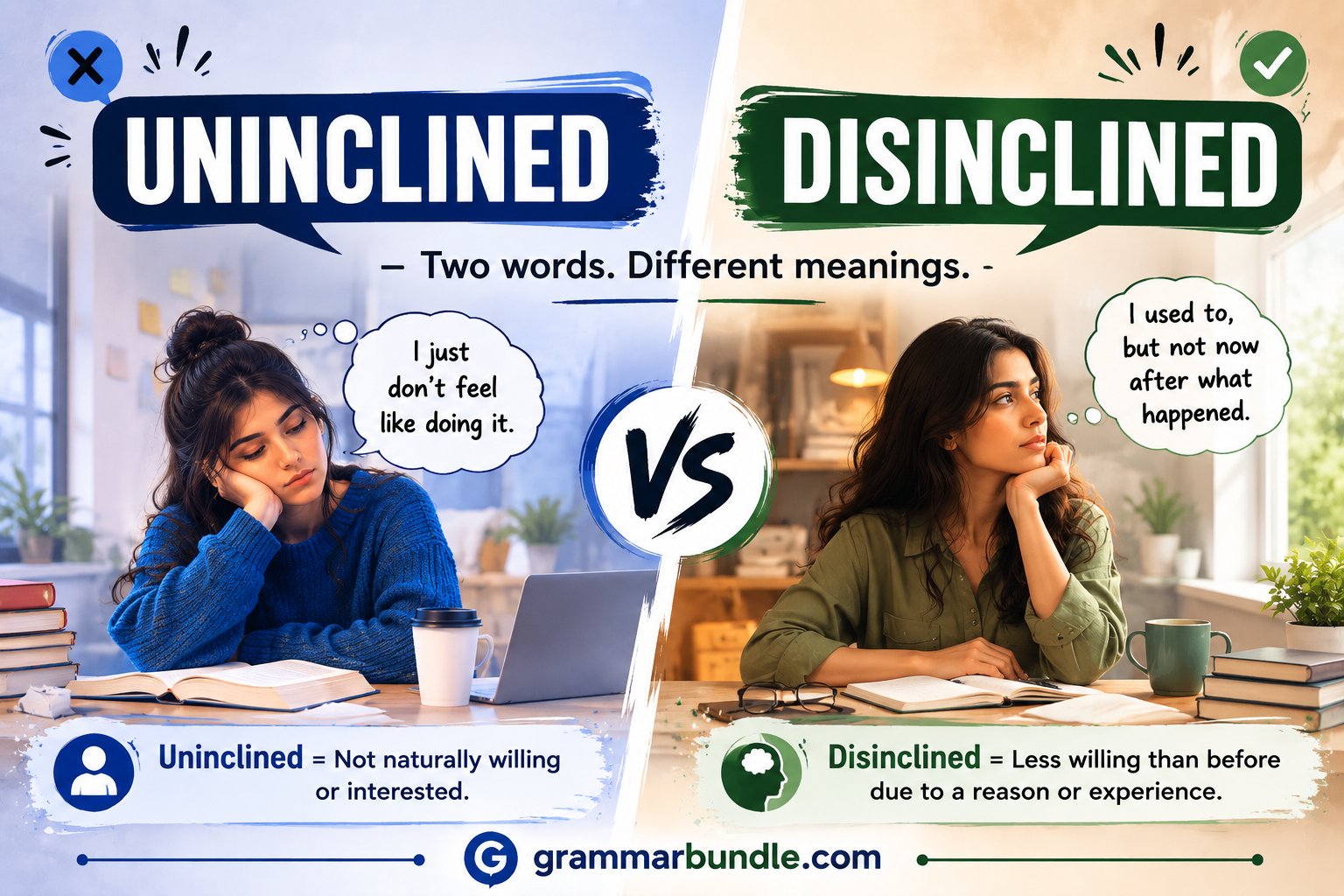
“uninclined” and “disinclined,” two words that sound similar, but they do not have the same meaning. They are sometimes used in the same way, but using the wrong words can cause confusion and make your writing unclear.
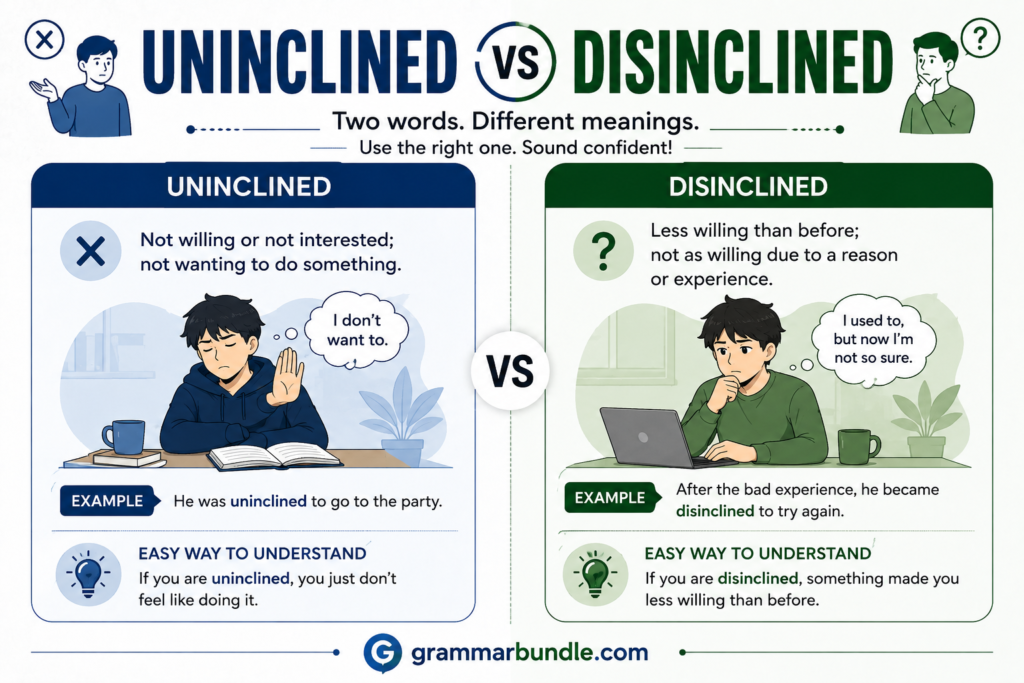
Uninclined vs Disinclined The Core Difference
The easiest way to understand uninclined vs disinclined is to remember the difference.
- Uninclined means no interest or desire to do something.
- disinclined means reluctant or unwilling to do it, often for a specific reason.
Quick Comparison Table
| Word | Basic Meaning | Tone | Common usage |
| Uninclined | Having no desire | Neutral | Everyday conversations |
| Disinclined | Reluctant or Unwilling | Slightly Negative | Formal writing or professional context |
Uninclined Meaning Explained Clearly
- The meaning of uninclined is a lack of interest or desire.
- It does not show opposition. It simply means a person is not interested or motivated.
Uninclined Definition
Having no interest or desire to do something.
Emotional Tone of Uninclined
The words often suggest are:
- Lack of motivation
- Less excitement
- No interest
- Not caring much
- Neutral attitude
Uninclined in a Sentence
Here are several natural examples of uninclined in a sentence:
- “She was uninclined to join the discussion because it did not interest her.”
- “They are uninclined to watch horror movies.”
- “I am uninclined to engage in a debate about politics.”
- “He seemed uninclined to take sides in the argument.”
Disinclined Meaning Explained Simply
Now let’s look at the meaning of disinclined.
Unlike uninclined, it shows reluctance or unwillingness to do something.
Disinclined Definition
Being unwilling to do something.
Emotional Tone of Disinclined
Disinclined often suggest are:
- Reluctant behavior
- Hesitation
- Personal feelings
- Past experience
Disinclined in a Sentence
Here are several examples of disinclined in a sentence:
- “She felt disinclined to attend the gathering.”
- “He was disinclined to accept the job.”
- “The company was disinclined to invest.”
- “Investors became disinclined because of their past experience.”
The Difference Between uninclined vs disinclined
Many grammar mistakes happen because these words have similar dictionary meanings. However, their use depends on the context.
Side-by-Side Comparison
| Situation | Better Word | Reason |
| Lack of interest | Uninclined | no inclination |
| Strong reluctance or aversion | Disinclined | stronger unwillingless |
| Highlighting indecision | Uninclined | no clear preference |
| Negative context | Disinclined | Has a more negative tone |
Example Comparison
Softer Tone
“I'm uninclined to choose this option.”This sounds simple and natural.
Stronger Tone
“She is disinclined to support this approach.”This sounds firm and reluctant.
One word sounds softer. The other sounds stronger.
That is the key difference between uninclined and disinclined.
How to Use Uninclined Correctly
Learning to use uninclined becomes easier once you understand its meaning.
Common Sentence Structures
Uninclined is often followed by:
- to
- toward
- towards
Examples of Uninclined
- She is uninclined to follow trends.
- He remained uninclined to participate.
- They are uninclined toward any specific ideology.
Best Situations for Using Uninclined
Use uninclined to describe:
- Lack of interest
- weak motivation
- casual hesitation
- Indifferent attitudes
How to Use Disinclined Correctly
Using disinclined correctly requires attention to tone and context.
It is more formal and deliberate than uninclined.
Common Structures
Disinclined is often followed by:
- disinclined to compromise
- disinclined to adapt
- disinclined to engage
- disinclined to trust
- disinclined to seek help
Best Situations for Using Disinclined
Use disinclined in these situations:
- Formal settings
- Written communication
- Client interactions
- Feedback sessions
- Business discussions
Examples of Disinclined
- He is disinclined to join a new club.
- She is disinclined to attend a party.
- A student may feel disinclined to participate in a group project.
Uninclined vs Disinclined Examples
Examples make grammar differences easier to understand.
Example Set One
- I’m uninclined to join the meeting today.
- This sounds simple and natural.
- An employee may be disinclined to accept the new policy.
- This shows stronger reluctance.
Example Set Two
- Feeling uninclined to join friends.
- This has a gentle tone.
- Disinclined to accept an offer.
- This has a formal tone.
Commonly Confused Words Related to This Topic
Comparing similar words makes English easier to learn.
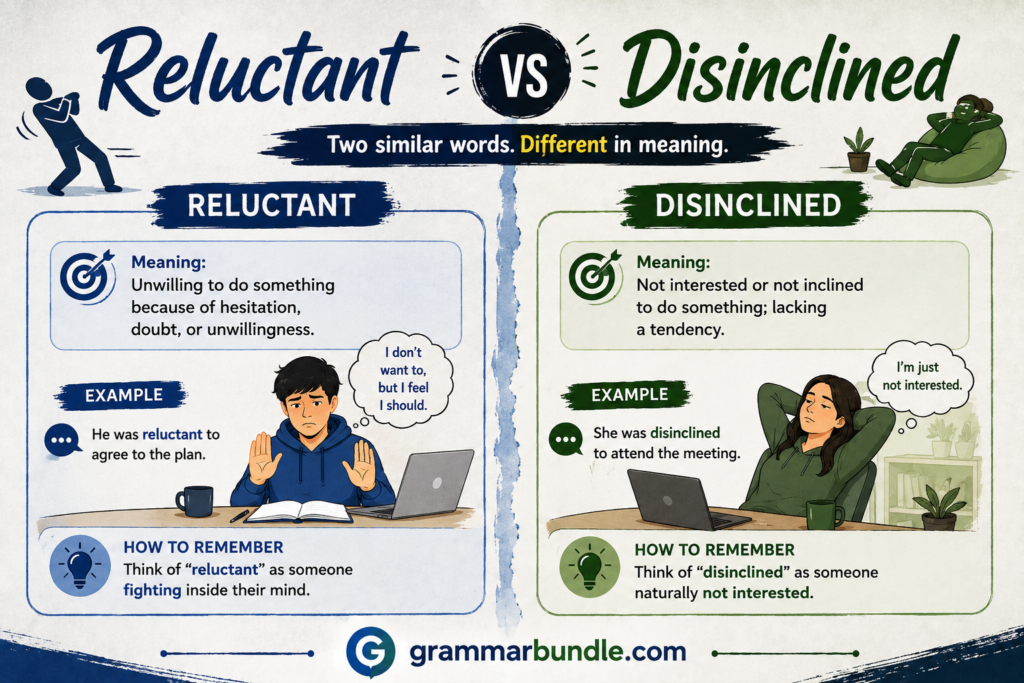
Reluctant vs Disinclined
Both words show hesitation, but they have different meanings.
| Word | Tone |
| Reluctant | Emotional hesitation |
| Disinclined | Passive resistance |
Example
- She was reluctant to take a new job.
- A student was disinclined to join a club.
Unwilling vs Disinclined
People also confuse the unwilling and disinclined.
- Disinclined indicates a softer hesitation.
- Being unwilling suggests a strong refusal.
Comparison Table
| Word | Strength |
| Uninclined | Neutral |
| Disinclined | Mild |
| Unwilling | Strong |
Example
- She was disinclined to join the hike.
- He was unwilling to join the project.
Disinclined Synonym and Uninclined Synonym Lists
Learning related words improves vocabulary.
Disinclined Synonym Options
Synonyms are:
- Reluctant
- Averse
- Unwilling
- Opposed
Uninclined Synonym Options
Synonyms are:
- Neutral
- Indifferent
- Unmoved
- Apathetic
Averse Meaning Compared to Disinclined
Averse is often compared with disinclined, but it usually shows a stronger dislike.
Comparison
| Word | Emotional Intensity |
| Disinclined | Milder reluctance |
| Averse | Stronger emotional weight |
Examples
- She is averse to certain foods.
- He is disinclined to take part.
If you want more details check :https://thecontentauthority.com/blog/uninclined-vs-disinclined
Pronunciation Guide
Correct pronunciation improves English communication.
Disinclined Pronunciation
Pronounced as /ˌdɪs.ɪnˈklaɪnd/.
Uninclined Pronunciation
Pronounced as /ˌʌn.ɪnˈklaɪnd/.
The endings sound similar, but the prefixes change the meaning.
Why Writers Confuse These Words
These words have similar meanings, so even experienced writers get confused.
Main Reasons for Confusion
- Both words suggest a lack of willingness.
- Their prefixes can be confusing.
- Their differences are subtle.
- Both words sound similar.
Professional Writing and Word Choice
Professional writing requires precise word choice.
A small word mistake can change your message.
Workplace Example
An employee may be uninclined to join the new project. This sounds softer.
Now compare it with:
An employee may be disinclined to join the new project.This shows stronger reluctance.
Case Study: Tone Changes Everything
Version One
“I’m disinclined to join the project due to other commitments.”
This shows a stronger tone.
Version Two
“I’m uninclined to join the project because I have other priorities.”
This sounds softer.
English Writing Tips for Choosing the Right Word
Clear writing depends on choosing the right words.
Use Uninclined When:
- Describing a lack of interest.
- Showing a neutral stance.
- Talking about general disinterest.
- Using a formal tone.
Use Disinclined When:
- The context matters.
- A more thoughtful tone is needed.
- Showing willingness with hesitation.
- Choosing the right synonym.
People may search forhttps://grammarbundle.com/loot-vs-lute/
Memory Tricks That Actually Work
Simple tips help you remember word differences.
The “Dis-” Prefix Trick
The prefix “dis-” often shows resistance or dislike.
Examples:
- Disagree
- Disapprove
- Disrupt
- Displace
So, disinclined sounds stronger and more resistant.
Practice Exercises
Fill in the Blank
Choose the correct word.
- I’m to volunteer for that project.
- I’m to learn about astrophysics.
- She felt to work on the boring project.
- The student was to join the group discussion.
Answer:
- Disinclined
- Uninclined
- Uninclined
- Disinclined
Quick Summary Table
| Features | Uninclined | Disinclined |
| Meaning | Lack of interest | Reluctant or unwilling |
| Tone | Neutral | Stronger |
| Ease of Use | User-friendly | Enhances creativity |
| Common Usage | Casual | Formal |
People may search for https://grammarbundle.com/comming-vs-coming/
FAQs
What does “uninclined” mean?
Ans:“Uninclined” refers to a lack of interest or willingness to engage in something.
How is “disinclined” different from “uninclined”?
Ans:“Disinclined” suggests a reluctance towards something, while “uninclined” indicates a complete lack of interest.
Can someone be both uninclined and disinclined?
Ans:Yes, a person can be uninclined toward a specific activity while feeling disinclined about another, indicating varying levels of interest.
Is “uninclined” a stronger term than “disinclined”?
Ans:Yes, “uninclined” generally implies a more definitive lack of interest compared to the milder reluctance implied by “disinclined.”
Conclusion
Uninclined and disinclined both describe hesitation, but they differ in tone and strength. Knowing when to use each word makes your writing more accurate, natural, and effective.