
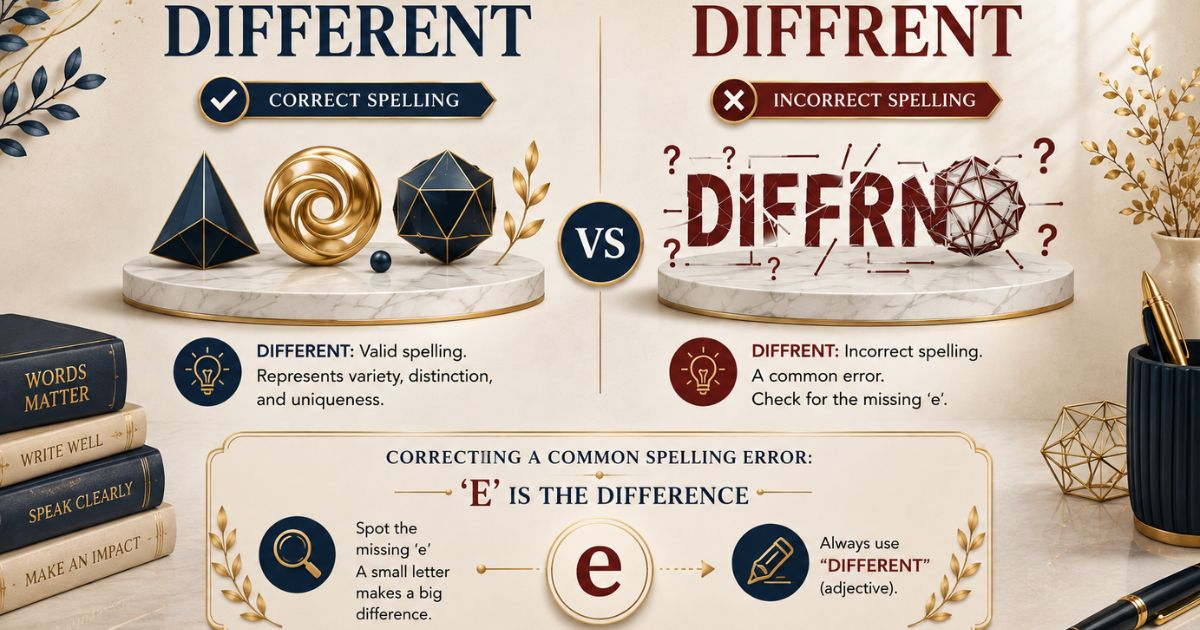
The spelling of “different” can be confusing, especially for English learners. In this guide, we’ll explain why “different” is correct and “diffrent” is a common spelling mistake. By the end, you’ll know how to spell and use the word correctly.
Different or Diffrent Quick Answer
The correct spelling is “different.” The spelling “diffrent” is incorrect because it leaves out the second “e.” This small spelling mistake can make the word look and sound confusing.
Incorrect:
- They have a diffrent approach to solving problems.
Correct:
- They have a different approach to solving problems.
Remembering the extra “e” in different helps you spell the word correctly and keep your writing clear.
What “Different” Really Means in Simple Words
“Different” means not the same or unlike something else.
It can describe differences between people, ideas, choices, styles, or things.
For example, different foods offer different flavors, while different opinions can introduce us to new ways of thinking.
We commonly use “different” for:
- Opinions
- Choices
- Styles
- Ideas
- People
- Experiences
Examples:
- We have different opinions.
- She chose a different style.
- Everyone has different ideas.
In simple terms, “different” means something is not the same as another thing.
Related Articles You May Find Helpful https://grammarbundle.com/passtime-or-pastime/
How to Spell Different Without Forgetting It
The word “different” is often misspelled as “diffrent.” A simple way to avoid this mistake is to break the word into three parts:
dif – fer – ent
Saying each part slowly can help you remember the correct spelling and avoid dropping the “e.”
Connect Different With Difference
Another useful trick is to connect “different” with “difference.” Both words share the same root, so remembering one can help you spell the other correctly.
You can also remember the “fer” part by using a simple sentence:
- “I have several differing perspectives.”
These small memory tricks make it easier to remember different and avoid the common spelling mistake diffrent.
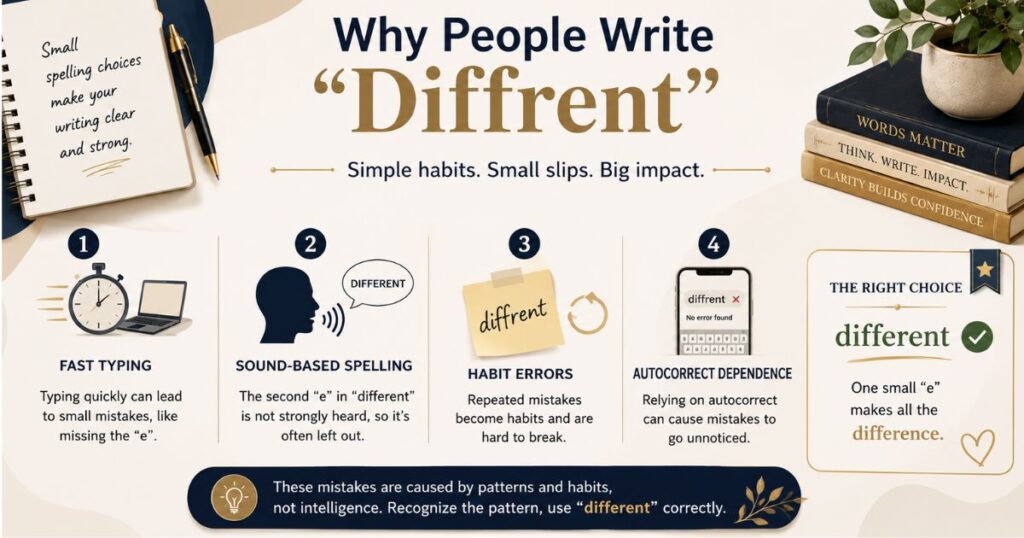
Why People Write “Diffrent” So Often
Many people make this mistake, often because of simple spelling habits.
Fast Typing
Typing quickly can lead to small spelling mistakes. When people focus on speed, letters like the “e” in “different” can easily be missed.
Sound-Based Spelling
Some people spell words the way they sound. Because the second vowel in “different” may not sound very strong, it can be left out when writing.
Habit Errors
Repeated spelling mistakes can become habits. Once someone gets used to writing “diffrent,” they may continue using it without noticing the error.
Autocorrect Dependence
Relying too much on autocorrect can make people less careful about spelling. If a device does not highlight a mistake, the incorrect spelling may go unnoticed.
These mistakes are usually caused by spelling patterns and habits, not intelligence. Recognizing the pattern can make it easier to use “different” correctly.
Related Articles You May Find Helpful https://grammarbundle.com/ingage-vs-engage/
Difference Between Diffrent and Different
The main difference between “different” and “diffrent” is simple: “different” is the correct English word, while “diffrent” is a misspelling.
| Aspect | Different | Diffrent |
| Status | Correct English word | Misspelled |
| Meaning | Not the same or distinct | No recognized meaning |
| Usage | Common in speech and writing | Should be avoided |
| Writing Quality | Clear and professional | Can reduce credibility |
“Different” is used to describe differences between people, objects, ideas, or choices. “Diffrent” is simply an incorrect spelling and has no accepted meaning in standard English.
Using the correct spelling helps keep your writing clear, accurate, and professional.
Is “Diffrent” Ever Acceptable?
No. “Diffrent” is a common spelling mistake, while “different” is the correct form in standard English.
Although people may overlook spelling errors in casual communication, using “different” is important in formal writing because it keeps your message clear and professional.
Why “Different” Is Spelled This Way
The spelling of “different” comes from its historical roots. It traces back to the Latin word differens, meaning “to separate” or “to bear apart.” It later passed through French as différent before becoming part of English.
Because of this history, the spelling of “different” does not always match the way the word sounds. Understanding its origin can make the spelling easier to remember.
Related Articles You May Find Helpful https://grammarbundle.com/implicit-vs-complicit/
Common Mistakes People Make With “Different”
The word “different” is often misspelled in several ways, including:
- diffrent
- diferent
- diffirent
- diffren
These mistakes usually happen when people type quickly or guess the spelling. The most common error is “diffrent,” which leaves out the middle vowel.
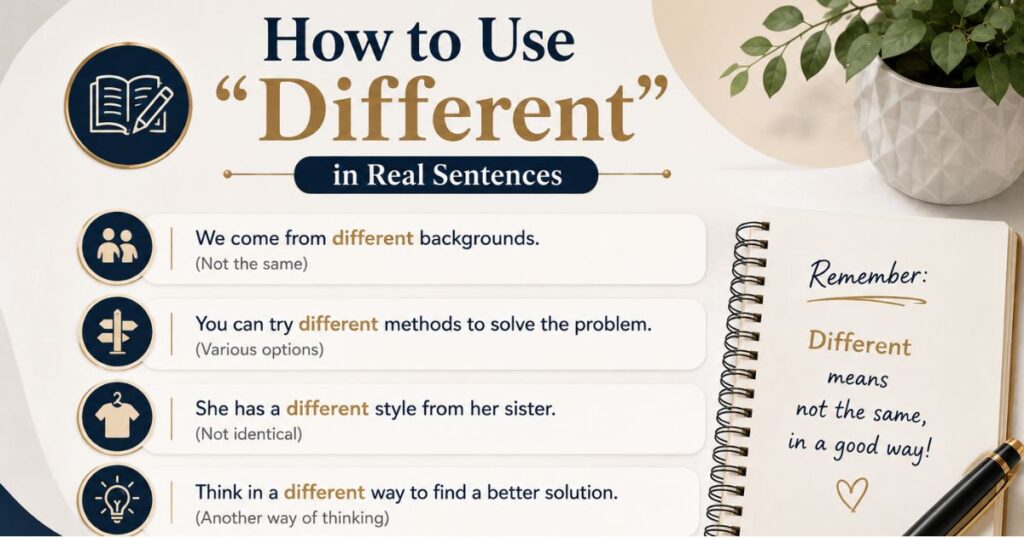
How to Use “Different” in Real Sentences
“Different” is used to show variation or contrast.
Everyday Conversation
- I chose a different outfit today.
- We have different tastes in music.
- This place feels different today.
Work or Study
- Different perspectives improve our understanding.
- We need a different approach to solve this problem.
- The results show different patterns.
Emotional Use
- I feel different today.
- Each painting tells a different story.
In simple terms, “different” helps describe things that are not the same.
For more guidance: https://grammorax.com/
“Different From,” “Different Than,” and “Different To”
The phrases “different from,” “different than,” and “different to” are used differently depending on the variety of English.
American English
“Different from” is the most common choice, especially in formal writing.
- This fabric is different from that one.
“Different than” is also used in American English, particularly in informal contexts.
- She is different than most people you meet.
British English
British English commonly uses “different from” and “different to.”
- This fabric is different to that one.
Both “different from” and “different to” are acceptable in British usage.
Knowing these regional preferences can help you choose the form that best fits your audience and writing style.
How to Use “Differ,” “Different,” and “Difference” Correctly
Understanding the Nuances
- Differ is a verb that expresses a distinction. For instance, “Cats and dogs differ in their behavioral patterns,” emphasizes a clear contrast.
- Different functions as an adjective, describing a noun that is unlike another.For EXample, “She has different tastes in music.”
- Difference is a noun that denotes the specific characteristic that distinguishes one thing from another. It’s often used to articulate the result of comparative analysis, as in, “The difference between poetry and prose lies in structure.”
Simple Table: Correct vs Incorrect Usage
A simple side-by-side table can make common spelling mistakes easier to recognize.
| Sentence Type | Incorrect | Correct |
| Basic usage | diferent ideas | different ideas |
| Comparison | diferent from you | different from you |
| Opinion | diferent opinion | different opinion |
| Approach | diferent method | different method |
Why This Small Spelling Mistake Matters
A small spelling mistake can affect the clarity and credibility of your writing. Errors may distract readers and make your writing seem less careful or professional.
Using the correct spelling helps keep your message clear, polished, and easy to understand.
Quick Mental Fix to Remember It
A simple way to remember “different” is to connect it with “difference.”
Think of the phrase:
- “The difference is clear.”
This connection can help you remember the “e” in “different” and avoid common spelling mistakes.e, which can help you avoid confusing it with similar-sounding words.
FAQs
- What is the correct spelling: “different” or “diffrent”?
Ans: The correct spelling is “different.” - Why is “diffrent” considered a mistake?
Ans: “Diffrent” deviates from standard English spelling rules and is not recognized in dictionaries. - How can I remember the correct spelling of “different”?
Ans: A helpful tip is to remember it has “err” in the middle, which can be associated with “error.” - Are there common phrases where this mistake occurs?
Ans: Yes, people often misspell it in phrases like “different than” or “different from.” - What resources can help me improve my spelling?
Ans: Online dictionaries, spelling apps, and educational websites can be beneficial for improving your spelling skills. - Is it important to correct spelling mistakes like this?
Ans: Yes, correct spelling enhances clarity and professionalism in communication. - Can using spell check prevent spelling errors?
Ans: Absolutely! Spell check tools can catch many common spelling mistakes, including “diffrent.” - Where can I learn more about common spelling mistakes?
Ans: There are many online courses and articles focused on grammar and spelling that can help you learn more.
Conclusion
The correct spelling is “different,” which means “not the same” or “unlike something else.” “Diffrent” is a common spelling mistake caused by leaving out the middle “e.” Remembering the correct spelling can help you write more clearly and avoid this common error. Always use “different” in your writing to keep your communication clear and professional.