
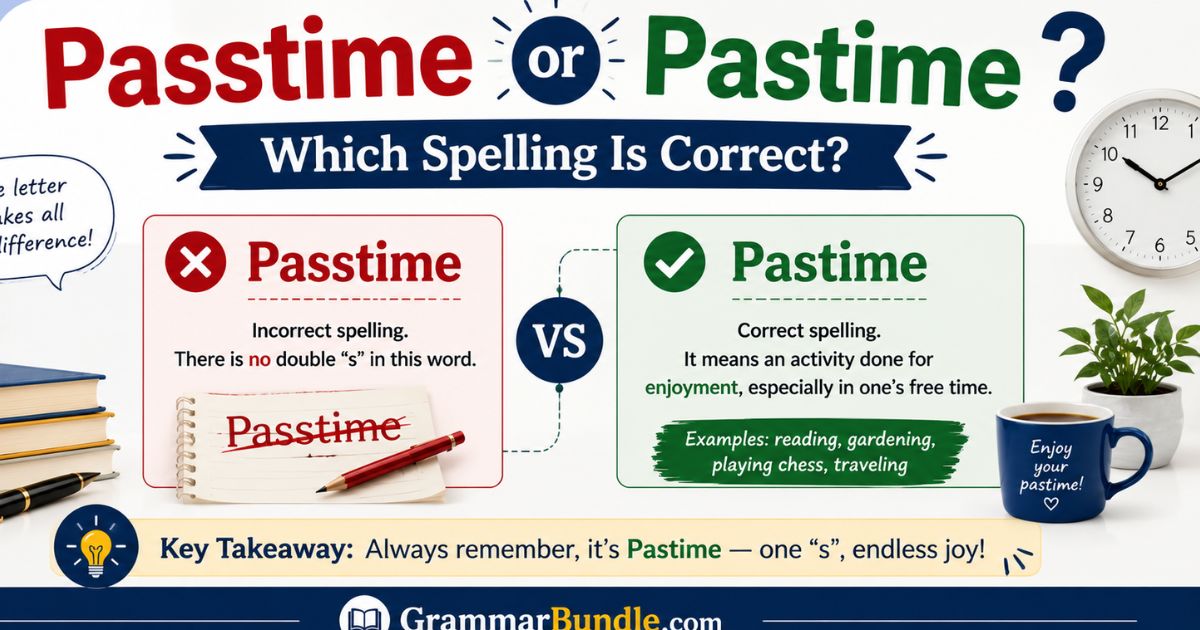
Passtime or Pastime? Many people mistakenly spell “pastime” as “passtime,” leading to confusion in everyday conversation. The correct term is “pastime,” a word that signifies a beloved hobby or activity.Understanding the correct spelling can improve communication and clarity in writing. This article will explore the correct spelling, its origins, and how to use it effectively.
Pastime Meaning in Simple English
“A pastime is an activity people enjoy doing in their free time.”
It’s a way to relax, have fun, and take a break from daily routines. Whether it’s reading a book, gardening, or playing a game, pastimes give us a chance to express ourselves and connect with others.
Here are some key points about pastimes:
Personal Choice:
Each person chooses pastimes that fit their interests.
Mental Benefits:
Engaging in enjoyable activities can reduce stress and improve mood.
Social Connections:
Many pastimes, like sports or cooking, allow you to bond with friends and family.
Lifelong Learning:
Hobbies can teach new skills, helping us grow as individuals.
Pastimes are more than just ways to fill time; they enrich our lives and make every day a little brighter.
You may seek guidance from:https://wordspry.com/passtime-or-pastime/
Common Pastime Examples
Pastime activities don’t just fill time; they enhance our experiences.
Indoor Pastime Ideas
- Reading: Dive into novels.
- Cooking: Try new recipes.
- Crafting: Create unique arts.
- Puzzles: Challenge your mind.
- Gardening: Grow indoor plants.
Outdoor Pastime Activities
- Hiking: Explore nature trails.
- Picnicking: Enjoy meals outdoors.
- Cycling: Boost fitness levels.
- Photography: Capture stunning visuals.
- Volunteering: Help local communities.
Community Engagement
- Events: Attend local festivals.
- Workshops: Learn new skills.
- Meetups: Connect with others.
- Clubs: Share common interests.
- Classes: Join group activities.
Creative Pursuits
- Writing: Journal thoughts daily.
- Painting: Explore colors freely.
- Music: Play instruments joyfully.
- Dancing: Move to the rhythm.
- Theater: Participate in drama.
Sports and Fitness
- Yoga: Enhance flexibility.
- Running: Hit the pavement.
- Team Sports: Foster teamwork.
- Swimming: Refresh in water.
- Martial Arts: Master disciplines.
Relaxation Techniques
- Meditation: Find inner peace.
- Bathing: Enjoy soothing baths.
- Listening: Chill with podcasts.
- Breathing: Practice mindfulness.
- Stargazing: Marvel at the night sky.
Engaging in these acts fosters personal growth and cultivates memorable moments.
Article you may find helpful: dysregulated vs disregulated
Why People Write “Passtime”
Many people often use “passtime” instead of the correct spelling, “pastime.”
Your brain naturally connects the word to:
- pass
- passing
- passer
- passport
This mistake can stem from several sources:
Phonetic Misinterpretation:
The way we say words can mislead spelling. “Pastime” might sound like it should be spelled with an ‘s’ to some.
Typographical Errors:
Quick typing can lead to slips, creating “passtime” unintentionally.
Cultural Influence:
Some might see the term in social media or casual settings.
Pronunciation Causes Spelling Confusion
The pastime pronunciation sounds smooth when spoken quickly:
- PAS-tym
Is Passtime a Word?
No. “Passtime” is a common misspelling and not recognized in English. The correct term is “pastime,” which refers to activities we enjoy doing in our free time.
- Definition: A pastime is a hobby or enjoyable activity.
- Examples: Reading, painting, or playing a sport can be pastimes.
- Benefits: Engaging in pastimes can reduce stress and boost happiness.
So if you are asking:
- is passtime a word
- passtime meaning
- pastime spelling
The answer is simple:
- “Pastime” is correct
- “Passtime” is a spelling error
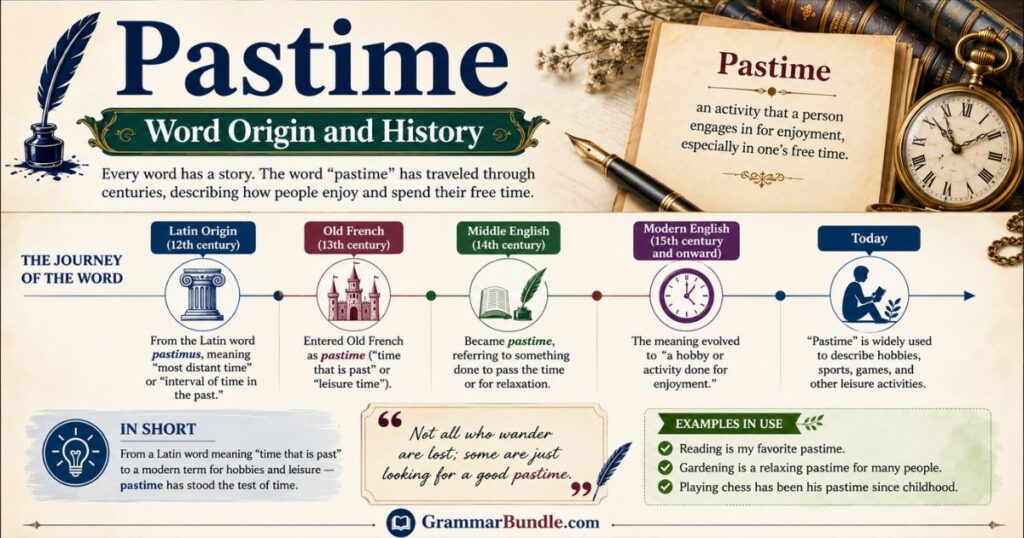
Pastime Word Origin and History
Word Origin of “Pastime”
- Etymology: The term “pastime” comes from the Old English pæst, meaning “to pass.”
- Root Words: It combines “past” with “time,” reflecting the act of spending time pleasantly.
- Usage: First recorded in the 16th century, it emphasized enjoyable activities.
Historical Evolution
- Cultural Influence: Early pastimes varied by culture; games, literature, and social gatherings shaped leisure.
- Social Changes: The Industrial Revolution shifted focus, making leisure activities essential for work-weary individuals.
- Modern Context: Today, pastimes span a digital landscape, from gaming to creative hobbies, evolving with technology.
Personal Connection
- Serenity Through Hobbies: Engaging in pastimes fosters community and personal growth.
- Reflection of Self: Choices in leisure reveal interests and values, providing insight into individual identities.
- Shared Experiences: Pastimes now often unite people across distances, forming bonds over shared passions.
Language changes constantly. Many modern English words started as separate phrases before merging together.
Examples include:
- someone
- everybody
- everyone
- butterfly
- Therefore
- anyone
Articles you may find helpful: Implicit vs Complicit
Pastime vs Passtime
| Feature | Pastime | Passtime |
| Meaning | An enjoyable activity | No recognized meaning |
| Status | Valid and widely used | Incorrect / misspelled |
| Pronounciation | /ˈpæstaɪm/ (same) | /ˈpæstaɪm/ (same) |
| Usage | Commonly used in conversation | Rarel seen |
Understanding the distinction between the two can enhance both writing and speaking clarity.
Pastime vs Passtime In Context Of Grammar
Understanding “Pastime”
Definition:
“Pastime” is a noun that refers to an activity done for enjoyment during one’s free time.
Usage Example:
“Reading novels is a popular pastime among many people.”
Context:
It represents hobbies or interests that provide relaxation or fun.
Understanding “Pass Time”
Definition:
“Pass time” is a verb phrase meaning to spend or occupy time in a particular way.
Usage Example:
“We can pass the time by playing games until dinner.”
Context:
It implies a deliberate action to fill a duration, often when waiting for something.
Key Differences
Grammar:
“Pastime” is strictly a noun, while “pass time” functions as a verb phrase.
Pastime as a Noun
The “Pastime” refers to a hobby or enjoyable activity.
Examples:
- Gardening has become a popular pastime among city dwellers.
- For countless individuals, playing chess is more than a pastime.
- Reading is a cherished pastime for many, allowing people to escape into different worlds or gain new knowledge.
Pass Time as a Verb Phrase
Pass time means engaging in activities to fill the gaps between responsibilities, creating opportunities for relaxation and joy.
Example:
- “During the long winter evenings, she tends to pass time by practicing her painting skills.”
- “They often pass time by exploring the local hiking trails.”
- “She immersed herself in reading a novel, to pass the time at the airport.”
Article you may find helpful : Implicit vs Complicit Clear Differences Explained
Quick Comparison Table
| Aspect | Pass Time (Verb Phrase) | Pastime (Noun) |
| Definition | To engage in an activity to occupy time | An activity done for enjoyment during free time |
| Usage | “They pass time by playing games.” | “Reading is her favorite pastime.” |
| Nature | Active and dynamic | Often passive or leisure-focused |
| Examples | Watching movies, going for a walk | Gardening, knitting, painting |
British vs American English Spelling
When it comes to British and American English, spelling differences can occur.
| American English | British English |
| Color | Colour |
| Theater | Theatre |
| Travelled | Traveled |
| Program | Programme |
| Liter | Litre |
Pastime in American English and British English
In the world of linguistics, the word “pastime” remains one of those delightful terms that display the distinctions between British and American English. While the spelling itself remains unchanged — both utilize “pastime” — the context and usage can differ significantly.
Cultural Context:
- In the UK, “pastime” often refers to traditional activities like gardening or cricket, reflecting a rich history of leisure.
- In contrast, Americans might lean towards modern hobbies, like binge-watching shows or gaming.
Frequency of Use:
- British English tends to use “pastime” in more formal contexts
- Americans may prefer simpler alternatives, like “hobby.“
Social Significance:
- For British, engaging in a pastime often carries a social narrative, connecting people through shared interests,
- In the US, it might be viewed more as a personal pursuit.
Understanding these highlights show language is more than words; it’s a reflection of cultural identity and lifestyle.
Easy Breakdown
The word “pastime” is a blend of:
- “pass” and “time,” suggesting a way to pass the time meaningfully.
It invites us to consider what activities we engage in when we step away from our daily routines. Whether it’s knitting, hiking, or reading, pastimes are the little joys that enrich our lives.
Pastime Examples in Sentences
1. Indoor Pastimes
- Reading novels is my favorite pastime.
- Solving crossword puzzles is a relaxing pastime.
- Writing short stories is a creative pastime.
2. Outdoor Pastimes
- Hiking is a healthy pastime for nature lovers.
- Fishing is a popular pastime in many coastal towns.
- Birdwatching is a peaceful pastime.
3. Creative Pastimes
- Painting is a rewarding pastime that encourages creativity.
- Photography has become her favorite pastime.
- Baking is a fun pastime for the whole family.
4. Sports and Games
- Playing chess is an enjoyable pastime for people of all ages.
- Playing badminton is a favorite weekend pastime.
- Swimming is a healthy pastime during the summer.
5. Technology and Entertainment
- Watching movies is a common pastime.
- Listening to podcasts is my favorite pastime while traveling.
- Playing video games is a popular pastime among teenagers.
6. Family and Social Pastimes
- Spending time with grandparents is a cherished pastime.
- Playing board games is a favorite family pastime.
- Picnics with friends are an enjoyable weekend pastime.
7. Educational Pastimes
- Learning a new language is a productive pastime.
- Reading history books is an informative pastime.
- Practicing math puzzles is a challenging pastime.
8. Relaxing and Mindful Pastimes
- Meditation is a calming pastime after a busy day.
- Knitting is a relaxing pastime enjoyed by many people.
- Listening to soft music is a peaceful evening pastime.
Hobby vs Pastime
Hobbies and pastimes often blur together but they carry distinct meanings that can shape our leisure experiences.
Hobby
A hobby is an activity pursued for pleasure, typically with a level of commitment or skill development.
For example:
- Gardening: Not just planting flowers but learning about soil types and plant care.
- Photography: Going beyond snapping pictures to mastering techniques and editing skills.
Pastime
A pastime is meant to fill time or serve as a distraction. It might not require as much investment or growth. For Exampe:
- Watching TV: Enjoyable but often passive, leading to a break from daily routines.
- Browsing social media: Light and entertaining, yet it rarely cultivates deeper skills.
Understanding these differences can enhance how we choose to spend our free time.
Popular Pastimes Around the World
| Feature | Pastime | Hobby |
| Definition | Light activities for relaxation | Activity pursued for pleasure, |
| Time Investment | Often casual and sporadic | Regular and often scheduled |
| Goal | Stress relief and enjoyment | Skill improvement or mastery |
| Social Aspect | Typically solitary | Often communal or shared |
| Commitment Level | Low commitment | Can require significant dedication |
Some activities can be both a hobby and a pastime.Like
- Gardening
- Photoraphy
- Cooking
You may visit: Noteable or Notable Learn the Correct Spelling
Popular Pastimes Around the World
| Country | Popular Pastime(s) |
|---|---|
| 🇺🇸 United States | Watching sports, hiking, camping |
| 🇬🇧 United Kingdom | Gardening, reading |
| 🇯🇵 Japan | Anime, manga, origami, gaming |
| 🇮🇳 India | Cricket, yoga |
| 🇦🇺 Australia | Surfing, swimming, barbecues |
| 🇨🇦 Canada | Ice hockey, camping, fishing |
| 🇮🇹 Italy | Cooking, football (soccer) |
| 🇧🇷 Brazil | Football, samba dancing |
| 🇨🇳 China | Tai Chi, table tennis |
| 🇵🇰 Pakistan | Cricket, Urdu poetry |
| 🇫🇷 France | Cycling, café culture, reading |
| 🇩🇪 Germany | Cycling, hiking |
| 🇰🇷 South Korea | Gaming, K-dramas, hiking |
| 🇪🇸 Spain | Football, flamenco dancing |
| 🇳🇿 New Zealand | Rugby, hiking, kayaking |
Global Pastime Comparison
| Pastime | Popular Countries |
|---|---|
| Cricket | India, Pakistan, Australia |
| Football (Soccer) | Brazil, Italy, Spain, United Kingdom |
| Reading | United Kingdom, France, United States |
| Hiking | United States, Canada, Germany, New Zealand |
| Gardening | United Kingdom, United States |
| Gaming | Japan, South Korea, United States |
| Cooking | Italy, France |
| Dancing | Brazil, Spain |
| Camping | Canada, United States, Australia |
| Cycling | France, Germany, Netherlands |
Why Correct Spelling Matters
Correct spelling is more than just a matter of accuracy. It is a crucial part of effective communication. Misplaced letters can change meanings and confuse readers.
Here are a few reasons why it matters:
- First Impressions Count: Spelling errors can make writing unprofessional.
- Clarity is Key: Correct spelling helps convey your message clearly. A simple misspelling can lead to misunderstandings.
- Attention to Detail: Good spelling reflects a writer’s attention to detail that shows respect for the reader and the subject matter.
Using the correct English spellings helps:
- Clear communication
- Professional image
- Increased clarity
- Stronger connections
- Boosted credibility
Easy Tricks to Remember Pastime Spelling
1. Remember: It’s Past + Time
The word pastime is formed from past + time, not pass + time.
Memory Tip:
Past + Time = Pastime ✅
2. Think of “Past” as Free Time
A pastime is something you do to pass the time, but the word itself uses past, not pass.
Example:
Reading is my favorite pastime.
3. There Is Only One “S”
If you’re tempted to write passtime, remember that pastime contains only one “s” in the middle.
❌ Passtime
✅ Pastime
4. Use This Simple Phrase
Repeat this sentence whenever you’re unsure:
“My favorite pastime helps pass the time.”
Notice that pastime is one word, while pass the time is a three-word phrase.
5. Remember the Rule
When referring to a hobby or leisure activity, always write pastime as one word.
Examples:
- ✅ Gardening is a relaxing pastime.
- ✅ Photography is her favorite pastime.
- ❌ Gardening is a relaxing passtime.
Quick Memory Recap
| Trick | How It Helps |
|---|---|
| Think Past + Time | Reminds you of the correct spelling. |
| One “S” only | Avoids the common mistake passtime. |
| Repeat the phrase | “My favorite pastime helps pass the time.” |
| One word | Pastime is always written as a single word. |
| Connect it to hobbies | If it means a leisure activity, the correct spelling is pastime. |
Common English Spelling Mistakes Related to Pastime
| Correct | Incorrect |
| definitely | definetly |
| reccommend | reccomend |
| occasion | ocassion |
| embarrassment | embarassment |
| separate | seperate |
Pastime Synonym
| Synonyms | Meanings |
| Hobby | An activity done regularly in one’s leisure time. |
| Leisure | Free time utilized for enjoyment or relaxation. |
| Recreation | Activities done for enjoyment often involving physical exertion. |
| Amusement | Activities designed to entertain, often light-hearted. |
| Diversion | An activity that distracts from everyday routines. |
Pastime Antonyms
| Antonym | Meaning |
|---|---|
| Work | Paid or productive labor |
| Job | Regular employment |
| Labor | Physical or mental effort |
| Duty | A task or responsibility |
| Responsibility | Something you are expected to do |
| Obligation | A commitment that must be fulfilled |
| Chore | A routine household task |
| Task | A piece of work to be completed |
| Assignment | A specific piece of work |
| Occupation | A person’s profession or employment |
Common Opposites of Pastime
- Work
- Job
- Duty
- Responsibility
- Obligation
- Labor
- Chore
- Task
- Assignment
- Occupation
Important Note
There is no single direct antonym for pastime in English. The best opposite depends on the context. When pastime means a leisure activity, words like work, duty, responsibility, or obligation are the most appropriate opposites because they refer to activities done out of necessity rather than enjoyment.
Reading as a Pastime:
Benefits of Reading
- Knowledge growth
- Vocabulary expansion
- Stress relief
- Mental relaxation
- Creative thinking
- Better concentration
- Memory improvement
- Lifelong learning
- Language development
- Imagination boost
Reading Materials
- Fiction novels
- Mystery books
- History books
- Science magazines
- Poetry collections
- Travel guides
- Comic books
- Digital articles
- Self-help books
- Children’s stories
Many teachers encourage reading because it combines entertainment with learning.
Gaming as a Pastime
Gaming is one of the most popular pastimes today. People of all ages enjoy playing games.
Benefits of Gaming
- Stress relief
- Mental stimulation
- Problem solving
- Strategic thinking
- Quick reflexes
- Teamwork skills
- Social connection
- Creative exploration
- Healthy competition
- Skill development
Popular Game Types
- Action games
- Adventure games
- Puzzle games
- Racing games
- Sports games
- Strategy games
- Simulation games
- Role-playing games
- Mobile games
- Online multiplayer
Example Sentences
- Gaming is a popular pastime among teenagers.
- He enjoys gaming as a relaxing pastime after work.
- Online gaming has become a favorite pastime worldwide.
- Many friends share gaming as a weekend pastime.
- Gaming is both entertaining and mentally engaging when enjoyed in moderation.
Sports as a Pastime
Sports are more than just games—they are an exciting pastime that keeps people active, healthy, and entertained.
Why People Enjoy Sports
- Stay active
- Build friendships
- Relieve stress
- Improve health
- Learn teamwork
- Boost confidence
Popular Sports Pastimes
- Playing football
- Watching cricket
- Riding bicycles
- Swimming laps
- Playing tennis
- Hiking trails
- Running races
- Playing badminton
Skills Developed
- Quick reflexes
- Better balance
- Strong discipline
- Leadership skills
- Time management
- Decision making
Who Enjoys Sports?
- School children
- College students
- Working adults
- Senior citizens
- Fitness enthusiasts
- Professional athletes
Indoor and Outdoor Pastime Ideas
Sometimes people search for pastime ideas instead of grammar explanations.
Indoor Pastime Ideas
- Reading books
- Writing journals
- Painting pictures
- Drawing sketches
- Solving puzzles
- Playing chess
- Cooking meals
- Baking cookies
- Learning languages
- Watching movies
- Listening music
- Playing games
- Knitting scarves
- Practicing yoga
- Meditation sessions
Outdoor Pastime Ideas
- Hiking trails
- Cycling routes
- Gardening plants
- Fishing lakes
- Camping weekends
- Birdwatching parks
- Running mornings
- Swimming pools
- Playing football
- Playing cricket
- Playing tennis
- Walking trails
- Nature photography
- Flying kites
- Family picnics
How to Choose the Right Pastime
- Match interests
- Consider budget
- Check schedule
- Stay active
- Learn skills
- Have fun
Articles you may find helpful:
Uninclined vs Disinclined the Real Difference
Comming vs Coming: Easy Grammar and Spelling Guide
FAQs
FAQ 1: What is the correct spelling of the word for leisure activities?
Ans: The correct spelling is “pastime.”
FAQ 2: Can “passtime” be considered a valid variant?
Ans: No, “passtime” is a common misspelling; the proper term is “pastime.”
FAQ 3: What does “pastime” mean?
Ans: “Pastime” refers to an activity that is done for enjoyment during free time.
FAQ 4: Are there any exceptions where “passtime” is used?
Ans: There are no standard exceptions; “passtime” is generally incorrect.
FAQ 5: Why is it important to use the correct spelling?
Ans: Using the correct spelling ensures clear communication and maintains professionalism.
FAQ 6: How can I remember the correct spelling?
Ans: Think of “pastime” as an activity that passes time; this can help reinforce the spelling.
FAQ 7: Is “pastime” used in any idioms or expressions?
Ans: Yes, phrases like “a favorite pastime” are common in everyday language.
FAQ 8: Where can I find more information about common spelling mistakes?
Ans: Many online dictionaries and language resources offer guides on common spelling errors.