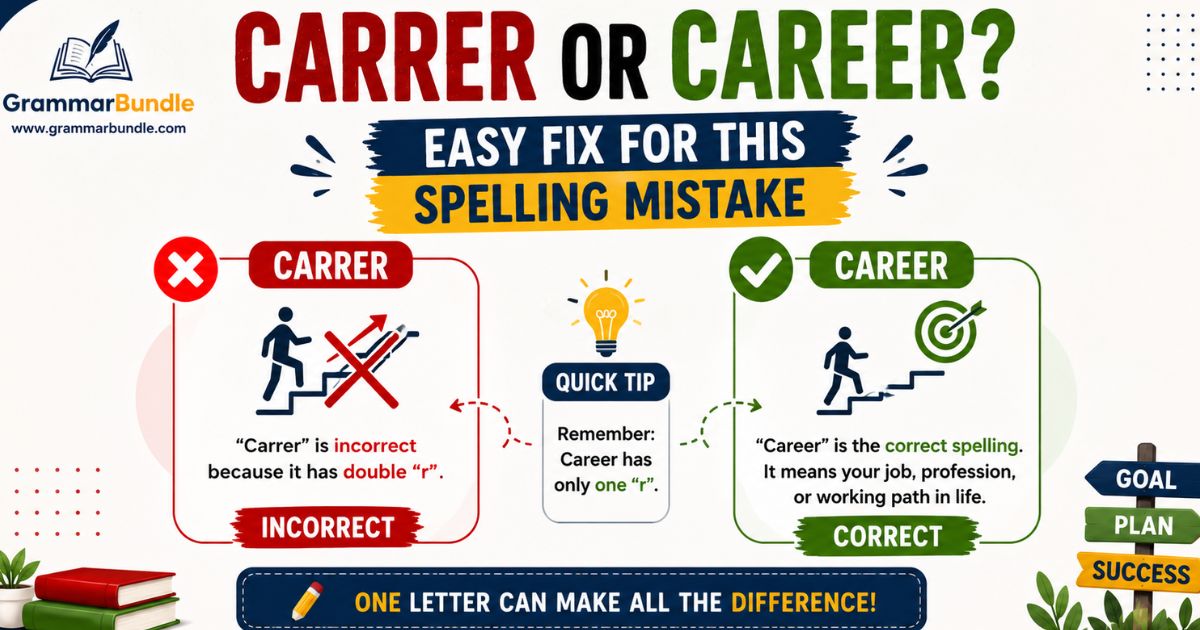
Career or career? It’s a common mix-up that can lead to confusion despite the word’s straightforward importance in our lives. Understanding the correct spelling not only reflects your attention to detail but also impacts your professional reputation.
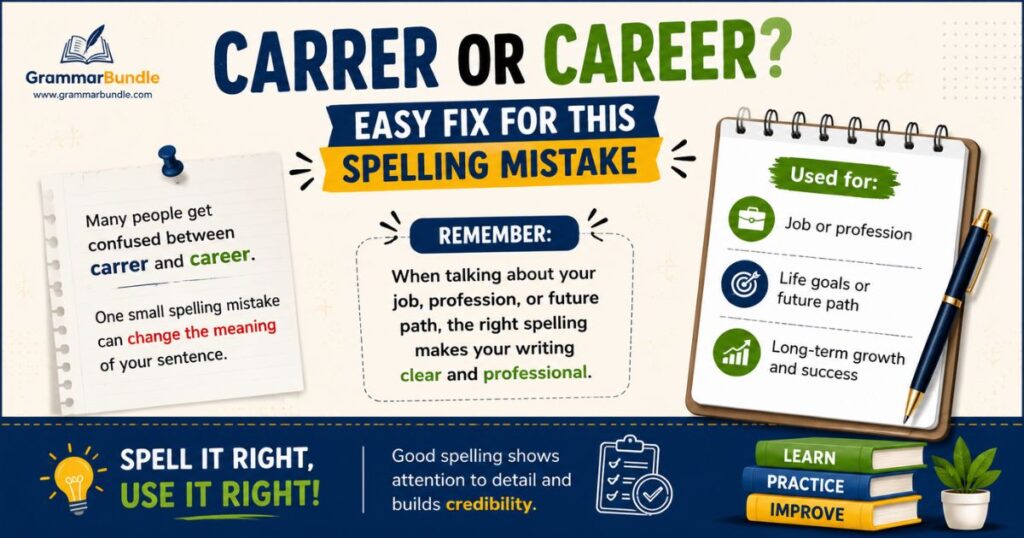
Carrer or Career The Quick Truth
Career vs. Carrer:
It’s all about spelling and meaning.
“Career” refers to your professional journey, “Carrer” is simply a common misspelling.
Importance of Clarity:
Correct spelling in resumes and job applications is crucial. A minor error can lead hiring managers to question your attention to detail.
Trends in Careers:
- Emerging fields like AI and renewable energy are growing rapidly.
- Lifelong learning is becoming essential to adapt to changing job markets.
| Term | Meaning | Example |
|---|---|---|
| Career | A professional journey | A software engineer grows from junior to senior roles. |
| Carrer | Misspelling | “I want to build my carrers” is incorrect; it should be “career.” |
Explore more common spelling mistakes in our article about Comming vs Coming: Easy Grammar and Spelling Guide
What Career Really Means in Real Life
The Reality of Career Choices
Growth Over Time:
A career often reflects personal growth, not just job titles. Each experience — successes and failures — shapes skills and character.
Passion and Purpose:
Finding a career that aligns with personal passions elevates the everyday grind to something meaningful. It becomes a part of who you are, not just what you do.
Networking and Relationships:
Success in a career isn’t just about individual effort. Building connections and learning from others plays a huge role in growth and opportunities.
Changing Landscape
Adaptability Matters:
Today’s job market is fast-changing. Embracing new skills and being open to change can open doors that rigid thinking might shut.
Work-Life Balance:
A fulfilling career understands the importance of balance. Prioritizing well-being leads to sustained success, not just temporary achievements.
Value Beyond Money:
A meaningful career often goes beyond financial gain. Job satisfaction, positive impact, and personal fulfillment carry significant weight in long-term happiness.
Explore more common spelling mistakes in our article about Wack or Whack The Real Difference and Correct Spelling
Where the Word Career Comes From
The Etymology of “Career”
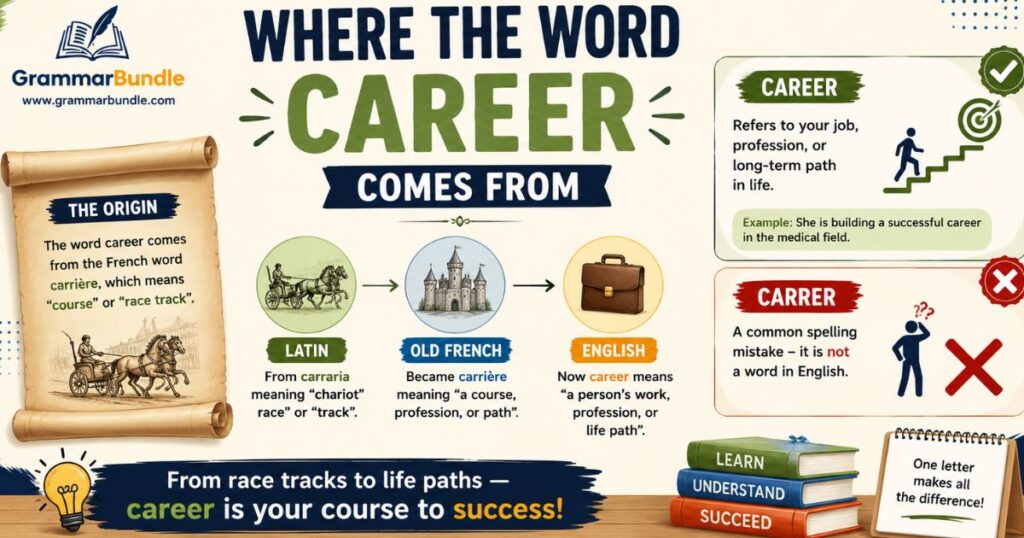
- Roots in Latin: The word “career” comes from the Latin word “carraria,” which means “road” or “path.”
- Evolution Over Time: Initially, “career” referred strictly to a racecourse or the act of running. Over the centuries, its meaning shifted towards the fields of work and profession, indicating a more structured life path.
Cultural Significance
- Reflection of Values: Different cultures interpret “career” in varied ways, with some emphasizing stability while others encourage exploration and change. This diversity showcases how careers can reflect personal values and societal expectations.
- Dynamic Journeys: Today’s careers are less about a fixed pathway and more about evolving experiences. People often change professions multiple times, illustrating the idea that a career can be a series of exciting adventures rather than a single route.
Why People Write Carrer Instead of Career
Phonetic Misinterpretation
Many people may write “carrer” simply because of how it sounds. The way we hear words can lead to misconceptions. When spoken quickly, “career” can blend together, making “carrer” an easy mistake.
Keyboard Slip-Ups
Another reason is typing errors. In our digital age, fingers can easily slip on the keyboard. This common mistake often goes unnoticed in a quick edit, especially when typing fast without checking spellings.
Lack of Exposure
Some people might not encounter the word “career” frequently in reading or conversation. Limited exposure to written content can lead to using incorrect forms without realizing it. Increased reading can help correct these misunderstandings.
Language Learning Influence
For non-native speakers, the struggle with English spelling is real. Similar-sounding words in their first language might influence their writing. This reflects the challenges of learning a new language while trying to write correctly.
By exploring these aspects, it’s clear that human factors like pronunciation, typing habits, and language backgrounds shape how we express ourselves, even in simple words.
For additional examples and explanations, see this trusted external source. https://grammerscope.com/carrer-vs-career/
How to Pronounce Career
- Start with the “k” sound, like in “cat.”
- Next, transition to the short “uh” sound.
- Follow with a strong “rear,” rhyming with ‘appear.’
- End with a soft “r” and a clear “ee” sound.
- Finally, finish off with a brief “r,” sounding smooth.
- Practice saying it slowly before speeding up.
- Use a mirror to observe your mouth movements.
Hearing the word spoken can help a lot.
Is Carrer a Real Word?
The term “carrer” often pops up in conversations but is not recognized as a real word. Here are key points to consider:
- “Career” is the correct spelling for professions.
- “Carrer” doesn’t appear in standard dictionaries.
- Misunderstandings can arise from similar-sounding words.
- Typos can lead to confusion in communication.
- Using the right term reflects professionalism and clarity.
- Learning from mistakes helps improve language skills.
- Relying on spell check can prevent common errors.
Understanding the difference between “career” and “carrer” enhances communication. It shows attention to detail and respect for language.
Explore more common spelling mistakes in our article about Different or Diffrent the Complete guide
Career Spelling in British and American English
The spelling career is the same in both British English and American English.
- British English: career
- American English: career
There’s no spelling difference between the two varieties. The word career refers to a person’s profession, occupation, or long-term working life.
Examples:
- She wants to build a successful career in medicine.
- He started his career as a teacher.
- Choosing the right career can be an important decision.
So, whether you’re writing for a British or American audience, career is the standard spelling.
Explore more common spelling mistakes in our article about Shinning or Shining the Correct Spelling
Common Confusion: Career vs. Carrier
The words “career” and “carrier” might sound similar, but they have very different meanings that are often misused in conversations. Understanding each term can clear up a lot of confusion.
Career:
- Refers to a professional journey, often involving education and experience in a specific field.
- Example: Someone may have a career in medicine, dedicating years to studying and working as a doctor.
Carrier:
- Refers to someone or something that carries or transports items, messages, or even diseases.
- Example: A courier is a carrier who delivers packages or important documents.
Recognizing the distinction between these two can enhance your communication skills. A solid understanding helps avoid misunderstandings, especially in professional settings.
Common Spelling Mistakes Related to Career
- “Carrar” is a common typo in resumes.
- “Carrer” often appears in job applications.
- Many write “carreer” without realizing it.
- “Carear” can confuse hiring managers easily.
- Some use “cereer” by mistake online.
- “Careeer” adds unnecessary letters.
Spelling mistakes like “carrer” or “carear” can lead to missed opportunities. A simple error can shift the focus away from your skills and experience. Employers notice details, and typos may suggest carelessness.
Explore more common spelling mistakes in our article about
Career Examples in Everyday Use
- She started her career after graduation.
- He is building a successful career.
- Teaching became her chosen career path.
- My career requires strong communication skills.
- She wants a career in medicine.
- He changed his career last year.
- A good career takes consistent effort.
- Her career has grown remarkably fast.
Understanding Career Pathways
Start with Self-Discovery
Identify your interests and strengths. This can help you figure out what careers might suit you best. Reflect on what activities make you feel energized and fulfilled.
Explore Education and Skills
Look into educational options that match your chosen field. Whether it’s a degree, certification, or online course, the right learning path can open doors for you. Don’t forget about gaining skills through internships or volunteer work.
Gain Experience
Real-world experience is vital. Seek internships, part-time jobs, or projects in your desired area. This will not only enhance your resume but also help you understand the job environment better.
Network and Build Connections
Connect with professionals in your field. Networking can lead to job opportunities and mentorship. Attend workshops, seminars, or online forums to meet people who can guide you.
Stay Flexible
Remember, career paths aren’t always linear. Be open to changing directions if you discover new interests along the way. Adaptability can lead to exciting, unexpected opportunities.
Explore more common spelling mistakes in our article about Noteable or Notable? Easy & Helpful Guide
Career Path Explained Simply
A career path is the journey you take through your education, skills, jobs, and professional growth. A general career pathway looks like this:
Education → Skills → Entry-Level Job → Experience → Career Growth → Advanced Position → Long-Term Goals
For example:
Degree → Internship → Junior Position → Professional Experience → Senior Position → Leadership Role
Career vs Job The Real Difference
When thinking about work, it’s easy to confuse a career with a job. A job is often something you do to earn money. It might be temporary or part-time, focused more on quick paychecks than long-term goals. In contrast, a career is a journey of growth and development .
| Feature | Job | Career |
|---|---|---|
| Duration | Short-term | Long-term |
| Focus | Immediate income | Skill and advancement |
| Stability | May vary | Generally more stable |
| Growth Potential | Limited | Continuous |
| Personal Fulfillment | Often lacking | Highly rewarding |
Explore more common spelling mistakes in our article about Uninclined vs Disinclined the Real Difference —
Why Career Matters More Than Just Work
The Heart of Purpose
A career isn’t just a job; it’s a journey that shapes who we are. Each step we take builds our skills and confidence, reflecting our values and passions.
It’s about finding meaning and making an impact in our own way. When we invest ourselves in our careers, we tap into:
- Personal Growth: Learning new things builds not just our resumes but also our characters.
- Connection: Working alongside others fosters relationships that can inspire and motivate us.
- Fulfillment: Achieving goals leads to a deep sense of satisfaction and pride in our contributions.
Beyond the Paycheck
Focusing on a career transforms our lives beyond income. It can enhance our mental well-being and shape our identity.
When we feel fulfilled, it radiates into our personal relationships and communities. Consider these aspects:
- Long-term Vision: A thoughtful career path leads to greater stability and potential for advancement.
- Values Alignment: Working in a field that resonates with our beliefs adds joy to our daily lives.
- Legacy: The impact we make through our work can inspire future generations.
Embracing a career that speaks to our hearts can turn work into a platform for change, innovation, and personal satisfaction.
How to Remember the Correct Spelling
- Break it down clearly.
- Focus on each syllable.
- Use rhymes to remember.
- Create a catchy phrase.
- Spell it out loud.
- Write it down repeatedly.
- Share it with friends.
- Quiz yourself often.
Tips to Remember the Correct Spelling of Career
A simple way to remember career is to break it into two parts:
CARE + ER = CAREER
Think of it as: “Care about your career.”
You can also remember that career has two E’s together in the middle: CAREER.
Quick reminder:
Career = C-A-R-E-E-R
Explore more common spelling mistakes in our article about
Why This Mistake Shows Up So Often Online
- Spelling mistakes reflect our busy lives.
- Typos slip through in a digital rush.
- Autocorrect can change words unexpectedly.
- Many write quickly, ignoring fine details.
- Online platforms lack rigorous proofreading.
- Education emphasizes content over grammar.
- A casual tone encourages relaxed writing.
Explore more common spelling mistakes in our article about Loot vs Lute: Meaning, Spelling Pronunciation
Simple Table Correct vs Incorrect Usage
When it comes to spelling, even small mistakes can change the meaning of a word or make communication unclear.
| Term | Correct Usage | Incorrect Usage |
|---|---|---|
| Career | “She started her career in marketing.” | “She started her careeer in marketing.” |
| Careeer | Not applicable | “He plans to focus on his careeer.” |
| Carear | Not applicable | “My carear is going well.” |
FAQs
- What is the correct spelling?
Ans: The correct spelling is “career.” “Carrer” is a common misspelling. - What does “career” mean?
Ans:A career is a job or profession that someone does for a long time. - Can “career” refer to any job?
Ans:Yes, it can refer to any job, but it usually means a job that involves skill and advancement. - Why do some people spell it “carrer”?
Ans: People might spell it “carrer” by mistake because the extra “r” seems right to them. - How can I remember the right spelling?
Ans: Just think of “career” as having two “e’s” and one “r.” - Is there a difference in pronunciation?
Ans: No, both “career” and “carrer” would sound the same, but only “career” is correct. - Where can I see the word used correctly?
Ans: You can find “career” in job listings, books about work, and educational materials. - What should I do if I see “carrer” in a text?
Ans: If you see “carrer,” just remember it’s a mistake and gently correct it if you can!
Conclusion:
Understanding the correct spelling of “career” is essential for clear communication. The word “carrer” is often a common mistake, but knowing the right form can enhance your writing. A career refers to your professional journey and the work you do over a long time.