
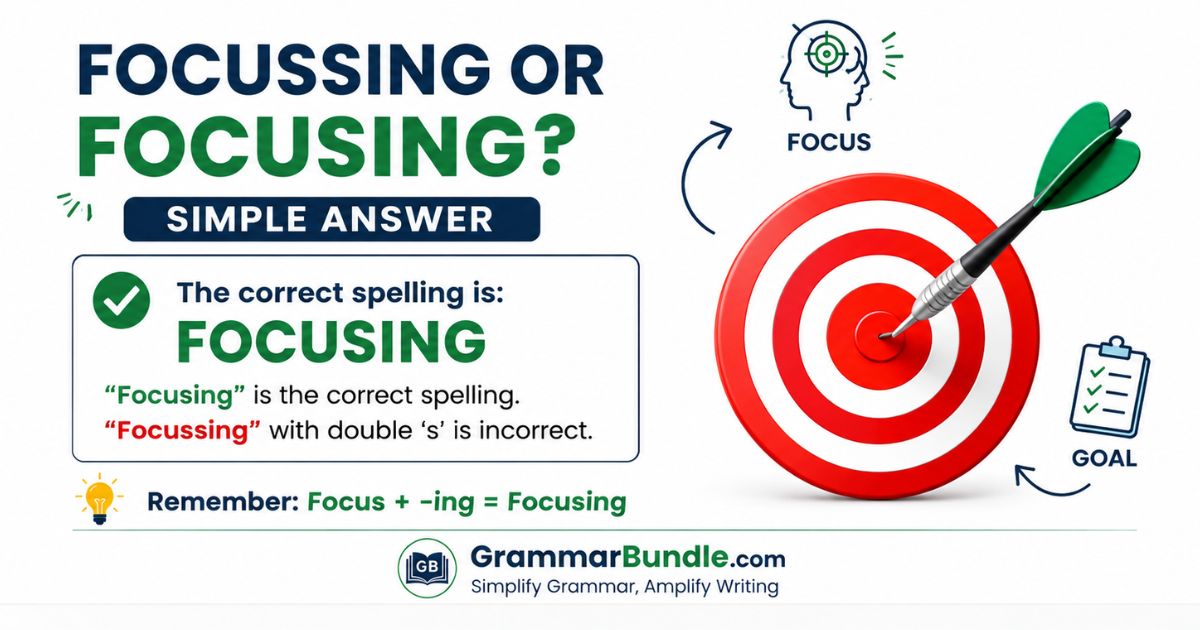
In the world of writing, even small details can make a big difference, and the choice between “focussing” or “focusing” is no exception. By examining the correct usage and underlying principles, this article will help you communicate more effectively and confidently.
Focussing or Focusing Quick Answer
In the debate between “focussing” and “focusing,” the winner is clear:
- “Focusing” is the correct spelling in American English.
- “Focussing” is often seen in British English.
This distinction highlights how language varies across cultures, influencing word usage and preferences.
- American English: Uses “focusing” for consistency with other “-ing” forms.
- British English: Accepts “focussing,” reflecting a different approach to doubling consonants.
- Language reflects identity: Choosing one form can signal regional ties, cultured backgrounds, or even personal preferences.
- Both versions convey the same message, yet the chosen spelling can affect perception.
The Correct Spelling: Focusing
The right spelling in American English is “focusing.” This version is widely accepted in formal writing, such as essays or articles. In contrast, “focussing” is more common in British English but is considered less standard in the U.S.
- American English: Focusing on your goals can lead to success.
- British English: Focussing on your studies is essential for passing exams.
The Importance of Spelling in Communication
Spelling affects clarity. Using the correct form helps your audience understand your message without distraction. Mistakes can cause confusion or make your writing seem less professional.
Clarity and Understanding
Precision in Language:
Correct spelling ensures that your message is received as intended. Even minor errors can lead to significant misunderstandings, altering the meaning of words entirely.
For example, a simple typo can transform a friendly invitation into an awkward insult.
Professionalism Matters:
In job applications and professional correspondence, accurate spelling reflects attention to detail and commitment to quality. Employers often interpret consistent errors as a lack of care, which could diminish your chances of success.
Building Trust and Credibility
First Impressions Count:
Spelling errors can detract from your credibility. In an era where communication spans digital platforms, a well-spelled message develops trust. A polished presentation often speaks louder than the content itself.
Cultural Sensitivity:
Spelling can also resonate beyond language; it reflects respect for diverse linguistic backgrounds. For instance, recognizing and correctly spelling names or terms from different cultures enhances your interpersonal connections.
Focussing or Focusing Difference Explained
Understanding the Basics: Focus vs. Focussed
“Focusing” is the standard form used in American English, while “focussing” is often seen in British English. Both terms relate to effort on a specific task or idea. This confusion is due to spelling difference, not the grammar rules.
Context Matters
In academic writing or formal settings, clarity is crucial. Choosing “focusing” may resonate better with an American audience, while “focussing” may feel more familiar in the UK.
- Use “focusing” for:
– American audiences
– Modern, tech-related contexts - Use “focussing” for:
– British publications
– Traditional or formal contexts
Encouraging Mindfulness
Focusing isn’t just about spelling; it’s about practice. Developing focus in your daily life can transform productivity. Techniques like the Pomodoro Technique or mindfulness meditation can sharpen your concentration and help you engage deeply with your tasks.
Related articles you may enjoy: Ingage vs Engage
Comparison table
| Aspects | Focussing | Focusing |
| Spelling | British English | American English |
| Usage | More common in US | More common in US |
| Connotation | Slightly Formal | Direct and Clear |
| Context | Often formal | Versatile in use |
| Frequency | Lower in media | Higher in media |
| Adjective Form | Focussed | Focused |
For more grammar tips, check out these related posts: Dysregulated bvs Disregulated
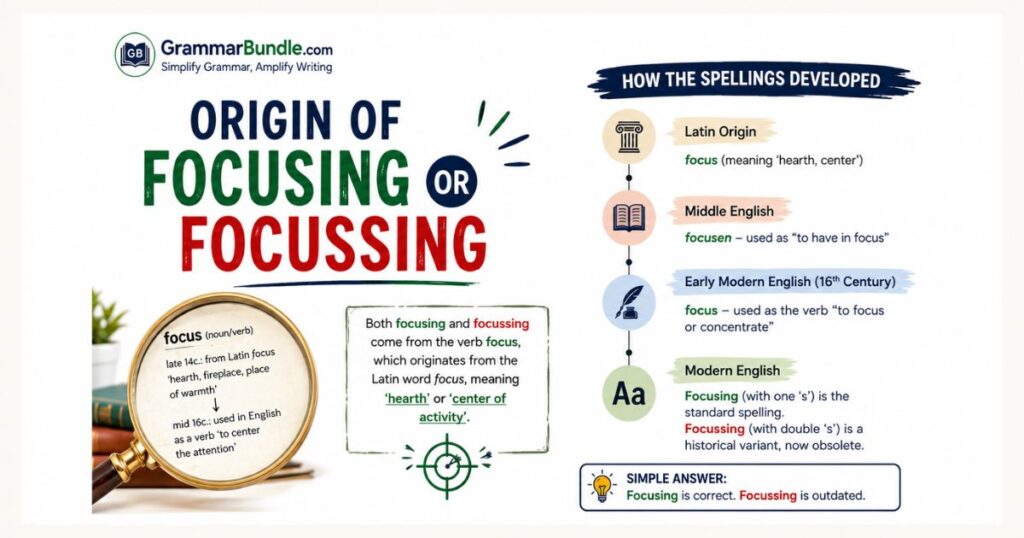
Origin of Focusing or Focussing
The origin of the word “focusing” (or “focussing”) unfolds a fascinating journey through language and meaning.
- Latin Roots: The word traces back to the Latin “focus,” meaning hearth or center, which suggests a place of warmth and concentration.
- 19th Century Usage: It gained prominence in English during the 19th century, especially in the context of optics and photography, marking a shift toward visual clarity.
- Scientific Expansion: With the rise of various scientific fields, “focusing” expanded its usage to describe the act of directing attention and energy in multiple contexts — from psychology to education.
- Cultural Relevance: The term embodies the modern pursuit of mindfulness, emphasizing clarity not just in vision but in thought and intention.
- Global Variations: Different cultures interpret “focusing” through unique lenses, showcasing how language shapes perception and interaction.
- Digital Age Lexicon: Today, the term resonates in the tech world, often linked to user experience and interface design, representing clarity in communication.
Expand your knowledge with these related posts: Loot vs Lute
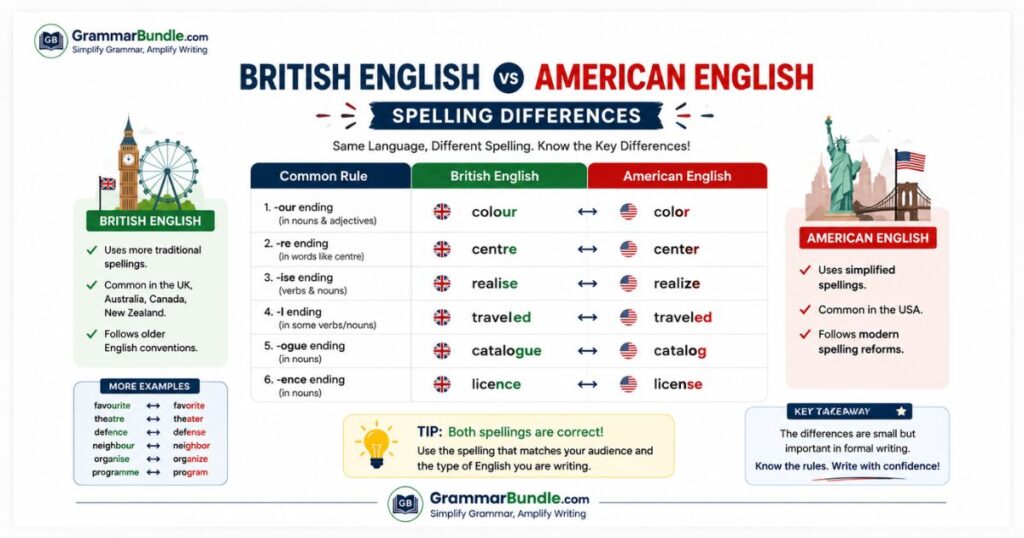
British English vs American English Spelling Differences
When it comes to British and American English, spelling differences often confuse writers and learners. For example, British English uses “colour” while American English opts for the simpler “color.” This isn’t just about aesthetics; it emphasizes how each spelling varies in different cultures.
Here’s a quick glimpse into some common spelling differences:
| British English | American English |
|---|---|
| flavour | flavor |
| centre | center |
| honour | honor |
| organise | organize |
| travelling | traveling |
| programme | program |
British English often retains more traditional spellings, while American English tends to simplify them for ease of use.
You may clarify at : https://grammetix.com/focussing-or-focusing/
Which Is Correct Focussing or Focusing
The Great Debate: Focussing vs. Focusing
While the two spellings — focussing and focusing — may seem interchangeable, the key lies in their usage across different forms of English.
“Focusing” is the preferred spelling in American English, while “focussing” is commonly used in British English.
- American English: Focusing
- British English: Focussing
Understanding your audience is essential. Using the correct form helps in maintaining professionalism and clarity.
Keep It Consistent
The version you choose be consistent. If you start with “focusing,” continue using it throughout your text. This will enhance readability and strengthens your argument.
Explore the Context
Both terms carry the same essential meaning — directing attention or concentration.
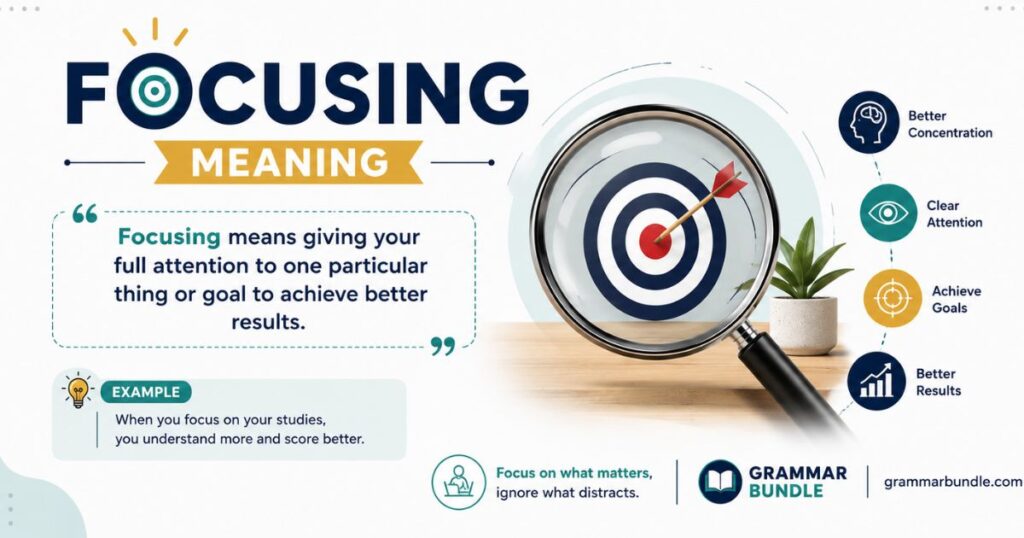
Focusing Meaning
Focusing means concentrating attention, effort, or interest on a particular person, object, or task.Practical applications of focusing on meaning include:
- Mindful Communication: Choosing words that resonate and truly reflect our feelings.
- Purposeful Living: Aligning daily activities with personal values to enhance overall satisfaction.
- Reflective Practices: Journaling or meditating on experiences to unearth hidden lessons.
Examples:
- She is focusing on her final exams this week.
- The teacher is focusing on grammar rules today.
- We are focusing our efforts on improving customer service.
- He kept focusing on the negative instead of the positive.
- The camera is focusing automatically on the subject.
Focussing Meaning
Focussing means concentrating your attention, effort, or interest on a particular task, goal, or subject(same as that of Focusing).
Example:
- She is focussing on her studies for the final exams.
- The company is focussing on improving customer service.
- We are focussing our efforts on reducing costs.
Synonyms of Focussing or Focusing:
- Concentrating
- Paying attention
- Directing
- Targeting
- Fixing attention on
Antonyms of Focussing or Focusing:
- Distracting
- Ignoring
- Neglecting
- Overlooking
- Diverting attention
Continue learning with these related guides: Coming vs Coming
Grammar Rules for Focussing and Focusing
- Both forms are the present participle of the verb “focus.”
- Use “focusing” when writing for an American audience.
- Use “focussing” if you’re addressing a British audience.
- The adjective form remains straightforward: focused for both.
Focusing Spelling American English
- In American English, the correct spelling is “focusing,” with just one “s.” This simple spelling choice can often confuse people, especially in British English, where it’s spelled “focussing” with two “s’s.”
- Knowing the right spelling helps you communicate clearly. It adds polish to your writing and shows attention to detail.
- Keeping your writing straightforward makes it more relatable. When readers feel connected to your words, they’re more likely to understand your message.
- When you write about focusing, remember the single “s”. Small details like this can make a big difference!
Examples:
- She is focusing on her career goals.
- The teacher is focusing on grammar lessons today.
- We are focusing our efforts on improving customer satisfaction.
Focussing Spelling British English
- In British English, “focussing” is often spelled with two ‘s’s.
- The word focussing means concentrating on something, whether it’s a task, an idea, or even a person.
- Using “focussing” can add a personal touch to your writing, especially in creative or informal pieces.
- Language is fluid, and different regions have their own spellings.
However, modern British usage now strongly prefers focusing.
Examples:
Older style:
- She is focussing on her career goals.
- The teacher is focussing on grammar lessons today.
- We are focussing our efforts on improving customer satisfaction.
Modern Style:
- She is focusing on her career goals.
- The teacher is focusing on grammar lessons today.
- We are focusing our efforts on improving customer satisfaction.
Focus or Focuss Spelling
The correct spelling is “focus,”. Missteps with spelling leads to misunderstandings. Here are some points to consider:
- The Impact of Spelling: Small errors can shift confusions. Using “focuss” might seem like a simple mistake, but it can reduce your credibility, especially in professional settings.
- Cultural Differences: Different English-speaking regions might offer varied spellings for words. However, “focus” remains a consistent standard across the board, simplifying things for writers everywhere.
- Being Mindful: Using correct spelling shows attention to detail, which transfers into other aspects of work and life. It’s a simple way to demonstrate that you care about what you communicate.
Focusing vs Focused vs Focussed
| Feature | Focusing | Focused | Focussed |
| Definition | The act of paying attention to something | Having concentrated attention | Alternative spelling of ‘focused’ |
| Usage | Often used in a continuous sense | Describes a state or condition | Mostly used in British English |
| Commonality | Common in everyday language | Common in both spoken and written English | Less common, more regional |
| Tense | Present tense | Past participle/adjective | Past participle/adjective |
| Part of Speech | Verb (present participle) | Adjective (past participle) | Adjective (British English) |
| State of Action | Ongoing attention | Completed attention | Completed attention |
| Usage Context | Active processes | Achieved results | Accomplished in British English |
| Wording Variations | Standard English | Standard English | British English |
| Reader Impact | Implies effort | Implies success | Implies success in UK context |
| Example | “I am focusing on my studies.” | “I was focused in the meeting.” | “He has always been focussed on his goals.” |
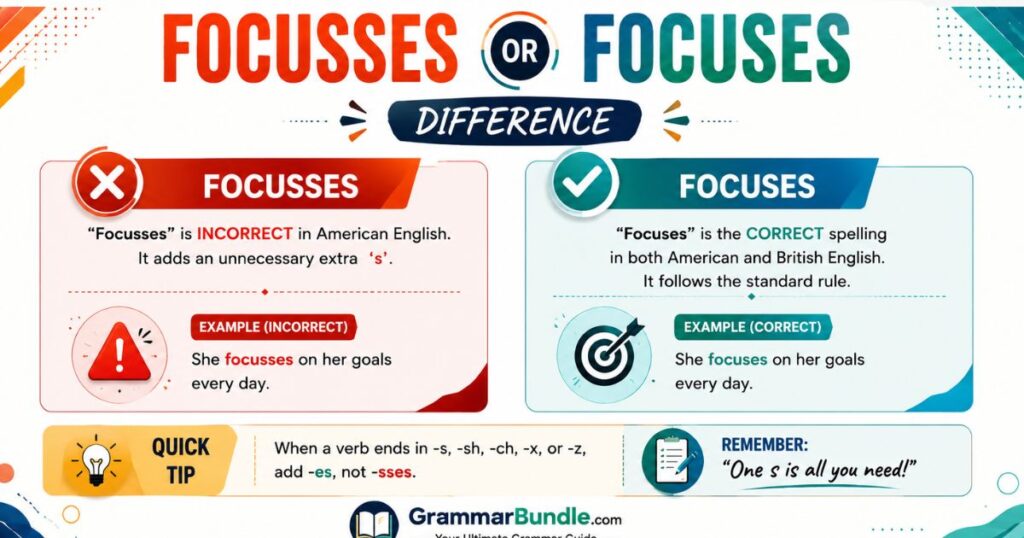
Focusses or Focuses Difference
| Feature | Focusses | Focuses |
|---|---|---|
| Usage | Rarely used today | Common in modern English |
| Connotation | A nostalgic or artistic vibe | Clear and straightforward |
| Context | Found in classic literature | Standard in articles & reports |
| Pronunciation | Can sound more elaborate | Simple and direct |
| Preference | Preferred in historical texts | Preferred in everyday language |
Correct Spelling of Focusing
- Focusing is the preferred spelling in American English and is also widely accepted in modern British English.
- Focussing is a traditional British English variant that is still considered correct by some dictionaries and publishers.
How to Spell Focusing Correctly
Check the Basics:
Focus + ing = Focusing
Sound it Out:
Breaking it into syllables — fo-cus-ing — can help reinforce the correct spelling.
Grammar of Focus Verb
- Base form: Focus,This is the base form we often use. For example, “I focus on my goals.”
- Third-person singular: focuses
- Present participle: Focusing ,This form captures the action happening right now. For example, “They are focusing on their health.”
- Past tense: Focused, Use this when talking about something you did before. For example, “She focused on her studies last year.”
- Past participle: focused
Definition and Usage of Focusing in different fields
Psychology
In psychology, focusing refers to the practice of tuning into one’s inner feelings and thoughts. This technique helps individuals process emotions and can lead to greater self-awareness and healing.
Education
Focusing in education is about honing in on specific subjects or skills during study sessions. This targeted approach can enhance understanding and retention, making learning more efficient and enjoyable.
Photography
In photography, focusing involves adjusting the lens to capture sharp, clear images. A well-focused photograph can convey emotions and stories more powerfully, turning a simple snapshot into art.
Business
In the business world, focusing means concentrating resources on core activities that drive success. This strategic focus enables companies to innovate and grow, ensuring they meet customer needs effectively.
Sports
Athletes often use focusing techniques to enhance performance and eliminate distractions. This mental clarity allows them to concentrate on their game, improving results and boosting confidence.
Technology
In technology, focusing refers to the act of distinguishing important data amidst vast amounts of information. This ability is crucial for effective decision-making, especially when navigating complex systems.
Personal Development
Focusing in personal development involves setting clear goals and concentrating efforts toward achieving them. This clarity helps individuals create actionable steps, motivating them to realize their dreams.
Cognitive and Language Insight
Focusing Cognitive Insights
When we talk about focusing cognitive insights, it’s all about sharpening our mental lens. Imagine your brain as a camera — adjusting the focus helps clarify what you truly want to see. By honing in on your thoughts, you can sift through the noise of daily distractions, uncovering deeper understanding and creativity. Techniques like mindfulness can be powerful tools here.
Focusing Language Insights
Language shapes our world, and focusing on language insights can open doors to richer communication. Think of every conversation as a canvas where words are your paint. By choosing to be mindful of the language you use — words, tone, and even body language — you create a more empathetic connection with others.
Why Focusing Is Preferred Today
Focusing is preferred because:
- Global usage dominates.
- Simplicity enhances understanding.
- Favorable in education.
- Consistent spelling patterns.
- Tech-savvy audiences prefer.
- Digital platforms influence.
- Engaging for diversity.
- Modern writing norms.
Quick Summary Table
| Feature | Focusing | Focussing |
|---|---|---|
| Region | American English | British English |
| Usage Context | More common in USA | Common in UK |
| Syllable Count | Three | Three |
| Recognition | Widely recognized | Recognized regionally |
| Educational Focus | Emphasized in US schools | Emphasized in UK schools |
| Cultural Relevance | Represents a fast-paced lifestyle | Reflects a diverse language heritage |
FAQs
- Is it ‘focussing’ or ‘focusing’?
Ans:The correct form is ‘focusing’ in American English, while ‘focussing’ is acceptable in British English. - Why do I see both spellings?
Ans:Both variations exist due to differences in English dialects. American English tends to simplify letter usage. - Does the meaning change between the two spellings?
Ans: No, both ‘focusing’ and ‘focussing’ convey the same meaning: the act of concentrating attention or effort. - Which spelling should I use in formal writing?
Ans:If you’re writing for an American audience, use ‘focusing’; for a British audience, ‘focussing’ is appropriate. - Are there any other words like this with different spellings?
Ans:Yes, examples include ‘organize’ (American) and ‘organise’ (British), among others. - Is one form considered more correct than the other?
Ans:Neither form is more correct than the other; it solely depends on regional spelling preferences. - Can I use either spelling in creative writing?
Ans:Yes, you can choose either spelling in creative writing as long as you maintain consistency throughout the text. - What should I do if my writing needs to be internationally acceptable?
Ans: It’s best to stick with ‘focusing’ to ensure clarity for a global audience, as it is the more widely recognized spelling.
Conclusion
Whether you choose to spell it “focussing” or “focusing,” the meaning remains the same. Each variation reflects the same idea of directing attention towards something important. It’s a small difference that doesn’t change the message you’re trying to convey.