
Have you ever paused to wonder whether it’s “grimey” or “grimy”? This common spelling mistake catches many off guard, leaving them unsure of which word to use. Understanding the difference is crucial, especially in a world where precise language is key to effective communication.
Grimey or Grimy Quick Answer Without Confusion
Understanding “Grimey” vs. “Grimy”
Grimy: This is the standard spelling and describes something that is dirty, covered in grime, or unpleasantly murky. Think of a neglected alley or an old, dusty attic.
Grimey: This is an informal variant often used within specific communities, particularly in urban slang or music scenes, to evoke a sense of rawness or grit. It can suggest not just physical dirt but also a cultural aesthetic.
Nuanced Uses
Using “grimy” might feel more appropriate in writing or formal contexts, while “grimey” brings a personal touch to casual dialogue. Both terms evoke strong imagery, but the vibe changes with the choice of word.
Selecting the right word can enrich storytelling and help you convey the depth of your subject matter. Being aware of these nuances can elevate your writing, making it resonate more deeply with your audience.
Wack or Whack The Real Difference and Correct Spelling
What Grimy Actually Means in Real Life
Understanding Grimy in Everyday Life
Literal Meaning: At its core, “grimy” refers to something that is dirty or covered in grime.
This could be a messy kitchen, a dusty car, or even unkempt spaces in our homes.
We often overlook how quickly our surroundings can become grimy with just daily use.
Emotional Layering: Beyond physical dirtiness, “grimy” can describe feelings or thoughts.
For instance, a grimy atmosphere can stem from negativity or unresolved conflict.
Places that feel grimy often dampen our spirits, affecting our mood and interactions.
Modern Applications
Technology and Grime: In the digital world, “grimy” can also apply to our online environments.
Social media feeds cluttered with negativity or conflict create a grimy virtual space, impacting our mental well-being.
Cleansing the Grime: Understanding what grimy truly means encourages us to seek cleanliness — not just physically, but emotionally and digitally as well.
Whether it’s tidying up a room or curating our online experiences, a little effort can lead to a fresher mindset and a more inviting space.
https://www.youtube.com/watch?v=OptqjohNozI
Sapphire or Saphire Avoid This Common Spelling Mistake
Grimy definition in simple words
Basic Definition:
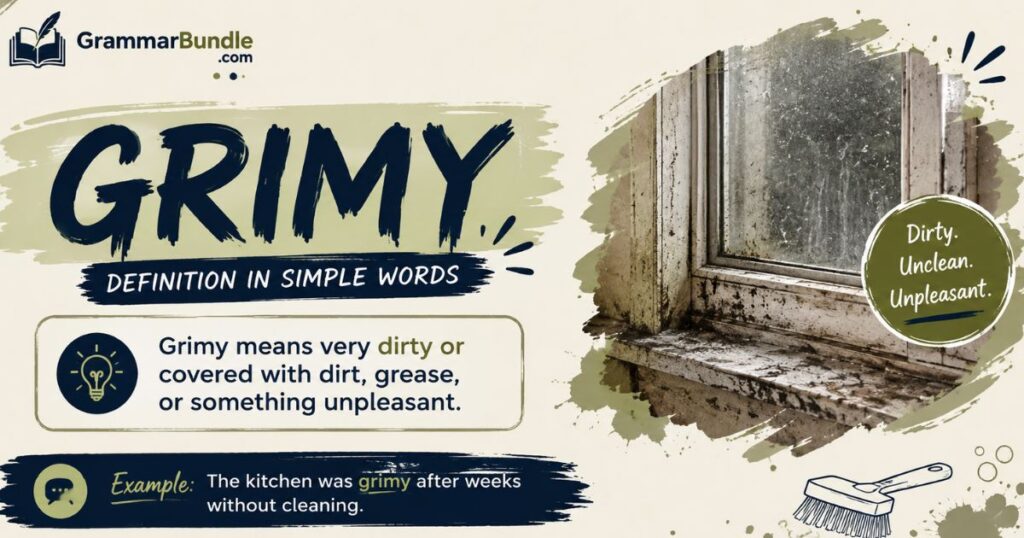
“Grimy” means very dirty or covered in dirt.
Appearance:
When something is grimy, it looks unkempt and neglected, often with stains or smudges.
Common Examples:
- Think of a child playing in the mud or a kitchen that hasn’t been cleaned in ages.
- Picture a pair of old sneakers, worn out and covered in mud. They look grimy after being worn for days without cleaning.
- Consider a computer screen that hasn’t been wiped down in weeks. Smudges and fingerprints make it grimy and hard to see through.
- Even a person’s mood can feel grimy, like when someone constantly complains and brings negativity into a conversation.
Related articles you may find helpful Comming vs Coming: Easy Grammar and Spelling Guide
Why Grimey Feels Right but Still Isn’t Correct
The Charm of “Grimey”
- “Grimey” has a certain ring to it. It sounds casual and fits into everyday conversation.
- Many people use it to describe something dirty or unkempt. This gives it a relatable vibe, capturing how we often speak.
The Reality of Usage
- Despite its charm, “grimey” is not in standard dictionaries. Its correct form is “grimy,” which has an official status in English.
- The misspelling doesn’t change what it means to most people. It shows how language evolves, reflecting our personal styles.
Finding a Balance
- Language is about connection. Using a term like “grimey” might feel right in a group of friends, but using “grimy” is safer in formal settings.
- Embracing both versions can be fun, reflecting how we adapt words in different contexts.
People Connect It to the Word “Grime”
The word “grimey” feels right because it sounds similar to “grime.” This makes it easy for people to link the two words together.
Sound Plays a Big Role
The way “grimey” sounds also adds to its appeal. The “y” ending gives it a casual vibe, making it feel more relatable. Words like “grimey” roll off the tongue and stick in your mind, creating a sense of familiarity.
Habit from Informal Writing
In informal settings, like texting or social media, people often bend language rules for fun. Words like “grimey” pop up easily in casual communication, becoming part of everyday speech. This habit makes it easy to forget the correct spelling.
While informal writing allows for creativity, it can lead to confusion in more serious contexts. Understanding the difference helps improve language skills while keeping our unique voices intact.
Related articles you may find helpful Loot vs Lute: Meaning, Spelling Pronunciation
Word Origin Where Grimy Comes From
The Roots of “Grimy”
- The word “grimy” has an interesting history. It comes from the Old English word “grim,” which means dirty or foul.
- Over time, “grim” evolved into “grimy” in the 19th century.
- This change was influenced by similar words in other languages like “grime,” which also means dirt or soot.
The Feel of Grimy
- When we say something is grimy, we picture not just dirt, but a deeper layer of neglect or age.
- It suggests that something has not just collected dust but has stories hidden in its layers.
- Imagine a forgotten attic or an old book covered in dust. These things are not just dirty; they carry a charm, hinting at their past lives and the moments they’ve witnessed.

Is Grimey a Real Word or Just a Mistake
The Meaning of “Grimey”
- “Grimey” is often used in casual conversations to describe something dirty or unclean.
- It reflects a feeling or atmosphere, often linked to urban life or music genres like hip-hop.
- Many people think it sounds more relatable than the formal word “grimy.”
Is It Really a Word?
- Some dictionaries list “grimey” as a variant of “grimy,” pointing to its acceptance in everyday language.
- Language evolves, and new words often come from popular culture.
- Whether in music or social media, terms like “grimey” add flavor and personality to conversations.
Embracing Language Change
- Using “grimey” shows how language can be fun and expressive.
- It reflects the unique ways people connect and communicate.
- Embracing words like this keeps our language alive and vibrant.
Grimy vs Filthy vs Dirty Understanding the Difference
| Term | Description | Example |
|---|---|---|
| Grimy | Slightly dirty, often with grease or dirt | Oily kitchen countertops |
| Filthy | Very dirty, often needing serious cleaning | A neglected public restroom |
| Dirty | General term for unclean, can vary in severity | Muddy shoes or dust-covered shelf |
Easy Way to Feel the Difference
Grimy:
Think of that sticky residue left on your kitchen counter after a cooking session. It’s unpleasant but manageable. Grime builds up over time, often tied to activities like cooking or working out. You can clean it up with some elbow grease and a good sponge.
Filthy:
Now, picture a neglected attic or a dusty garage. Filth goes beyond just surface dirt. It feels overwhelming and can require intense cleaning, maybe even hiring a professional.
Dirty:
This word is simple and broad. Just a little dust on the shelf or muddy shoes after a walk counts as dirty. It’s a temporary state that can often be fixed with a quick wipe down or sweep.
Grimy Meaning in Real-Life Contexts
The word “grimy” describes something that is not simply dirty but covered with built-up dirt, grease, or grime. It often suggests that the dirt has remained for some time.
Grimy Hands
“Grimy hands” can describe hands covered with dirt or grease, especially after hard or messy work.
Example:
- His grimy hands showed that he had been working all day.
Grimy Walls
“Grimy walls” suggests walls covered with layers of dirt, soot, or grease.
Example:
- The old factory had grimy walls covered in soot.
Grimy Kitchen
A “grimy kitchen” is a kitchen with noticeable buildup of dirt or grease, often from repeated cooking or lack of cleaning.
Example:
- The kitchen looked grimy after days of heavy cooking.
Grimy Shoes
“Grimy shoes” can describe shoes covered with dirt after traveling or walking through rough or dirty places.
Example:
- After the long trip, our shoes were completely grimy.
Grimy vs Dirty
- Although “grimy” and “dirty” are similar, there is a small difference.
Dirty generally means not clean, while grimy suggests ingrained or built-up dirt that makes something look neglected or heavily soiled.
So, grimy gives a stronger sense of dirt and buildup than the general word dirty.

Why People Ask “Grimey or Grimy” So Often
The confusion between “grimey” and “grimy” is common in everyday writing and online searches.
People often wonder which spelling is correct, whether it is “grimey or grimy,” and why “grimey” is sometimes written instead of “grimy.”
The reason is simple:
English pronunciation does not always match spelling. We may hear a word one way but spell it differently according to English spelling rules. This can create a “phonetic spelling trap,” where people spell words based on how they sound rather than how they are correctly formed.
British and American English Spelling Differences
British and American English can have different spelling rules, but “grimy” is spelled the same in both varieties. The word does not change to “grimey” in either British or American English.
For example:
British English uses “colour” and “centre,” while American English uses “color” and “center.” These differences show how English spelling can vary between regions, but “grimy” remains the standard spelling in both.
Common Mistakes People Make with Grimy
The word “grimy” is often confused with other words or misspelled as “grimey.” Some writers also confuse “grimy” with “grim,” even though they have different meanings. Using the right word in the right context helps make your writing clear and accurate.
Grimy vs Grim
“Grimy” means covered with dirt or grime, while “grim” describes something serious, unpleasant, or gloomy. For example, a grimy room is dirty, while a grim situation may feel serious or unpleasant.
Grimy vs Dirty
“Grimy” usually suggests built-up dirt or neglect, while “dirty” simply means not clean. For example, “grimy hands” can suggest dirt collected after playing outside, while “dirty clothes” simply means the clothes need cleaning.
Example of Correct Usage
The child’s hands were grimy after playing outside all day.
This use of “grimy” clearly shows that the hands were covered with dirt.
Easy Memory Trick to Remember Grimy
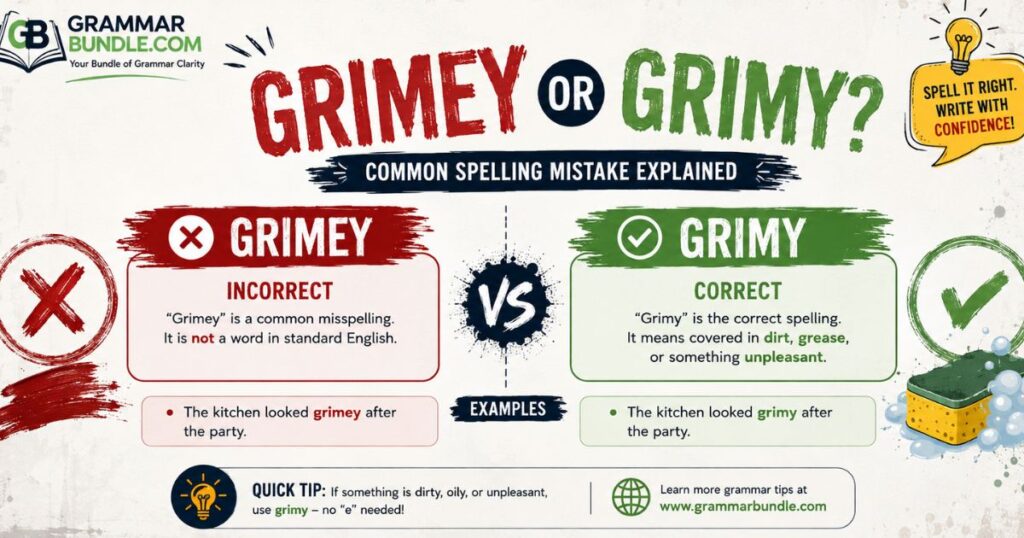
Remember that the correct spelling is “grimy,” not “grimey.”
The trick is to start with “grime.” When it becomes an adjective, the final “e” is dropped before adding “y.”
- Grime → Grimy
This simple pattern makes the spelling easier to remember.
Grimy vs Grimey
- Grimy — correct spelling
- Grimey — incorrect spelling
You can also remember the pattern with similar words:
- Dust → Dusty
- Dirt → Dirty
- Grime → Grimy
Why Grimy Feels Stronger Than Dirty
“Grimy” does more than describe something as dirty. It can also create a particular mood or atmosphere, especially when describing neglected or rough environments.
For example:
- A dirty street — a general description of something unclean.
- A grimy street — suggests deeper dirt, neglect, and a rough atmosphere.
Grimy in Descriptive Writing
The word “grimy” is often useful in storytelling and descriptive writing because it can suggest neglect, decay, and a raw environment.
It can describe places such as:
- Abandoned buildings
- Dust-covered city streets
- Neglected urban areas
While “dirty” is a general term for something unclean, “grimy” suggests a deeper or more built-up layer of dirt and can give the description more atmosphere.
Related articles you may find helpful Wack or Whack The Real Difference and Correct Spelling
FAQs
- What does “grimy” mean?
Ans: Grimy refers to something that is dirty, soiled, or covered with grime. - Is “grimy” a word?
Ans: Yes, “grimy” is a valid English word used to describe something that is very dirty. - How do you spell “grimy”?
Ans: It is spelled G-R-I-M-Y. - What is the difference between “grimy” and “grimey”?
Ans: “Grimy” is the correct spelling, while “grimey” is commonly considered a misspelling. - Why is “grimy” spelled without an “e”?
Ans: The word derives from the noun “grime,” and the omission of “e” in “grimy” follows standard English spelling rules for adjectives derived from nouns. - What is the difference between “grimy” and “dirty”?
Ans: While both can describe something unclean, “grimy” often implies a thick layer of dirt, whereas “dirty” can refer to any lack of cleanliness. - Can you provide a sentence using “grimy”?
Ans: Sure! “After a long day in the workshop, his hands were grimy from handling grease and dirt.” - What are common spelling mistakes for “grimy”?
Ans: Common mistakes include spelling it as “grimey” or “grimie,” both of which are incorrect.
Conclusion
“Grimy” describes something covered with built-up dirt or grime, often suggesting neglect over time. “Grimy” is the correct spelling, not “grimey.” While “dirty” simply means not clean, “grimy” gives a stronger and more specific picture of accumulated dirt. Using it correctly can make your writing clearer and more descriptive.