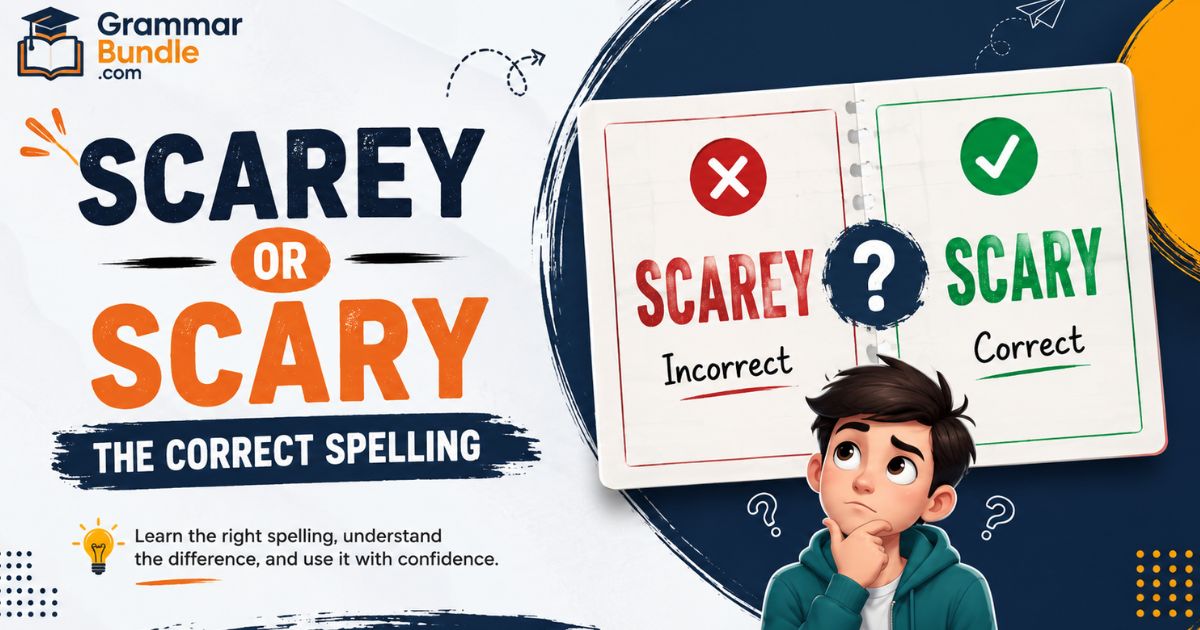
Many people often find themselves second-guessing their writing skills, especially when it comes to tricky words like “scary.” It’s surprising how a simple misspelling can change the tone of your message. You might be shocked to learn that many people find themselves confused about whether to spell it “scarey” or “scary.” This common mix-up can lead to misunderstandings, especially when trying to set a mood for a Halloween party or tell a spooky story.
Quick Answer Scarey or Scary Correct Spelling
Spelling:
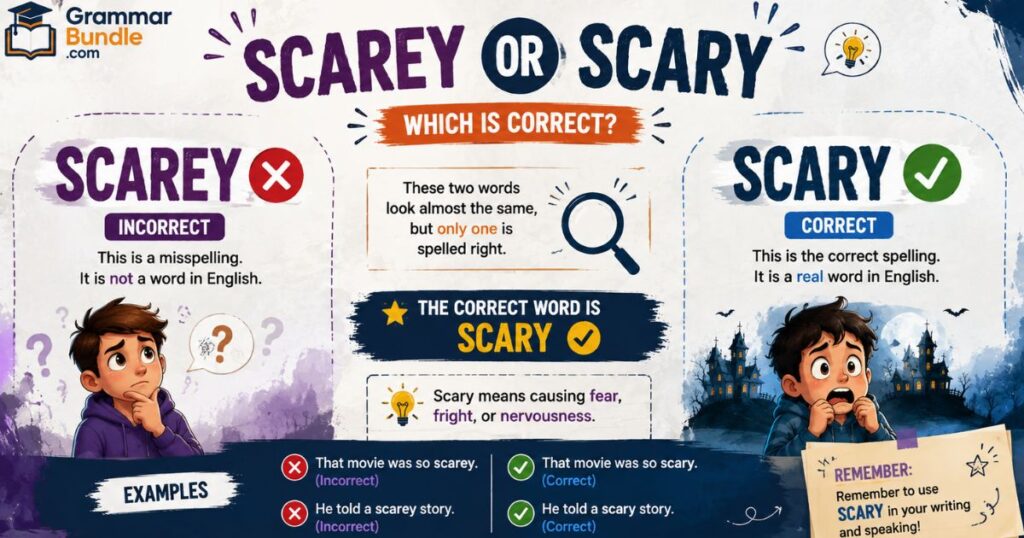
The correct spelling is “scary,” with just one ‘r.’
Roots:
The word is derived from “scare,” which conveys fear, combined with the suffix “-y,” indicating a quality. Thus, “scary” describes something that induces fear or apprehension.
“Scarey,” on the other hand, is often seen as a common misspelling.
While you might come across it in casual writing, sticking with “scary” keeps your language clear and sharp.
Understanding the spelling can enhance clarity in your writing.
Why “Scarey” Feels Right but Isn’t
The Allure of “Scarey”
- A Familiar Sound: The word “scarey” rolls off the tongue easily, almost playfully, creating an immediate connection with the emotions it describes. Its phonetic charm gives it an inviting, albeit incorrect, feel.
- Cultural Influence: Movies and stories often sensationalize fear, using “scarey” to capture attention. This informal use taps into our collective memory, making the term feel right even when it’s wrong.
The Correctness of “Scary”
- Linguistic Roots: “Scary” aligns with standard English rules, offering clarity and consistency. Using the correct form helps maintain the precision of language, ensuring the intended message shines through without distraction.
- Emotional Impact: Choosing “scary” over “scarey” can elevate your writing. It conveys a sense of professionalism and respect for the craft, making the reader feel more engaged and connected to your thoughts.
You may also like to explore our related articles about Wack or Whack The Real Difference and Correct Spelling
Meaning of Scary and Why It Matters
The Meaning of Scary
Definition:
Scary refers to something that instills fear, causing feelings of discomfort or anxiety. It can manifest in various forms — stories, images, or experiences.
Emotional Response:
When we encounter something scary, our body reacts — heart racing, palms sweating. This primal response connects us to our instincts, reminding us of our ability to confront danger.
Why Scary Matters
Coping Mechanism:
Engaging with scary content — like horror films or ghost stories — allows us to face fears in a controlled environment. It’s a safe way to explore the darker corners of our minds.
Cultural Reflection:
Scary themes in media often reflect societal anxieties, such as fear of the unknown or loss of control. For example, zombie apocalypses often symbolize fears about societal collapse.
Connection:
Experiencing scary moments together fosters bonding. Whether it’s huddling during a thriller film or telling ghost stories around a campfire, shared fear strengthens relationships.
Examples
1.The scary movie kept me awake all night.
→ The movie made me feel afraid.
2.It was scary to walk home alone in the dark.
→ The situation caused fear or nervousness.
3.We heard a scary sound outside the house.
→ The sound made us feel frightened.
4.The abandoned building looked scary at night.
→ Its appearance made people feel afraid.
You may also like to explore our related articles about Sapphire or Saphire Avoid This Common Spelling Mistake
The Simple Spelling Rule Behind Scary
The Power of the ‘C’
C and K Collaboration:
The word ‘scary’ follows a simple yet effective rule: the ‘C’ teams up with ‘R’ to create a soft ‘C’ sound. This gives it that smooth start that feels familiar and inviting, despite its frightening meaning.
The Easy Twist:
Notice how this applies to other words like ‘silly’ and ‘sunny’? They embrace the same soft sounds, demonstrating that consonant combinations can change the tone of language effortlessly.
Spelling with Ease
Consistency in Patterns:
Learning this pattern helps with spelling other similar words. When you see ‘SC’, think ‘soft’ — it opens the door to more connections between words, making them easier to remember.
A Common Mistake:
It’s easy to fall into spelling traps with words like ‘scary’. Many people might confuse it with harder combinations or miss the subtle sound shifts. Recognizing these simple rules can sharpen your writing and speaking skills, making communication smoother.
The Drop the E Rule
Understanding the Basics:
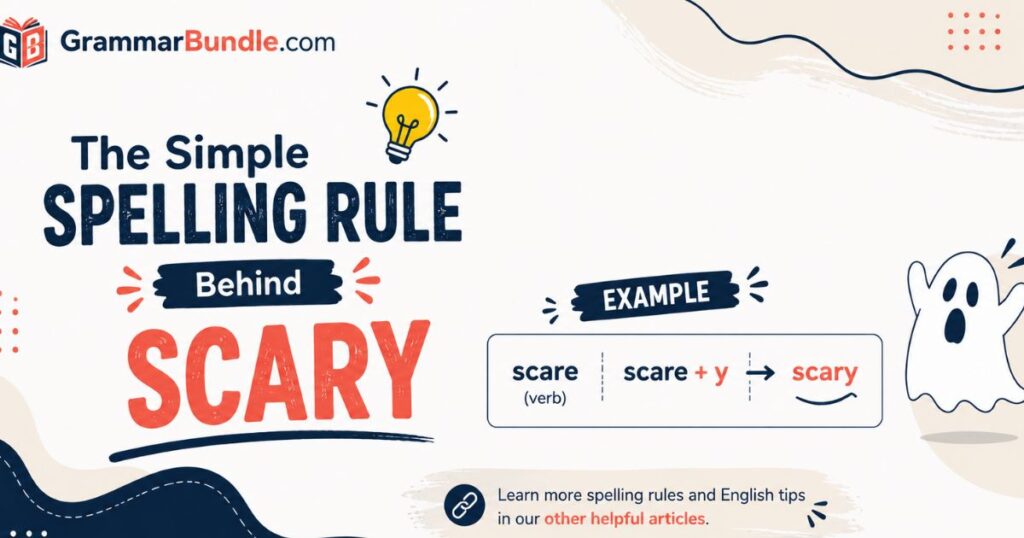
When you encounter the word “scary,” it’s easy to overlook the transformation that occurs with its spelling. The root word “scare” ends with an ‘e.’ To create the adjective, you simply drop that ‘e’ and add ‘y.’
Wider Applications:
This rule isn’t just limited to “scare.” Words like “make” turn into “maky” (though that one isn’t standard) and “live” becomes “lively.” It’s a small change that opens up a world of descriptors, making our language richer and more expressive.
You may also like to explore our related articles about Leary or Leery Differences and Real Usage
British vs American English Spelling
Standard Usage:
“Scary” is the accepted spelling in both British and American English. However, “scarey” often pops up as a common misspelling, particularly in informal contexts.
Modern Trends:
Online platforms often cause shifts in spelling conventions. As people communicate quickly, variations like “scarey” might gain traction but still remain unofficial.
The Power of Correctness:
Using the right spelling in appropriate contexts always matters. For both writers and readers, the correct spelling enhances clarity and trust.
For more helpful information, explore this related resource to learn more about the topic.https://grammarupdate.com/scarey-vs-scary
How to Spell Scary in Real Life Sentences
- “The old house at the end of the street looked scary.”
- “My little brother claims he saw a scary figure in his room.”
- “Walking through the dense woods felt scary.”
- “During the Halloween festival, the scary clowns made everyone jump, but their laughter soon turned the fear into fun.”
- “I watched a scary movie alone at night.”
- “The scary painting in the gallery seemed to follow me with its eyes.”
- “We heard a scary story about a ghost that roamed the old cemetery.”
The word never changes . It remains scary.
You may also like to explore our related articles about Unkept or Unkempt Learn the Correct Word in Seconds
Common Spelling Mistakes with “Scary”
- Scarey
Many people mistakenly add an “e,” believing it enhances the word. - Scarry
Some might think doubling the consonant gives the word extra weight, but it only leads to confusion. - Scery
Dropping the “a” changes the essence entirely. - Scarie
While it looks like it could belong in another language, this version feels off and doesn’t fit in English.
Scarey or Scary Comparison Table
| Feature | Scary | Scarey |
|---|---|---|
| Definition | Causing fear or dread | Informal variant of scary |
| Usage | Commonly used in writing | Often seen in casual speech |
| Tone | Formal to descriptive | Informal and playful |
| Examples | Scary movies, scary stories | “That ghost looks scarey!” |
| Correctness | Yes | Incorrect |
| Connotation | Strong emotional impact | Lighthearted approach |
You may also like to explore our related articles about Comming vs Coming: Easy Grammar and Spelling Guide
Why People Still Write “Scarey”
The Slip of the Pen
- Fast Fingers: In a rush, fingers can stumble over keys. Many people write “scarey” when they are typing quickly. The speed can lead to silly mistakes that stick around.
- Phonetic Spelling: Often, we spell words as they sound. “Scary” has that nice, soft “e” sound, making “scarey” feel natural to some. Our brains sometimes play tricks on us, favoring how words sound instead of how they’re spelled.
The Learning Curve
- Early Lessons: When we first learn to write, words don’t always make sense. “Scarey” might pop up as we remember classroom lessons or our favorite books. Old habits can sneak back in when we don’t pay attention.
- Cultural Influence: Movies, songs, and memes keep the misspelling alive. “Scarey” can become part of casual chat, making it feel familiar and fun. This playful twist on words often brings a smile, even if it’s wrong.
You may also like to explore our related articles about Loot vs Lute: Meaning, Spelling Pronunciation
Easy Way to Remember Scary Spelling
Visual Memory Tricks
- Create a Story: Build a short tale around the word. For example, “necessary” can become a story about a cat needing a “neck” and “a pair of socks.”
- Draw It Out: Sketch the word. Illustrating tricky parts can help you remember. For “receive,” draw an arrow indicating the “i” before the “e.”
Mnemonic Devices
- Acronyms & Rhymes: Turn difficult spellings into catchy phrases. For “definitely,” think “Definite-Ly Not ‘Definately.’”
- Chunking: Break words into smaller parts. Instead of tackling “embarrassment” as a whole, think of it as “em-barr-ass-ment.” This makes it less overwhelming.
Scary Used in Everyday English
Scary is commonly used in everyday English to describe something that makes a person feel afraid, nervous, or uncomfortable.
- That movie was really scary.
- The dark street looked scary at night.
- I heard a scary noise outside.
- It was scary when the lights suddenly went out.
- She told us a scary story.
- That thunderstorm sounded scary.
- The abandoned house looks scary.
Synonyms of Scary
- Frightening
- Terrifying
- Alarming
- Hair-raising
- Chilling
Antonyms of Scary
- Comforting
- Soothing
- Pleasant
- Calm
- Reassuring
Grammar Rules for Scary
Embrace the Active Voice
Choose Strong Verbs: Using active voice makes writing more engaging. Instead of saying “The monster was chased by the hero,” say “The hero chased the monster.” It creates excitement and clarity.
Keep it Direct: Short, punchy sentences are powerful. They convey urgency. Instead of “There was a dark shadow lurking,” say “A dark shadow lurked.” It sets a creepy tone right away.
Use Vivid Descriptions
Show, Don’t Tell: Instead of saying “It was scary,” describe the scene. “The wind howled, and the trees creaked,” paints a picture in the reader’s mind.
Select Specific Words: The right word can evoke strong feelings. Use words like “eerie” or “haunting.” These carry a heavier tone than “scary” and draw readers in deeper.
Keep an Eye on Punctuation
Use Dashes for Drama: Dashes can add suspense. They create a pause that keeps readers on edge: “The door creaked open – as if someone were waiting inside.”
Thoughtful Commas: Use commas to break up thoughts and build tension. A sentence like “She stepped into the room, her heart racing, eyes wide” creates an immediate emotional connection.
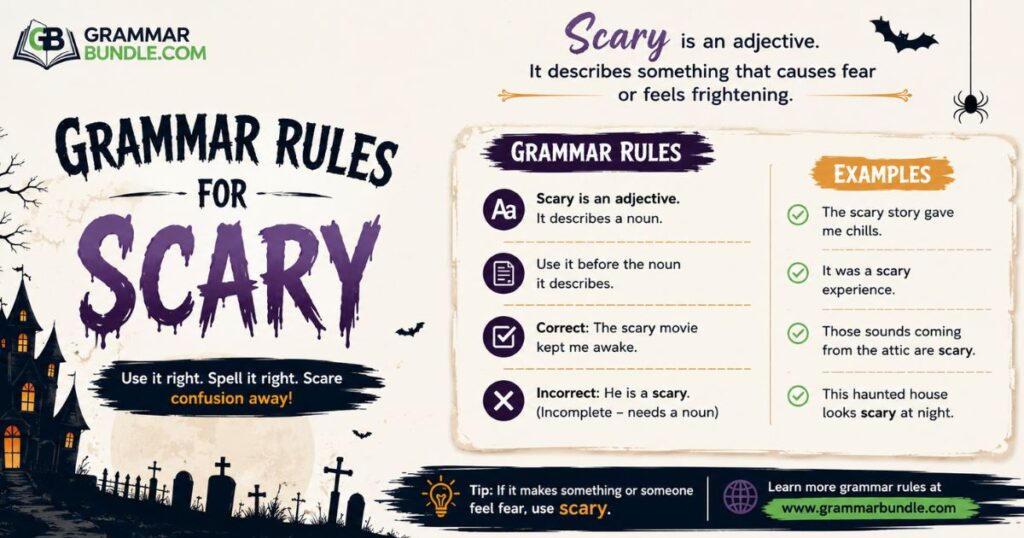
You may also like to explore our related articles aboutFocussing or Focusing : Which One is Correct?
Punctuation of Scary
Related Words of Scary
Noun: Fear
The feeling that makes our hearts race and keeps us on high alert. It’s the essence of what makes a moment terrifying.
Verb: Frighten
To cause someone to feel fear. Whether through a sudden noise or an unexpected shadow, this action sends chills down the spine.
Adjective: Dreadful
Something that evokes a sense of deep fear or apprehension, making us want to turn away.
Adverb: Terrifyingly
An adverb that adds emphasis to an action, often describing how frightening an experience can be. For example, “The haunted house was terrifyingly dark.”
Synonym: Alarming
This word captures a sense of urgent fear, often implying an immediate threat or worry that something bad might happen.
The word scary is an adjective. Here are its main grammatical forms and related words:
Scare (Verb): to make someone feel afraid.
The loud noise scared me.
Scared (Adjective): feeling afraid.
I was scared during the storm.
Scary (Adjective): causing fear.
That was a scary experience.
Scare (Noun): a sudden feeling of fear.
The strange sound gave me a scare.
Scarily (Adverb): in a frightening or alarming way.
The situation changed scarily fast.
Scariness (Noun): the quality of being scary.
The scariness of the movie made it difficult to watch.
You may also like to explore our related articles aboutBearable vs Bareable: Which Spelling is Correct?
Correct Way to Write Scary Sentences
When using scary in a sentence, remember that it is an adjective. It describes a person, thing, place, situation, or experience that causes fear.
- Correct: The movie was scary.
- Correct: That was a scary experience.
- Correct: We heard a scary noise outside.
- Correct: The old house looks scary at night.
- Correct: It was scary to walk through the dark street.
Common mistake
❌ The movie was scarey.
✅ The movie was scary.
Remember: The correct spelling is scary, not scarey.
Quick Summary of Scarey vs. Scary
Correct Spelling:
The right spelling is “scary.” This word describes something that causes fear or fright.
Common Mistake:
Many people mistakenly spell it as “scarey.” This confusion often comes from the way we pronounce it, but remember, it’s a case of sound versus spelling.
FAQs
1.What do you mean by “scary”?
Ans:Scary refers to things that make learners feel afraid or anxious, like tough topics or tricky tests.
2.Why do some learners feel scared?
Ans: Many learners feel scared because they worry about failing or not understanding the material.
3.How does fear affect learning?
Ans:Fear can block our ability to think clearly, making it harder to learn new things.
4.Can being scared actually help?
Ans:Sometimes, a little fear can motivate us to study harder and prepare better, but too much can be harmful.
5.What can I do if I feel scared about learning?
Ans:Talk to someone, take deep breaths, or break the material into smaller tasks to make it feel less overwhelming.
6.Are there safe ways to face scary topics?
Ans:Yes! Start with simple information and gradually move to more complex ideas. Group study can also help.
7.Can teachers help reduce fear?
Ans:Absolutely! Good teachers create supportive environments and encourage questions, which helps learners feel more secure.
8.Why is it important to address fear in learning?
Ans:Facing fear helps build confidence and skills, making learning a more enjoyable and successful experience.
Conclusion
While “scary” is the standard spelling used in contemporary English to describe something that induces fear, “scarey” appears as a common misspelling. Understanding the nuances of language helps us communicate more effectively and avoid confusion.