The words “wack” or “whack” may sound similar, but they have different meanings and uses. Understanding this distinction helps avoid common spelling and vocabulary mistakes. This guide explains both words clearly, with simple examples to help you use them correctly in everyday and formal writing.
Wack or Whack: The Quick Truth You Actually Need
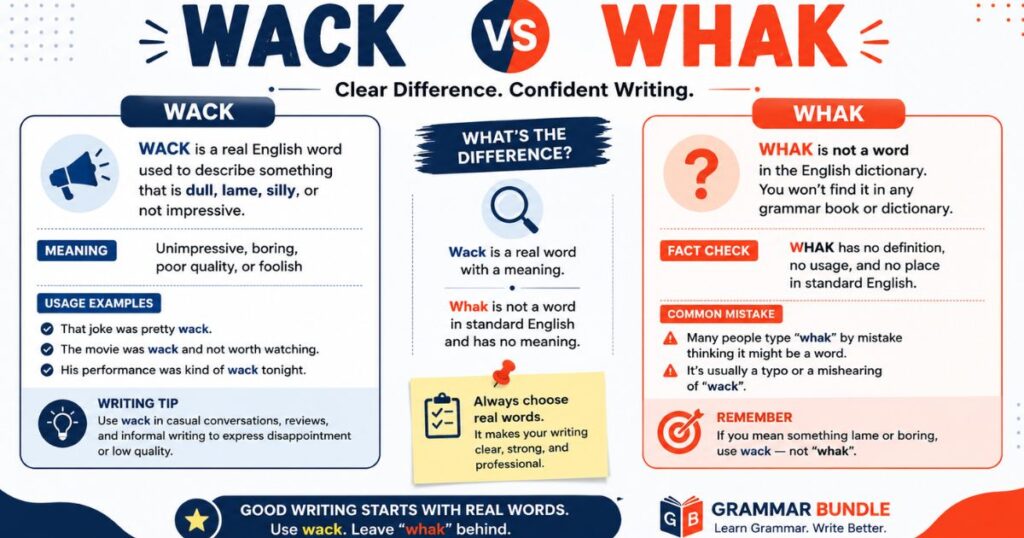
Understanding the difference between “wack” and “whack” can improve both your conversation and writing. Although they sound similar, they have different meanings and uses.
Whack Meaning
“Whack” is a standard English word that means a forceful strike or hit.
Example:
- He gave the ball a whack.
It is commonly used when talking about a strong hit, especially in sports.
Wack Meaning
“Wack” is a slang term used to describe something bad, disappointing, or low in quality.
Example:
- This pizza is wack!
- That film was wack!
- Choosing the Right Word
The correct choice depends on the context:
- Use whack when talking about a strong hit or strike.
- Use wack when describing something disappointing or of poor quality.
Understanding this distinction helps avoid spelling confusion and makes your communication clearer.
Related aticle you may find helpful: Sapphire or Saphire Avoid This Common Spelling Mistake
Wack or Whack Meaning:
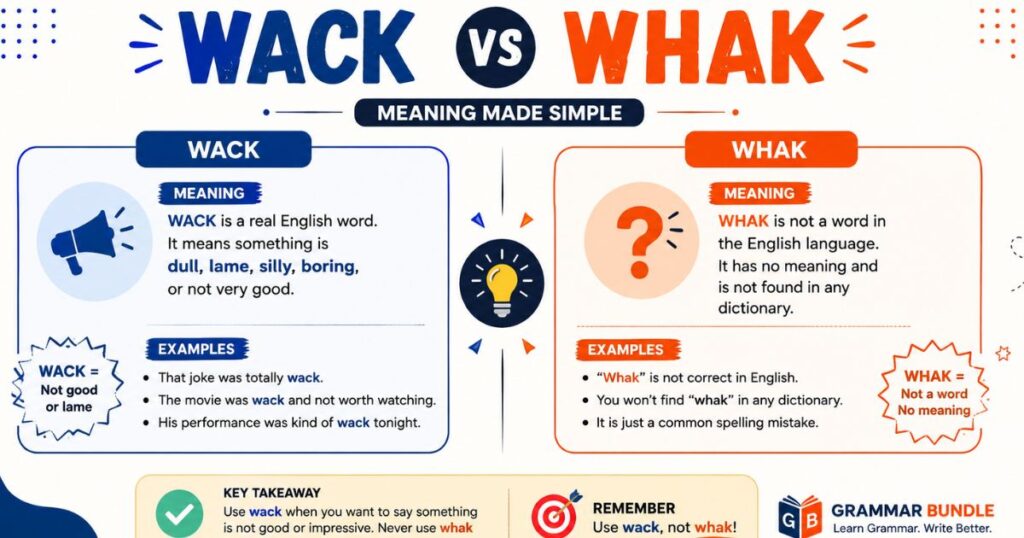
What Does Whack Mean in English?
“Whack” is a versatile English word that is mainly used as a verb meaning to hit or strike something with force. It can describe a sharp impact, such as a baseball bat hitting a ball or a playful tap.
In formal writing, “whack” may feel informal, so it is more commonly used in everyday conversation or creative writing.
Whack as a Verb
As a verb, “whack” means to hit something forcefully.
Examples:
- The bat whacked the ball.
- He gave his friend a playful whack.
- She whacked the table with her hand.
Whack as a Noun
As a noun, “whack” means a strong hit or forceful blow.
Examples:
- He gave the ball a good whack.
- I heard the whack of the baseball bat.
The related word “whacked” can also describe someone who feels tired or overwhelmed, showing how the word can be used in different contexts.
Related aticle you may find helpful: Leary or Leery Differences and Real Usage
Common Phrase: Out of Whack
The phrase “out of whack” means that something is not working properly, out of balance, or feels wrong. It is commonly used in both American and British English.
For example:
- My sleep schedule is out of whack.
- The system is out of whack after the update.
The phrase can describe different situations, including personal routines, relationships, technology, and social systems. It is useful when something feels unusual, unbalanced, or is not functioning as expected.
Overall, “out of whack” is a common expression for something that is off balance or not working as it should.
Related aticle you may find helpful: Unkept or Unkempt Learn the Correct Word in Seconds
What Does Wack Mean in Slang?
In modern slang, “wack” is used to describe something that is disappointing, poor quality, or uninspiring. The term became popular in the late 20th century and is strongly associated with music culture, especially hip-hop.
For example:
- Calling an album “wack” can express disappointment with its quality or performance.
Wack in Music Culture
The word “wack” is often used in music culture to criticize something that feels weak, boring, or below standard.
Example:
- The new album is wack.
Wack on Social Media
On social media, “wack” is commonly used in casual conversations to describe movies, excuses, or other disappointing situations.
Examples:
- That movie was wack.
- His excuse sounds wack.
Wack in Gaming
The term is also used in gaming communities when players dislike a game update because of bugs or unexciting content.
Example:
- This game update is wack.
Overall, “wack” is an informal slang expression used to show that something is bad, disappointing, or low quality.
Related aticle you may find helpful: Holistic or Wholistic the Complete Guide
The Real Difference Between Wack or Whack
The words “wack” and “whack” have different meanings and uses, even though they look and sound similar.
Whack: Action or Physical Force
“Whack” is used for a physical action, such as a hit or strike. It suggests a clear physical force.
Example:
- He delivered a strong whack to the ball.
Wack: Judgment or Opinion
“Wack” is slang used to describe something that is bad, boring, or low quality. It expresses a personal opinion rather than a physical action.
Example:
- The movie was wack because it failed to engage the audience.
Formal vs Informal Usage
In standard English, “whack” is used to describe physical impact, while “wack” remains an informal slang expression.
The key difference is simple:
- Whack = physical action or force
- Wack = opinion or judgment
Understanding the context helps you choose the right word and avoid confusion.
For more Information visit: https://capitalizemytitle.com/wack-or-whack/
Is Wack a Real Word?
“Wack” is a slang word used to express disapproval, disappointment, or poor quality.
It is mainly found in informal conversations, texting, and social media.
The term became popular through modern slang and hip-hop culture, but its informal nature makes it unsuitable for most formal writing.
Wack in Informal Communication
“Wack” is commonly used in casual conversations and digital communication, especially on social media.
Example:
- That movie was wack.
In these informal settings, the word can add a casual and expressive tone.
Wack in Formal Writing
In professional or academic writing, “wack” is generally considered inappropriate. Formal writing should use clearer and more standard vocabulary instead.
The key point is that “wack” can be acceptable in casual communication but should generally be avoided in formal contexts.
Related aticle you may find helpful: Different or Diffrent the Complete guide
Is Whack Correct English?
Yes. “Whack” is a standard English word and is widely recognized in formal and informal contexts.
It can be found in:
- Dictionaries
- Literature
- Journalism
- Academic writing
Unlike “wack,” the word “whack” is an established English term and can be used when the meaning fits the context.
Why People Get Confused Between Wack or Whack
The confusion between “wack” and “whack” is understandable because they have similar spellings and nearly identical pronunciations.
Both words are also commonly seen in modern conversations and online communication.
Similar Spelling and Pronunciation
The main difference is just one letter, which can make the two words easy to mix up.
When spoken quickly, they can sound almost the same, making it harder to remember which spelling to use.
Online and Social Media Usage
Both terms appear frequently online, especially in social media comments and casual conversations.
For example:
- That movie was wack. — meaning it was bad or disappointing.
- He whacked the ball. — referring to a strong hit.
Context Creates Confusion
The context in which these words appear can also add to the confusion. Fast typing and quick online conversations may cause people to use the wrong spelling.
Understanding their meanings and paying attention to context can help you choose between “wack” and “whack” correctly.
Related aticle you may find helpful: Focussing or Focusing : Which One is Correct?
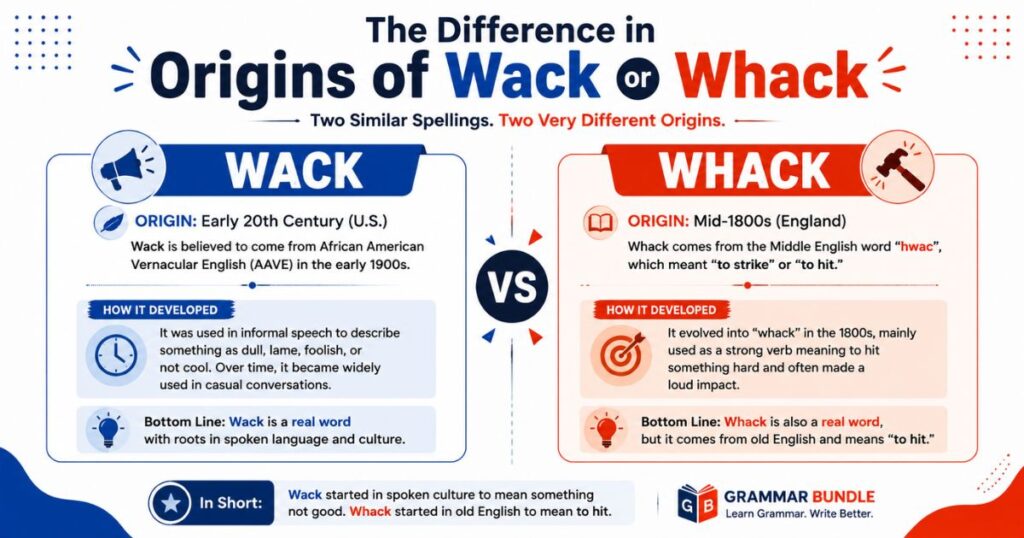
Where Each Word Came From
The words “wack” and “whack” have different histories, even though they look and sound similar.
Whack
“Whack” has older roots and is connected with the idea of a sharp hit or striking sound. The word developed through its association with sudden physical action.
Over time, “whack” became part of English and gained different uses.
It also appears in the common expression “out of whack,” which means something is not working properly or is out of balance.
Wack
“Wack” developed later as a slang term, particularly through urban culture and hip-hop in the 1980s. It became a way to describe something that was unimpressive, poor, or lacking quality.
The term is still used in modern slang to express disappointment or disapproval.
The Difference in Origins of Wack or Whack
Although “wack” or “whack” look similar, they developed through different language paths. “Whack” is an established English word, while “wack” developed as informal slang.
Related aticle you may find helpful: Bearable vs Bareable: Which Spelling is Correct?
When Should You Use Wack or Whack?
Knowing when to use “wack” and “whack” depends on their meanings and context.
When to Use Whack
Use “whack” when talking about a physical action or hit.
Example:
- He took a whack at the piñata.
- The bat made a loud whack when it hit the ball.
When to Use Wack
Use “wack” in informal situations, such as social media, casual conversations, or when expressing an opinion about something bad or disappointing.
Examples:
- That film was so wack!
- This app update is wack.
A Simple Memory Trick
Remember:
“Whack has H, and H is for hit.”
This helps connect “whack” with physical actions. “Wack” has no H and can be remembered as a slang word for something unfavorable or low quality.
This simple trick can make it easier to choose the right word in everyday writing and conversation.
Why “Wack” Feels So Popular Today
The word “wack” remains popular, especially in online communities, because it is a short and expressive way to show disappointment or disapproval. In today’s fast-paced digital communication, people often prefer quick expressions, and “wack” fits naturally into social media posts, memes, and casual conversations.
Wack in Modern Online Culture
“Wack” is widely used in social media and online communication because it can express an opinion in just one word. Its simple and punchy style makes it useful for quick reactions.
Wack Across Generations
The word also connects older and younger audiences. Older users may recognize its connection with hip-hop culture, while younger users continue to use it in modern online conversations.
This shows how slang can evolve and remain relevant as language changes. “Wack” continues to fit the fast and expressive style of digital communication.
Related aticle you may find helpful: Ingage vs Engage Stop Confusing These Two Words Today
FAQs
1. What’s the difference between wack or whack?
Ans: Wack is typically used to describe something that’s subpar or disappointing, while whack can mean to strike or impact something; it’s also used in slang to mean something is bizarre or unacceptable.
2. Is “wack” a real word?
Ans:Yes, “wack” is considered informal slang, primarily in American English, often denoting something that’s bad or of poor quality.
3. Is “whack” correct English?
Ans:Yes, “whack” is correct English and can refer to hitting something or be used in slang to describe something strange or crazy.
4. What is the meaning of “wack”?
Ans: Wack describes something that is disappointing, inferior, or generally not good; it’s often used in casual conversation.
5. What does “whack” mean as slang?
Ans: As slang, “whack” can mean something is weird, odd, or unacceptable, often conveying strong disapproval.
6. When should I use “wack”?
Ans: Use “wack” in informal settings when describing something that you find bad or unsatisfactory, typically in casual conversations.
7. When should I use “whack”?
Ans: Use “whack” when referring to a physical action of hitting or to express that something is strange or off in informal contexts.
8. What does “out of whack” mean?
Ans: “Out of whack” means something is not functioning properly or is in a disordered state, often used to describe mechanical issues or disruptions in routine.
Conclusion
Understanding the distinction between “wack” and “whack” is essential for anyone looking to communicate effectively in contemporary slang. While both terms may carry similar connotations of something being unacceptable , their correct usage can vary based on context and audience.