
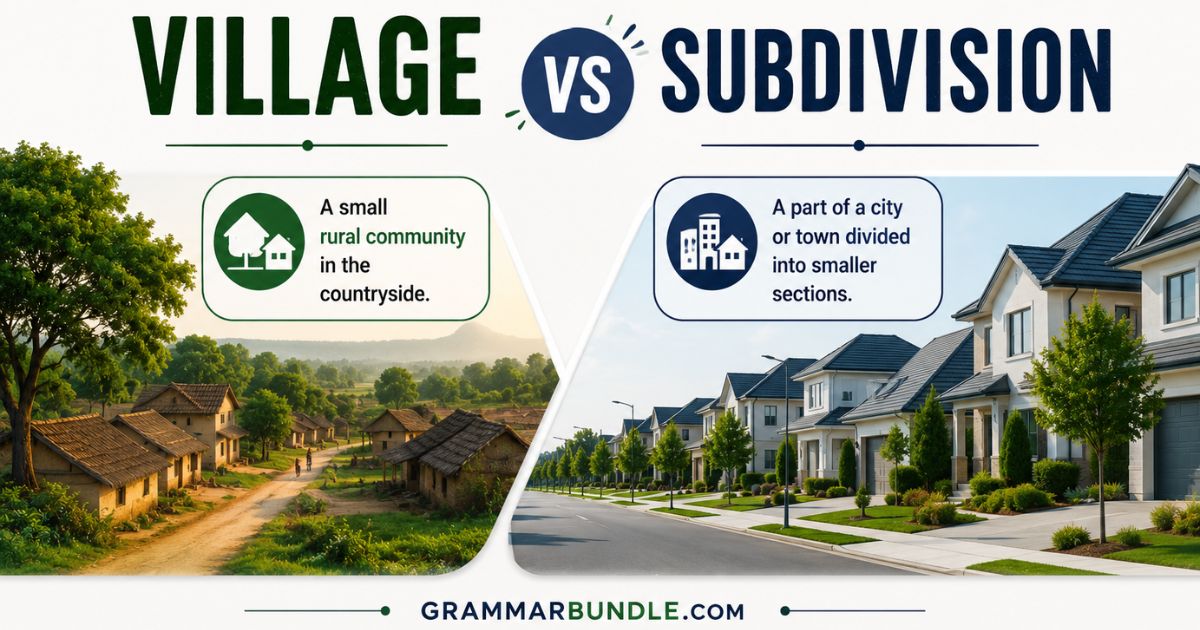
The terms “village” and “subdivision” can seem similar, but they describe different types of communities. A village is usually a smaller, established community, while a subdivision is a planned residential area created by dividing land into lots. Understanding the difference can help you use these terms correctly, especially when talking about communities, addresses, and local areas.
Village vs Subdivision: What Sets Them Apart?
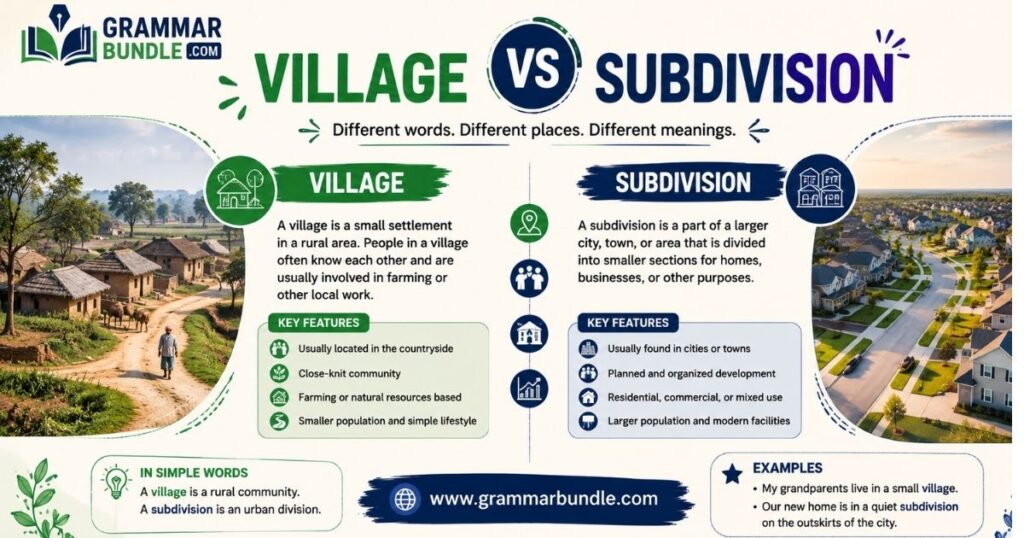
A village and a subdivision can both be residential communities, but they usually develop in very different ways. A village often grows naturally over time and reflects local traditions, while a subdivision is planned and developed as a residential area.
Village: Natural Growth and Community
Villages usually develop over generations and often have strong connections to local history and traditions. Their streets and shared spaces may encourage residents to interact and build a sense of community.
Common features:
- Organic development
- Traditional lifestyle
- Shared community spaces
- Close connection to local culture and history
- Often a slower pace of life
Subdivision: Planned Development
A subdivision is typically created by developers who divide land into residential lots and plan the layout in advance. Homes may have similar designs, while amenities such as parks or pools may be included.
Common features:
- Planned layout
- New residential homes
- Organized streets and lots
- Modern amenities
- HOA rules in many communities
Population and Lifestyle
Village populations often change gradually as the community grows with its local culture and history. Subdivisions may have more movement as residents move in or out for changing housing needs.
In simple terms, a village grows over time, while a subdivision is planned and built as a development.
Want to clear up another common spelling confusion? Check out our guide on Passtime or Pastime:Which Spelling Is Correct?
What Is a Village? A Simple Explanation
A village is a small, close-knit human settlement where community life plays an important role. Unlike busy urban areas, villages often have strong relationships between neighbors, shared traditions, and a close connection to nature.
https://youtu.be/Nkdn7dQJhNQ?si=UsuyND1V-HY8vgHf
Village Community Life
Villages are often built around community relationships. Neighbors may support each other, while traditions, festivals, and daily activities help create a strong cultural identity.
Natural and Simple Lifestyle
Village life is often connected to nature and local resources. People may take part in shared activities, local markets, community gardens, and other activities that bring residents together.
Village Layout and Infrastructure
Villages may have simple infrastructure, with winding streets and homes that fit naturally into the surrounding area. These features can add to the community’s sense of belonging and heritage.
Why Village Life Still Matters
Even as modern life becomes faster, villages continue to show the value of community, tradition, and connection with nature. Their simple lifestyle and strong relationships remain an important part of many communities
A Real-Life Picture
Imagine a peaceful village morning where children play in the streets and neighbors greet each other with friendly waves. Gardens are filled with fresh flowers, while the smell of homemade bread comes from a nearby bakery.
A Close-Knit Community
In village life, local shopkeepers often know their customers personally. The butcher may remember a customer’s preference, while the baker knows who likes extra chocolate in their pastries. These small interactions show the strong community ties found in village life.
Local Markets and Social Life
Local markets are more than places to buy fresh food. They are often lively spaces where people meet, share stories, and enjoy products such as fresh vegetables and homemade goods. This everyday interaction creates a strong sense of community.
Want to clear up another common spelling confusion? Check out our guide onHolistic or Wholistic the Complete Guide
Why Villages Still Matter Today
In today’s fast-paced world, villages remind us of the value of relationships, nature, and simple living.
Stronger Community Connections
Village communities often encourage people to care about one another. This creates a sense of belonging that can sometimes feel missing in busy city life.
Connection With Nature
Local markets can support farmers and provide fresh produce, while the slower pace of village life gives people more opportunities to enjoy nature and simple moments.
A Simpler Way of Life
From watching a sunset to sharing a meal, village life encourages people to appreciate everyday experiences. These qualities make villages meaningful even in a rapidly changing world.
What Is a Subdivision? A Simple Explanation
A subdivision is the process of dividing a larger piece of land into smaller lots or parcels. This is commonly done when creating new residential or commercial developments, making the land easier to organize, sell, or develop.
Subdivision Meaning
A subdivision transforms a large area into smaller, manageable sections. These individual lots can then be sold or developed for different purposes, such as building homes or businesses.
Key Characteristics of a Subdivision
Subdivisions often follow specific zoning regulations that determine how the land can be used. These rules may cover building height, housing density, and the types of structures allowed.
They may also include infrastructure and shared facilities such as:
- Roads
- Utilities
- Parks
- Community centers
Subdivisions can also bring homeowners or businesses together, creating a sense of community among neighbors.
A Real-Life Picture
Imagine a well-planned community where children play in a park, neighbors greet each other, and families enjoy their weekends in organized spaces.
Each home is part of a larger plan created through the subdivision of land. This shows how subdivision can create physical spaces while also supporting relationships and improving residents’ quality of life.
Want to clear up another common spelling confusion? Check out our guide onUnkept or Unkempt? Helpful Guide to the Correct Word
Village vs Subdivision Differences That Actually Matter
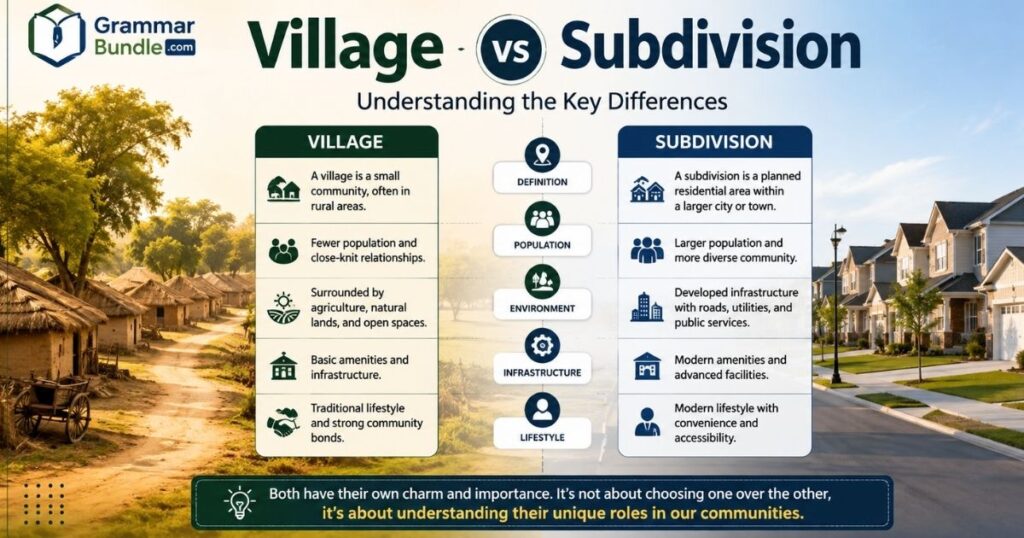
The differences between villages and subdivisions become clearer when you look at how they develop, feel, function, and use their space.
How Villages and Subdivisions Develop
Villages often grow organically over time, with families building homes according to agricultural or community needs. Subdivisions, however, are usually planned from the beginning. Developers design the streets, parks, and housing styles before construction starts.
This planned approach can provide predictable amenities, such as schools and shopping areas, while creating a sense of community from the start.
How They Feel
Villages often have a warm and friendly atmosphere, shaped by their history, architecture, and local traditions. People may know their neighbors well, creating a close-knit environment.
Subdivisions are often more modern and spacious, but they can sometimes feel less personal, especially when homes have similar designs and the focus is mainly on convenience.
How They Are Managed
Village management is often community-driven, with local councils and active participation from residents. Decisions about services and development may reflect the shared values of the community.
Subdivisions are frequently managed by homeowners’ associations (HOAs). These organizations may enforce rules about property maintenance, appearance, and community standards, creating a more regulated lifestyle.
How Space Is Used
Villages often use space in multiple ways, combining homes, farms, and public areas. These spaces can support community gatherings and local events.
In subdivisions, space is usually clearly organized, with designated areas for parks, playgrounds, parking, and homes. This creates a structured environment, while village layouts may encourage more informal interaction between residents.
Want to clear up another common spelling confusion? Check out our guide on: Sapphire or Saphire Avoid This Common Spelling Mistake
Understanding Villages vs. Subdivisions
A Closer Look: Comparison Table
| Feature | Village | Subdivision |
| Growth Style | Organic development | Planned development |
| Culture | Strong local traditions | Diverse backgrounds |
| Economy | Small, local businesses | Larger retail chains |
| Layout | Mixed-use and walkable | Uniform lot sizes |
| Amenities | Parks, community centers | Shared amenities, such as pools |
| Community Feel | Close-knit | More detached |
| Rules | Flexible and communal | Strict and governed |
This comparison shows that villages often develop naturally around local traditions and community life, while subdivisions are usually planned with organized layouts, shared amenities, and specific rules.
Why the Confusion?
People often use “village” and “subdivision” interchangeably because they can share some similar features. Villages usually have a strong sense of community and local traditions, while subdivisions often have organized layouts and shared amenities.
These similarities can sometimes make the difference between the two less obvious.
The Real Reasons Behind the Mix-Up
One major reason for the confusion is how developers market housing projects. A planned housing development may be called a “village” to create a feeling of charm, comfort, and community, even when its structure clearly fits a subdivision.
A Simple Example
Imagine a newly built neighborhood with planned streets, shared parks, and community events. It might be marketed as “Sunnyvale Village” to give it a cozy, community-focused image.
However, if the area was planned and developed with organized lots and specific rules, it may technically be a subdivision, despite having “village” in its name.
For additional examples and explanations, see this trusted external source:https://grammarcharm.com/village-vs-subdivision/
How To Use “Village” and “Subdivision” Correctly
“Village” and “subdivision” are terms that often confuse people, but they carry distinct meanings in urban
“Village” is a small, self-contained community, often with its own local government and unique culture. It’s a place where people often know one another and share a strong sense of belonging.
Examples of villages:
- She grew up in a small village.
- The village has a local school and a few shops.
- We visited a peaceful village during our trip.
- Many families in the village work in agriculture.
A “subdivision” is a section of land developed into housing units, usually within a larger urban or suburban area.
While subdivisions can be part of a village, they often lack the communal feel that characterizes traditional villages.
Examples of subdivisions:
- They bought a house in a new subdivision.
- The developer created several residential lots in the subdivision.
- A new road was built to connect the subdivision with the main highway.
- The subdivision contains dozens of homes.
Choosing the Right Term in Context
When deciding whether to use “village” or “subdivision,” consider the social dynamics and geographic layout. Villages often have historical significance, while subdivisions focus on modern living.
Use “village” when discussing:
- Community events or local traditions.
- Historical aspects or cultural identity.
Use “subdivision” when referring to:
- Real estate developments or zoning laws.
- Features like amenities and design of homes.
Cultural Implications
Using these terms correctly can reflect local pride and identity. Villages usually celebrate their heritage, while subdivisions may emphasize convenience and modernity.
Villages often feature:
- Local farmers’ markets.
- Annual festivals celebrating traditions.
Subdivisions might highlight:
- Nearby shopping centers.
- Recreational facilities like parks and pools.
Common Mistakes People Make When Using “Village” and “Subdivision”
People often confuse “village” and “subdivision” because both words can be used when talking about places where people live. However, they describe different things, so using one in place of the other can make a sentence unclear.
1. Treating “Village” and “Subdivision” as Synonyms
One of the most common mistakes is assuming that the two words have the same meaning.
Incorrect idea:
“The subdivision is a small village.”
Better:
“The subdivision is a planned residential development.”
2. Using “Subdivision” for Every Small Community
A small community isn’t automatically a subdivision. The word subdivision is commonly associated with land division and property development.
Example:
“She lives in a small village.”
Here, village is appropriate because the sentence focuses on the community.
3. Assuming Every Village Is a Subdivision
A village doesn’t necessarily consist of land that was formally divided into residential lots. Villages can develop naturally over time and may have their own history, local identity, and community structure.
4. Ignoring the Local Meaning
The exact meaning and official use of these terms can vary by country, state, province, or local government. In some places, village may be an official administrative designation, while subdivision may have a specific legal or planning meaning.
That’s why it’s important to consider the local context when using these terms in official or property-related writing.
5. Using the Words Without Considering Context
The best word depends on what you are trying to describe.
If you’re talking about a community, use village.
If you’re talking about divided land, lots, or a planned residential development, use subdivision.
Quick Reminder
Village → Small community or settlement
Subdivision → Divided area of land or planned development
Village vs Subdivision Lifestyle Differences
The Village Lifestyle
Living in a village offers a unique charm that many find appealing. Here are some standout features:
- Sense of Community: Villagers often know each other, creating strong social bonds.
- Nature at Your Doorstep: Beautiful landscapes and outdoor activities are often just a walk away.
- Slower Pace: Life tends to move slower, allowing for more relaxation and reflection.
For example, community events like harvest festivals or local markets foster a sense of belonging that many cherish.
The Subdivision Lifestyle
In contrast, subdivisions provide a different atmosphere, particularly for those who enjoy modern conveniences:
- Amenities Galore: Many subdivisions boast pools, gyms, and parks, making recreation easily accessible.
- Structured Environment: Uniform aesthetics and rules offer a sense of order.
- Diverse Neighbors: People from different backgrounds often come together, enriching the social fabric.
With a quick drive to nearby shopping centers or restaurants, subdivisions cater to those who love a buzzing social scene and the conveniences of urban life.
Want to clear up another common spelling confusion? Check out our guide on:Contractor vs Contracter: Avoid This Common Mistake
Pros and Cons You Should Actually Care About Village Living
Pros of Village Living
- Strong Community Ties: In village life, neighbors often know each other well, creating a tight-knit community.
- Slower Pace of Life: Life moves at a slower rhythm, allowing residents to savor everyday moments. Imagine enjoying a leisurely walk through scenic landscapes rather than navigating a bustling city.
- Lower Living Costs: Generally, living in a village can be more affordable. For example, housing prices often drop compared to urban areas, making it easier for families to own homes.
Cons of Village Living
- Limited Job Opportunities: Jobs may be scarce, meaning residents might have to commute to a nearby city. This can be inconvenient and time-consuming.
- Fewer Amenities: While villages have charm, they might lack services like diverse dining or entertainment options. For instance, finding a good restaurant or cinema could require a drive.
- Rural Isolation: Being far from friends or varied attractions might be a challenge.
Pros and Cons You Should Actually Care About Subdivision Living
Pros of Subdivision Living
- Community Vibes: Living in a subdivision often means joining a tight-knit community. Neighbors are usually friendly, making it easy to build lasting relationships.
- Safety First: Many subdivisions feature gated entrances or security patrols, adding an extra layer of safety for families and individuals.
- Amenities Galore: From playgrounds to pools, subdivisions often have shared spaces that enhance your lifestyle. Easy access to these amenities can save money on memberships.
Cons of Subdivision Living
- HOA Fees: Homeowners Associations (HOAs) can charge monthly fees for maintenance. These costs can add up, especially if you’re on a tight budget.
- Limited Freedom: Many subdivisions have strict rules about property modifications, making it difficult to personalize your space.
- Traffic Woes: With the rise of families moving in, traffic can often increase.
Subdivisions offer a mix of benefits and drawbacks. It’s important to weigh these factors to see if this lifestyle aligns with your preferences.
Want to clear up another common spelling confusion? Check out our guide on:Cheer vs Chear When to Use Each One?
Real-Life Case Study: Two Families, Two Choices Between Village and Subdivision Living
Choosing between village and subdivision living often depends on a family’s lifestyle, priorities, budget, and daily needs. The following two fictional examples show how different families might make different choices.
Case Study 1: The Ahmed Family Chooses Village Living
The Ahmed family consists of four members: two parents and two children. They prefer a quieter lifestyle and enjoy having more open space around their home.
Why They Chose a Village
- Peaceful surroundings: They wanted to live away from heavy traffic and busy streets.
- More open space: The family enjoys gardens, farmland, and outdoor areas.
- Community connections: They value knowing their neighbors and participating in local community activities.
- Lower-density environment: They prefer having fewer houses and less congestion around them.
- Simple lifestyle: The parents enjoy a slower pace of life.
Example
The family moves into a home in a small village. Their children have space to play outdoors, and the parents enjoy spending time in the garden. Although some larger shops and services are farther away, the family feels that the peaceful environment suits them.
Their Main Priority
A quieter community with more open space and a slower lifestyle.
Case Study 2: The Khan Family Chooses Subdivision Living
The Khan family also has four members, but their needs are different. Both parents have busy work schedules, and they prefer a planned neighborhood with convenient access to everyday facilities.
Why They Chose a Subdivision
- Planned neighborhood: They prefer organized streets and residential lots.
- Convenience: Shops, schools, parks, and other facilities may be located nearby.
- Modern housing: They want a recently built home with modern features.
- Community facilities: They like having access to shared parks or recreational areas.
- Easy access: They want convenient routes to workplaces and major roads.
Example
The family purchases a house in a newly developed subdivision. Their children can use a nearby park, while the parents appreciate having shops and other services within a short distance.
Their Main Priority
Convenience, planned development, and easy access to everyday facilities.
Comparing the Two Families
Although both families want a comfortable place to live, their priorities are different.
| Factor | Ahmed Family | Khan Family |
|---|---|---|
| Preferred lifestyle | Quiet and slower | Convenient and organized |
| Location | Village | Subdivision |
| Main attraction | Open space | Planned development |
| Community | Small local community | Residential neighborhood |
| Housing preference | More traditional setting | Modern housing |
| Main priority | Peace and space | Convenience and accessibility |
What These Cases Teach Us
These examples show that there isn’t one perfect choice for everyone. Village living may appeal to families who value a quieter environment, open space, and a close-knit community.
On the other hand, subdivision living may suit families who prefer planned neighborhoods, modern housing, and convenient access to services.
Final Example
Imagine two families who have the same number of family members and a similar budget. One may choose a village because it values peace and open space, while the other may choose a subdivision because it values convenience and organized development.
The best choice depends on what matters most to the people who will live there.
Want to clear up another common spelling confusion? Check out our guide on:Tweek vs Tweak: Essential Guide to Correct Usage
Which Is Better Village or Subdivision?
When choosing between a village and a subdivision, several factors come into play that can deeply affect lifestyle and community engagement. Villages often boast a rich tapestry of history and tradition, drawing residents who crave a slower pace of life and closer ties with neighbors. The charm of a village includes:
- Sense of Community: Stronger bonds with locals, fostering neighborly relationships.
- Unique Character: Distinct architecture and local shops that reflect the area’s heritage.
- Nature Access: Proximity to parks, forests, and scenic landscapes enhancing outdoor activities.
On the other hand, subdivisions typically offer modern conveniences and a structured environment ideal for families. These areas often feature:
- Amenities: Parks, swimming pools, and clubhouses designed for social engagement.
- Planned Layouts: More predictable safety and traffic patterns, making it easier for families with children.
- Diverse Housing Options: Greater variety in home styles and sizes to meet different needs.
Ultimately, the choice hinges on what lifestyle resonates best with you and your family, whether it’s the rustic charm of a village or the modern comforts of a subdivision.
Choose village living if you prefer:
- Peace and quiet
- Nature and open space
- A close-knit community
- A slower, traditional lifestyle
Choose subdivision living if you prefer:
- Convenience
- Planned neighborhoods
- Modern facilities
- Easier access to schools, shops, and services
Key Takeaways You’ll Actually Remember
When discussing “village” versus “subdivision,” consider these key aspects:
- Villages often feature historical significance.
- Subdivisions typically symbolize modern development.
- Community ties are stronger in villages.
- Subdivisions focus on convenience and amenities.
- Villages may lack mass transportation options.
- Subdivisions usually offer private spaces.
FAQs
- What is the main difference between a village and a subdivision?
Ans: A village is a small community that often has its own local government, while a subdivision is a collection of homes built together, usually within a larger area. - Can a subdivision be part of a village?
Ans: Yes, a subdivision can exist within a village. It’s often a newer development within the village limits. - Are villages more historic than subdivisions?
Ans:Usually, yes. Villages often have a longer history, while subdivisions are typically more modern and built in recent years. - Do villages have their own rules and regulations?
Ans:Yes, villages usually have local laws and regulations that govern the community, while subdivisions might have rules set by developers or homeowner associations. - Is it better to live in a village or a subdivision?
Ans:It depends on your preferences. Villages can offer a close-knit community feel, while subdivisions may provide more amenities like parks and pools. - Can you find more services in a village than in a subdivision?
Ans:Villages often have local shops, schools, and parks, while subdivisions may rely on nearby towns for services. - Are subdivisions always part of larger towns or cities?
Ans:Not always, but many subdivisions are located near or within larger municipal areas, while some can be more isolated. - How can I know if I’m in a village or a subdivision?
Ans:You can look for signs indicating the name of the area, check local government websites, or simply ask neighbors for information.
Conclusion
Both villages and subdivisions have their unique charms and drawbacks. Villages often offer a sense of community and a slower pace of life, while subdivisions provide modern conveniences and quicker access to city amenities. Choosing between the two depends on what you value most in your living environment.