
Implicit and complicit are often confused because they sound similar, but they have different meanings. Understanding the difference helps you communicate clearly and use each word correctly.
Quick Comparison Table of Implicit vs Complicit
| Feature | Implicit | Complicit |
| Meaning | Understood without being stated. | Involved in wrongdoing. |
| Tone | Neutral | Negative |
| Used For | agreements. | illegal actions. |
| Example | Trust is implicit in close relationships. | He was complicit in the fraud. |
| Memory Trick | Implicit = implied | Complicit=accomplice |
This simple comparison helps you easily understand the difference between implicit and complicit.
What Does Implicit Mean?
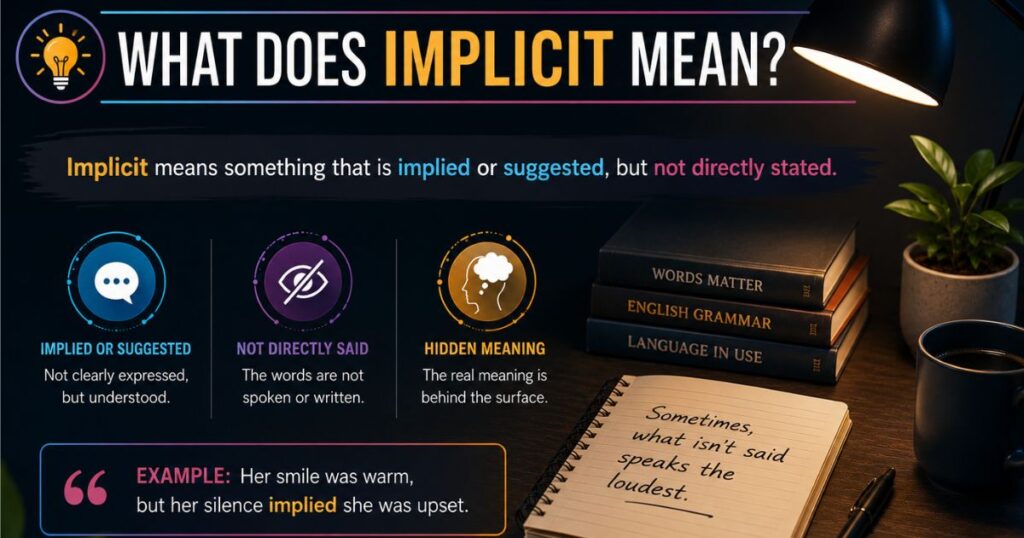
Implicit means something is understood without being stated directly. The meaning comes from the context rather than clear words.
In simple words, implicit means something is understood without being said directly.
Implicit Definition
The definition of implicit is:
Implicit definition refers to meanings that are suggested rather than directly stated.
People use implicit language every day without realizing it. It helps express ideas that are understood without being stated directly.
For example:
“It’s getting chilly,” your friend says while looking around.
The sentence does not directly ask for anything. However, you understand that your friend may want to go inside or get a jacket.
That is an implicit statement.
| Situation | Hidden Meaning |
| Crossed arms | Feeling defensive or uncomfortable |
| Fake smile | discomfort |
| Checking the time | Wanting to leave |
| Saying “I guess” | Uncertainty |
These examples show how implicit meaning works in everyday communication.
You may search for https://grammarbundle.com/loot-vs-lute/
Common Uses of Implicit
The word implicit is commonly used in phrases such as:
- Implicit trust
- Implicit agreement
- Implicit message
- Implicit bias
- Implicit assumption
- Implicit threat
- Implicit knowledge
These phrases describe something that is understood without being stated directly.
For example:
The child showed implicit trust in his parents.
The child never said, “I trust you,” but his actions clearly showed it.
That is an example of implicit meaning.
What Does Complicit Mean?
Complicit means being involved in or helping with something wrong. It has a negative meaning and is used when someone supports or allows a bad action.
Complicit Definition
Complicit means being involved in or helping with something wrong, dishonest, or illegal.
It also describes someone who supports wrongdoing, even if they do not take direct action.
Complicit Meaning in Law
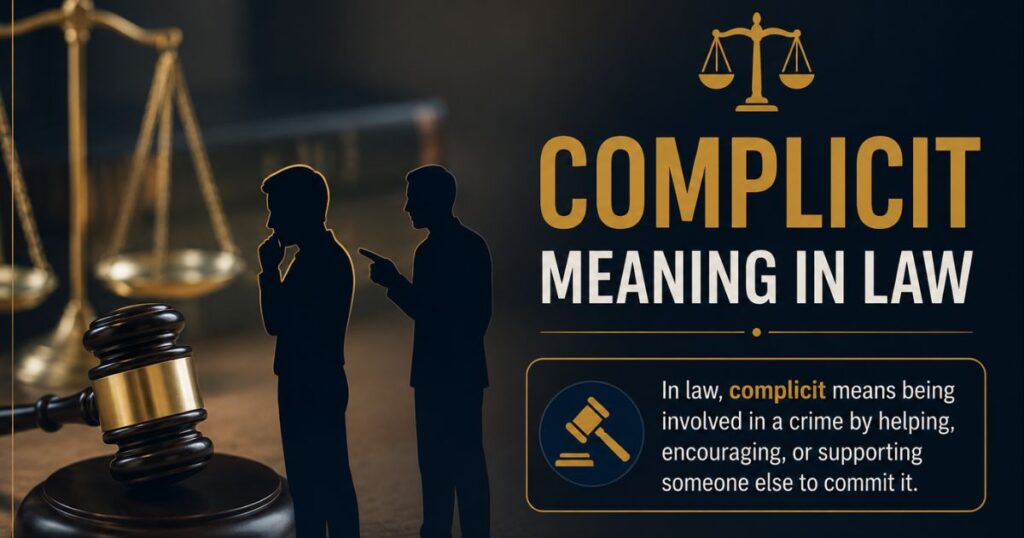
In law, complicit means knowingly helping or supporting a crime, even if you are not the main offender. A complicit person can still be held legally responsible.
Examples include:
- Helping plan a crime
- Driving someone to commit a crime
- Sharing information to help a crime
- Selling illegal items
- Encouraging criminal activity
Being complicit can lead to legal consequences, even without directly committing the crime.
Real-Life Examples of Complicit Actions
| Scenario | Why It Is Complicit |
| A teacher ignores bullying | It allows the behavior to continue. |
| Friends laugh at harmful jokes | They encourage the behavior. |
| A witness stays silent about a crime | They protect the wrongdoer. |
| A parent ignores harmful online behavior | It allows the problem to continue. |
| A shopper supports an unethical business | They indirectly support unfair practices. |
These examples show that staying silent or helping others can also make someone complicit in wrongdoing.
Implicit vs Complicit Explained Simply
Here is a simple comparison of implicit and complicit.
| Word | Main Idea |
| Implicit | Hidden meaning |
| Complicit | Involved in wrongdoing |
Implicit is about meaning that is understood without being said directly.
Complicit is about helping or allowing something wrong.
That is the main difference between implicit and complicit.
Difference Between Implicit and Complicit With Examples
These examples make the difference between implicit and complicit easier to understand.
Example One
Incorrect:
He was implicit in the fraud.
Correct:
He was complicit in the fraud.
Fraud involves wrongdoing, so complicit is the correct word.
Example Two
Incorrect:
Her complicit approval surprised everyone.
Correct:
Her implicit approval surprised everyone.
The approval was understood without being stated directly.
Example Three
Correct:
The agreement was implicit.
It was understood without being explained.
Example Four
Correct:
They were complicit in the crime.
They knowingly helped or supported the wrongdoing.
People also search for https://grammarbundle.com/uninclined-vs-disinclined/
Why Do People Confuse Implicit and Complicit?
People often confuse implicit and complicit for several reasons.
Similar Pronunciation
Both words sound very similar.
- Implicit
- Complicit
Similar Structure
Both words:
- End with “licit”
- Are adjectives
- Often appear in formal writing
- Sound similar
These similarities make the two words easy to confuse.
Rare Everyday Usage
These words are mostly used in formal writing, so many people are not familiar with them.
That is why implicit and complicit are among the most commonly confused English words.
How To Use Implicit and Complicit Correctly
Understanding the context helps you use implicit and complicit correctly.
Use Implicit for Communication or Meaning
Use implicit when discussing:
- Underlying emotions in a conversation
- Unspoken cultural norms
- Hidden meanings in literature
- Assumptions in social situations
- Body language
Examples:
His smile had an implicit warmth.
The story carried an implicit message about friendship.
She gave an implicit nod of agreement.
Use Complicit for Wrongdoing or Responsibility
Use complicit when discussing:
- Aiding a crime
- Environmental damage
- Ignoring unethical behavior
- Sharing in deceit
- Tolerating injustice
Examples:
She was complicit in the theft by not reporting it.
The company was complicit in pollution.
They remained complicit by ignoring the unfair treatment.
Implicit in a Sentence
These examples show how implicit is used in different situations.
Everyday Examples:
- Her smile carried an implicit promise of friendship.
- His silence had an implicit message.
- They had an implicit understanding without saying a word.
Workplace Examples:
- The report included implicit suggestions for improvement.
- Her tone carried an implicit warning.
Academic Examples:
- The study revealed implicit bias.
- The author’s argument contained implicit assumptions.
Complicit in a Sentence
These examples show how complicit is used in different situations.
Everyday Examples:
- She felt complicit after staying silent about the theft.
- Ignoring dishonesty can make someone complicit.
Legal Examples:
- The company was found complicit in environmental violations.
- Employees became complicit by allowing unethical practices to continue.
Ethical Examples:
- The manager was complicit by ignoring workplace bullying.
- Teachers became complicit by overlooking cheating.
Implicit vs Complicit Grammar Rules
Both implicit and complicit are commonly used as adjectives, but they have different meanings.
| Word | Part of Speech | Common Pairings |
| Implicit | Adjective | implicit agreement, implicit trust |
| Complicit | Adjective | complicit behavior, complicit in a crime |
Common Grammar Mistakes With Implicit and Complicit
Mistake One
Incorrect:
The teacher gave complicit approval to the group project.
Correct:
The teacher gave implicit approval to the group project.
Mistake Two
Incorrect:
His implicit involvement in the crime was evident.
Correct:
His complicit involvement in the crime was evident.
Implicit vs Explicit vs Complicit
These three words have different meanings, but they are sometimes confused.
| Word | Meaning |
| Explicit | Clearly stated |
| Implicit | stated directly |
| Complicit | Involved in wrongdoing |
Explicit vs Implicit
Explicit communication states the message clearly and directly.
Example:
“I need help with this task.”
Implicit communication suggests the message without saying it directly.
Example:
“This task is harder than I expected.”
Explicit leaves no room for confusion, while implicit depends on context and interpretation.
People may search https://grammarbundle.com/instalments-or-installments/
Where Complicit Fits In
Complicit is different from implicit and explicit because it is not about communication. It refers to involvement in wrongdoing or unethical behavior.
Understanding the difference between explicit, implicit, and complicit makes it easier to choose the correct word in different situations.
Implicit Communication and Hidden Meaning
Implicit communication depends on meaning that is understood without being stated directly.
It often relies on:
- Body language
- Tone of voice
- Conversation context
- Shared experiences
- Cultural norms
- Unspoken rules
Example
“It’s getting late,” a friend says while looking at their watch.
The words mention the time, but the hidden meaning is that they want to leave.
That is implicit communication.
Implicit Bias and Unconscious Implication
Implicit bias is a common term used in psychology.
What Is Implicit Bias?
Implicit bias refers to unconscious attitudes or assumptions that influence our thoughts, actions, and decisions without our awareness.
Implicit bias may involve assumptions about:
- Age
- Gender
- Race or ethnicity
- Occupation
- Social background
These unconscious attitudes can influence everyday decisions and interactions.
Being Complicit and Moral Responsibility
Being complicit is not limited to crime. It can also involve silence, support, or passive involvement.
Moral Complicity
Moral complicity happens when someone knowingly allows harmful behavior to continue.
Examples include:
- Ignoring workplace bullying
- Supporting brands that exploit workers
- Remaining silent about harmful policies
- Ignoring environmental damage
- Failing to challenge discrimination
These actions create ethical responsibility and encourage greater awareness.
Is Silence Considered Complicit?
This question is widely discussed in law, ethics, and society.
When Silence Can Be Complicit
Silence can sometimes make a person complicit.
Silence may be complicit when someone:
- Witnesses harassment but says nothing
- Ignores someone’s cry for help
- Sees unethical behavior at work but remains silent
- Fails to speak up against harmful stereotypes
Example
A coworker witnesses bullying but chooses not to report it.
Their silence may allow the behavior to continue and be seen as support for wrongdoing.
When Silence Is Not Complicit
Silence does not always mean someone is complicit.
People may stay silent because of:
- Fear of backlash
- Uncertainty about the situation
- Personal trauma
- Cultural or social pressure
- Needing time to process their thoughts
The context and circumstances help determine whether silence is complicit.
Easy Way To Understand Implicit and Complicit
A simple memory trick can make these words easier to remember.
Implicit = implied
Both words begin with “im.”
It refers to ideas or feelings that are understood without being directly expressed.
Complicit= accomplice
It means being involved in someone else’s wrongdoing.
Linking each word to its meaning makes the difference easier to remember.

Implicit Synonym and Antonym
These words help explain the meaning of implicit.
Synonyms
- Implied
- Understood
- Suggested
- Tacit
- Inferred
Antonyms
- Explicit
- Clear
- Obvious
- Direct
Complicit Synonym and Antonym
These words help explain the meaning of complicit.
Synonyms
- Involved
- Collaborating
- Participating
- Conniving
- Accomplice
Antonyms
- Innocent
- Uninvolved
- Detached
- Unrelated
Implicit vs Complicit Pronunciation
Pronunciation also contributes to confusion.
| Word | Pronunciation |
| Implicit | im-PLIS-it |
| Complicit | kom-PLIS-it |
Implicit vs Complicit for Students
Students often confuse these words because they are used in different subjects.
In English Class
Implicit refers to something suggested but not directly stated.
- It shapes themes and character motivations.
- Often found in literature and poems.
- Requires reading between the lines.
In Law or Ethics
Complicit means being involved in wrongdoing, even if not directly acting.
- Implicates being part of a conspiracy.
- Assumes responsibility for the outcome.
- Highlights moral and legal consequences.
Understanding the context makes the difference easier to remember.
you can verify the topic at https://wordspry.com/
FAQs
What does “implicit” mean?
Ans:“Implicit” means something that is suggested or understood without being clearly stated. It is often used to describe ideas or meanings that are inferred from context.
What does “complicit” mean?
Ans:“Complicit” refers to being involved in or having a role in something unethical or illegal, often by not taking action to stop it. It implies cooperation or consent in wrongdoing.
How are “implicit” and “complicit” different?
Ans:“Implicit” relates to understanding without direct expression, while “complicit” involves involvement in wrongdoing. The former is about communication; the latter is about moral responsibility.
How do you pronounce “implicit”?
Ans:“Implicit” is pronounced as im-PLIS-it. The emphasis is on the second syllable, and you can hear the “im” sound clearly.
How do you pronounce “complicit”?
Ans:“Complicit” is pronounced as kom-PLIS-it. Similar to “implicit,” the emphasis is on the second syllable, highlighting the “plis” sound.
Can you give an example of “implicit” in a sentence?
Ans:Sure! “Her smile was an implicit sign of approval.” Here, the approval is understood rather than explicitly stated.
Conclusion
Implicit refers to something understood without being stated directly, while complicit means being involved in wrongdoing. Knowing the difference helps you choose the right word and communicate more clearly. With regular practice, using implicit and complicit correctly becomes much easier.