
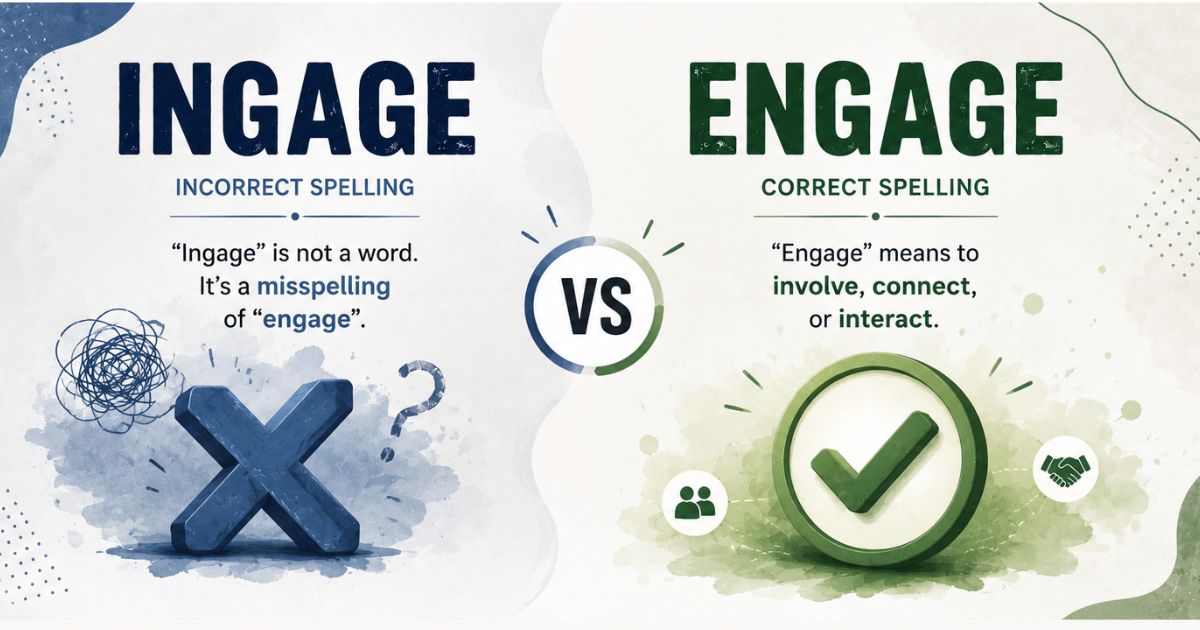
Many people confuse “Ingage” vs “Engage” because they look similar. However, “engage” is the correct spelling, while “ingage” is a common misspelling. Learn the difference, their meanings, and the correct usage to avoid common spelling mistakes.
What Is the Difference Between Ingage and Engage?
Although they look similar, only one is correct in modern English.
| Word | Correct Spelling | Meaning | Modern Usage |
| Engage | Yes | To involve, connect, interact, or attract attention | Standard English |
| Ingage | No | Common misspelling of engage | Incorrect in modern writing |
The correct word is “engage,” which always begins with “en.”
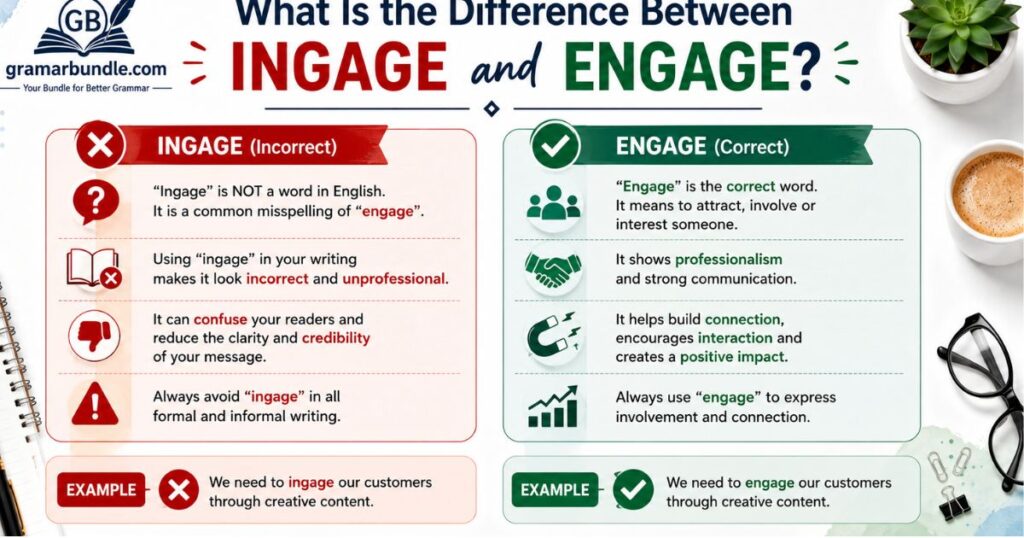
Ingage vs Engage Examples:
Correct Example
“She knows how to engage her students in class.”
Incorrect Example
“She knows how to ingage her students in class.”
A single letter makes all the difference.
Engage Meaning Explained in Simple Words
The engage meaning can change slightly depending on the situation, but the main idea stays the same.
Engage generally means:
- to take part in something
- to become involved
- to connect with others
- to interact actively
- to attract attention
The word engage is used in many different contexts. In everyday life, it means taking part in a conversation or activity.
What Does Engage Mean in Communication?
In communication, engage means connecting with people through active listening, meaningful conversations, and clear interaction. It focuses on building understanding and encouraging participation.
Examples
- “The speaker engaged the audience with a clear and interesting presentation.”
- “Good communication skills help teams engage and work together effectively.”
Whether in everyday conversations, teamwork, or public speaking, engage means creating a strong connection and keeping people actively involved in the conversation.
Engage Meaning in Business
In business, engage means actively involving employees, customers, or clients through effective communication and relationship building. It helps create a workplace where people feel valued and connected.
Businesses focus on:
- encouraging employee participation
- building strong customer relationships
- understanding customer needs
- responding to customer feedback
- improving teamwork and collaboration
Example
“The coffee shop engaged customers by asking for feedback on new menu items.”
Customer engagement builds trust, increases loyalty, and helps businesses create stronger relationships with their customers.
Engage Meaning in Marketing
In marketing, engagement refers to how people interact with a brand’s content. It shows how interested the audience is and how they respond to marketing efforts.
Engagement can include:
- liking posts
- leaving comments
- sharing content
- clicking links
- watching videos
- interacting with a brand
Higher engagement helps businesses understand their audience, improve marketing campaigns, increase brand awareness, and build stronger customer relationships.
Example
“The fitness brand engaged its audience by sharing workout videos and encouraging users to join the conversation.”
Strong engagement helps brands build trust, attract more customers, and create long-term relationships with their audience.
Engage Meaning in Education
In education, engage means encouraging students to take an active part in the learning process. It involves participating in discussions, asking questions, completing activities, and interacting with teachers and classmates.
Engaged students often:
- participate in classroom discussions
- ask questions
- work on group activities
- interact with teachers and classmates
- develop critical thinking skills
- remember lessons more effectively
Example
“The teacher used a hands-on ecosystem activity to engage students in learning.”
Active participation helps students understand concepts better, improve memory, and make learning more enjoyable.
Related articles you may find helpful:Implicit vs Complicit

Is Ingage a Real Word?
Many people wonder whether “ingage” is a real English word.
The answer is simple. Ingage is not accepted as the correct spelling in modern English. Today, it is considered a spelling mistake.
Although “ingage” appeared in some older historical texts, modern dictionaries and grammar guides recognize only “engage” as the correct spelling.
Using engage instead of ingage improves clarity and helps you communicate more effectively.
Why People Confuse Ingage vs Engage
Many people confuse “ingage” and “engage” because the two words sound very similar when spoken quickly. This can cause spelling mistakes, especially in casual writing or while typing fast.
The confusion is often caused by:
- similar pronunciation
- fast typing habits
- casual writing
- common spelling mistakes
When many speakers say “engage” quickly, it sounds close to:
- in-gage
- en-gage
The “En” and “In” Prefix Problem
Some commonly confused words include:
| Correct Word | Common Misspelling |
| Encourage | Incourage |
| Enclose | Inclose |
| Engage | Ingage |
| Ensure | Insure |
The similar prefixes often lead to common spelling mistakes, even among fluent writers.
You may find helpful:Comming vs Coming: Easy Grammar and Spelling Guide
Ingage vs Engage Grammar Rules
The correct spelling is “engage.” It comes from the French word “engager” and has Latin roots that use the “en-” prefix. This is why “engage” follows the standard English spelling pattern.
Many English words use the same “en-” prefix, including:
- enable
- encourage
- enrich
- engage
- entertain
- enlighten
- entrust
Recognizing this spelling pattern helps writers remember the correct form of “engage” and use similar words with confidence.
How to Use Engage Correctly
Use “engage” when you want to show that someone is actively involved, connected, or participating in something. The meaning may change slightly depending on the situation, but the main idea remains the same.
You can use engage to:
- become involved in an activity
- connect with other people
- gain someone’s interest
- take part in a discussion
- communicate effectively
Using engage in the right context makes your communication clearer and more effective.
You may search for:https://grammarbundle.com/loot-vs-lute/
Engage in a Sentence
Here are some simple examples of engage in different contexts.
Business Communication Examples
- “Let’s engage in a discussion about our project timeline.”
- “Let’s engage the team in brainstorming solutions for this quarter’s targets.”
Marketing Examples
- “We aim to engage our audience through interactive content.”
- “Our goal is to engage our audience with interactive challenges that build community around our brand.”
Education Examples
- “To engage students in this lesson, we’ll use hands-on activities.”
- “Today’s lesson will engage students through hands-on experiments to explore scientific concepts.”
Writing Examples
- “This story engages readers by weaving in relatable experiences.”
- “The article aims to engage readers with relatable anecdotes, making complex ideas easier to digest.”
Everyday Communication Example
- “I want to engage you in this conversation about our favorite books.”
- “I really want to engage you in my thoughts about the recent documentary we watched.”
Online Content Example
- “We strive to engage our followers with daily challenges.”
Incorrect Ingage in a Sentence Examples
Many people mistakenly use “ingage” instead of “engage.” However, “ingage” is a spelling mistake, and “engage” is the correct English word.
Incorrect
- “The teacher tried to ingage her students during the lesson.”
- “We need to ingage our clients more effectively.”
- “Let’s ingage in a discussion about our plans.”
Correct
- “The teacher tried to engage her students during the lesson.”
- “We need to engage our clients more effectively.”
- “Let’s engage in a discussion about our plans.”
Always use “engage” in standard English writing.
How to Use Ingage
“Ingage” is not accepted as a correct word in modern English. It should not be used in professional, academic, business, or formal writing because it is considered a spelling mistake.
You may see “ingage” in:
- spelling mistakes
- grammar discussions
- outdated publications
- typographical errors
For clear and correct writing, always use “engage” instead of “ingage.”
Ingage vs Engage in Marketing
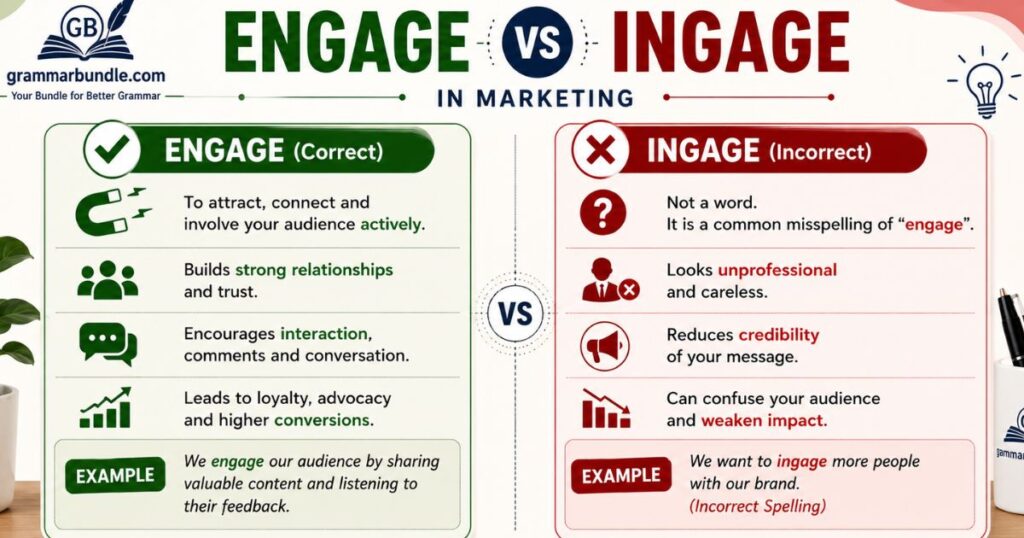
In marketing, using the correct spelling is important because it affects how people see your brand. “Engage” shows professionalism and helps businesses build trust with their audience, while “ingage” can confuse readers and reduce credibility.
Correct spelling is especially important in:
- advertisements
- websites
- social media posts
- email marketing
Example
Incorrect: “We help ingage customers through social media.”
Correct: “We help engage customers through social media.”
Using “engage” instead of “ingage” helps businesses create a professional image and build stronger customer trust.
You may study this article at https://learniffied.com/ingage-vs-engage/
Ingage vs Engage in Business Writing
In business writing, the correct spelling of words affects how your message is understood. Using “ingage” instead of “engage” can reduce professionalism, confuse readers, and raise questions about attention to detail.
Correct spelling is important in:
- emails
- reports
- proposals
Incorrect
“We hope to ingage with our clients more effectively.”
Correct
“We hope to engage with our clients more effectively.”
A spelling mistake can distract readers from your message and affect the quality of your communication. Accurate spelling helps create trust in business relationships.
Engage Synonym List
Using synonyms for “engage” makes writing more interesting and reduces repetition. The right synonym depends on the context and helps make your message clearer.
| Context | Synonyms |
| Communication | connect, involve |
| Marketing | captivate, entice, stimulate |
| Business | collaborate, incorporate |
| Education | enrich |
Using the right word makes your writing more natural, clear, and effective.
Related articles you may find helpful: Noteable or Notable
Common Grammar Mistakes With Engage
Using Ingage Instead of Engage
One common grammar mistake is spelling “engage” as “ingage.” This confusion often comes from the way the word sounds, but “engage” is the correct spelling in modern English and should always be used in professional, academic, and casual writing.
Wrong
“I hope to ingage the audience with my presentation.”
Correct
“I hope to engage the audience with my presentation.”
Overusing the Word Engage
Using “engage” too often can make your writing sound repetitive and awkward. Repeating the same word reduces its impact and may make readers lose interest.
Overused Example
- “We engage our audience to engage with our content and engage in discussions.”
That sentence feels exhausting.
Better Version
- “We connect with our audience to enjoy our content and participate in discussions.”
Cleaner writing improves reader engagement.
Using Engage in the Wrong Context
The word “engage” should match the meaning of the sentence. Using it in the wrong context can make your writing sound confusing or awkward.
Strange Example
“I engage with my breakfast every morning.”
Engage Definition and Examples by Industry
Customer Service
Businesses engage customers by:
- answering questions
- solving problems
- using personalized communication
- following up on previous interactions
Education
Teachers engage students through:
- group discussions
- hands-on projects
- curiosity
- collaboration
Social Media
Creators engage audiences by:
- posting relatable content
- responding to comments
- hosting live events
Public Speaking
Speakers engage audiences by:
- storytelling
- asking questions
- inviting audience participation
Healthcare
Healthcare professionals engage patients by:
- asking about symptoms
- giving clear explanations
- encouraging questions
- involving patients in decisions
Sales
Sales professionals engage customers by:
- asking insightful questions
- providing tailored solutions
- building relationships
How to Remember the Correct Spelling of Engage
If you find it difficult to spell “engage,” a few simple memory tricks can help.
Word Association Trick
Think of “engage” as “enjoying a game.” This reminds you that engage means taking part or getting involved, making the spelling easier to remember.
Typing Tip
Type the word slowly and read it as you write. Paying attention to each letter helps you remember the correct spelling and avoid writing “ingage.”
How to Improve English Writing and Avoid Grammar Mistakes
Understand the Rules, Then Break Them
Familiarizing yourself with basic grammar rules is essential.
- Study common grammar rules.
- Practice creative sentence structures.
- Experiment and find your voice.
Embrace Feedback
One of the fastest ways to improve your writing is through feedback. Sharing your work with friends or joining a writing group can provide you with fresh perspectives. Constructive criticism helps you identify mistakes and areas for improvement.
- Seek out peers for honest reviews.
- Join online or local writing communities.
- Stay open-minded and willing to adapt.
Read Widely
Reading a variety of genres exposes you to different writing styles and techniques.
- Diversify your reading list.
- Note down phrases or styles you admire.
- Try to emulate them in your own writing.
Practice, Practice, Practice
Regular writing is key to mastering English. This consistent practice builds memory for grammar and enhances your confidence as a writer.
- Commit to a daily writing routine.
- Use prompts to spark creativity.
- Reflect on your progress over time.
Commonly Confused English Words
| Correct Form | Incorrect Form |
| Embarrass | Embarass |
| Maintenance | Maintainance |
| Necessary | Neccessary |
| Privilege | Privelege |
| Judgment | Judgement |
How to Engage Readers in Writing
Know Your Audience
Understanding who your readers are can change everything. Transform your content to their interests, age, and preferences to create a more personalized experience.
Use Relatable Stories
People love stories. Use real-life examples into your writing to create a connection and illustrate your points more clearly.
Ask Questions
Engaging your readers means inviting them into the conversation. Pose questions that encourage them to reflect and interact with your content.
Break It Down
Keep your paragraphs short and sweet. Use bullet points or lists to highlight key ideas, making it easier for readers to digest information quickly.
Use Visuals
Use images, infographics, or videos when possible. Visuals can capture attention and enhance understanding, making your writing more beautiful.
Include a Call to Action
Encourage your readers to take a step further. Whether it’s leaving a comment, sharing the post, or exploring a related topic, a clear call to action motivates engagement.
Quick Quiz: Engage or Ingage?
When it comes to the words “engage” and “ingage,” many stumble upon their usage, often leading to confusion. “Engage” means to involve or attract, while “ingage” isn’t recognized as a standard word. That said, a quick quiz can help clarify these concepts in an enjoyable way!
Which sentence is correct?
- The children love to _______ in fun activities.
Answer: engage - She tried to ________ the audience with her story.
Answer: engage - You must always ________ in meaningful conversations.
Answer: engage
FAQs:
- What does “ingage” mean?
Ans: “Ingage” isn’t a standard word; it’s often a misspelling. Use “engage” instead! - What does “engage” mean?
Ans: “Engage” means to actively involve or participate in something. - Can I use “ingage” in my writing?
Ans: It’s best to avoid “ingage.” Stick with “engage” for clarity! - Why do people confuse the two words?
Ans: The similar sounds and appearances can easily mix people up. - How can I remember which one to use?
Ans: Just think: “Engage” is the right choice.
Say it out loud and remember: “Engage is the way!” - Where should I use “engage”?
Ans: Use “engage” in conversations, articles, and social media to invite involvement.
Example: “Let’s engage the community.” - Are there any synonyms for “engage”?
Ans: Yes! You can use words like “involve,” “participate,” or “connect.”
It adds variety to your writing! - What’s the takeaway about “ingage” and “engage”?
Ans: Just remember: “engage” is the one you want!
Avoid “ingage” to keep your communication clear.
Conclusion:
It’s crucial to recognize the differences between “ingage” and “engage.” While they may sound similar, their meanings are distinct and can affect the clarity of your communication.