
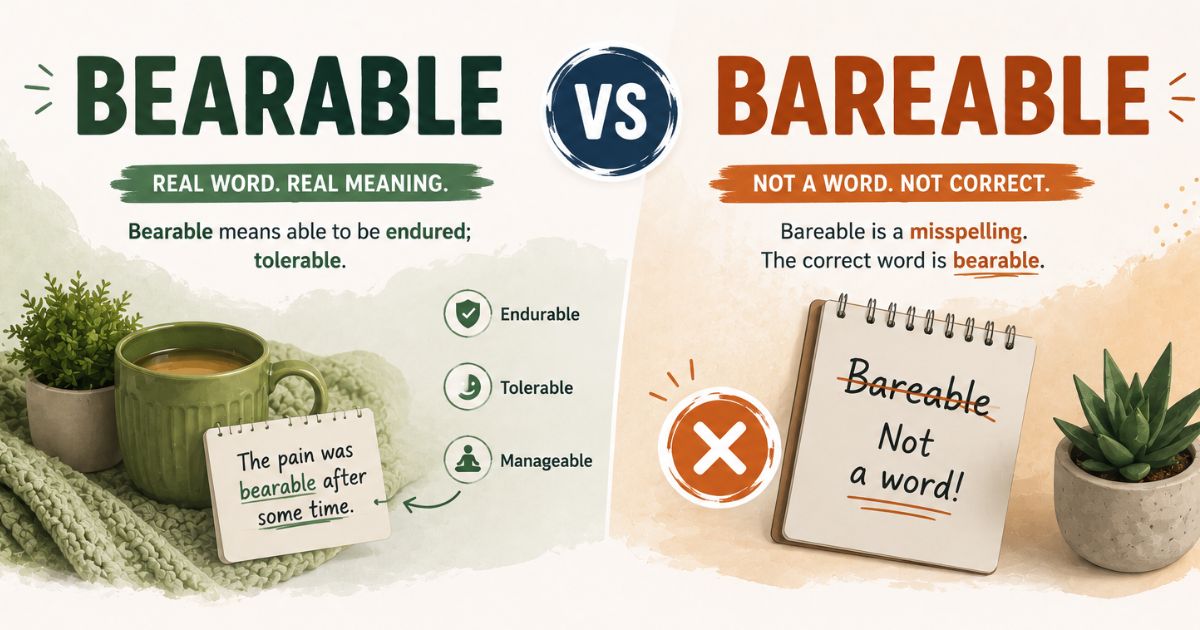
Many people confuse “bearable” vs “bareable” because they look similar. However, “bearable” is the correct spelling, while “bareable” is a common misspelling. Understanding the difference helps you avoid spelling mistakes and use the correct word with confidence.
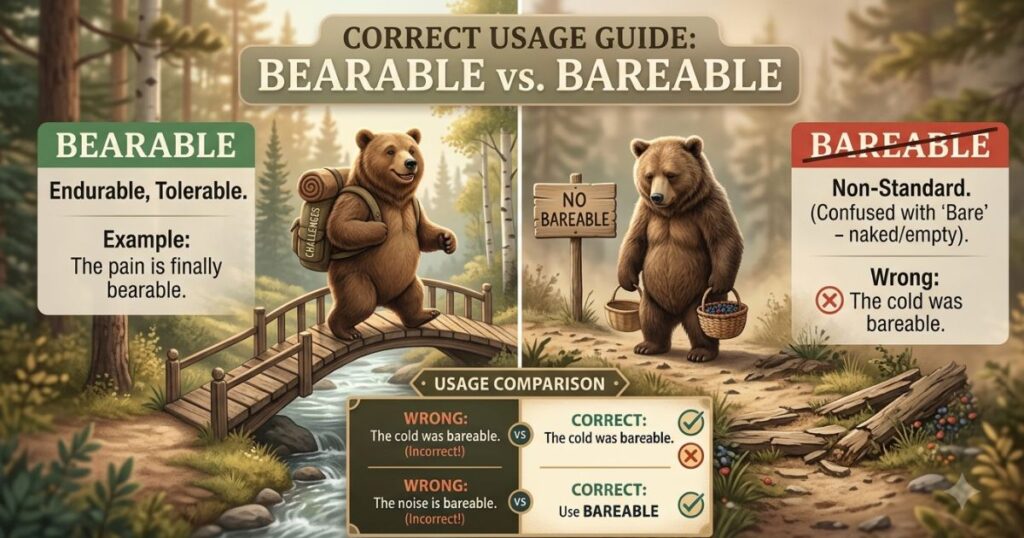
What Does Bearable Mean?
The word “bearable” describes something that can be endured, tolerated, or managed without becoming overwhelming.
Bearable Definition
Bearable means able to be endured or tolerated.
Common Uses of Bearable
The word “bearable” is commonly used when referring to:
- Pain or discomfort
- Hot or cold weather
- Stressful situations
- Loud noise
- Difficult experiences
Bearable Examples
- After days of back pain, the medication made the discomfort bearable.
- The hot weather became bearable with a fan and cold drinks.
- The construction noise was bearable once he played music.
- The exam stress became bearable after taking short breaks.
- Her friend’s support made the difficult situation more bearable.
Related Articles You May Find Helpful https://grammarbundle.com/ingage-vs-engage/
Is Bareable a Word?
No. “Bareable” is not a recognized word in standard English. It is a common misspelling of “bearable,” which means something that can be endured or tolerated.
Is Bareable the Correct Spelling?
No. “Bareable” is not the correct spelling. Standard English dictionaries recognize “bearable” as the correct form, while “bareable” is considered a spelling mistake.
Why Do People Write Bareable?
The confusion usually happens because “bear” and “bare” have the same pronunciation. Many writers choose the wrong spelling because it looks similar to familiar words.
Common reasons include:
- Bear and bare sound the same.
- Similar words such as bare, barefoot, and bare skin influence spelling.
- English pronunciation can make spelling confusing.
Although “bareable” may seem correct, “bearable” is the only accepted spelling in modern English.
Bearable vs Bareable Meaning and Difference
Understanding these root meanings makes the correct spelling easier to remember.
| Root Word | Meaning |
| Bear | To endure or tolerate |
| Bare | Exposed, uncovered, or empty |
Learning the difference between these root words helps you avoid spelling mistakes and use the correct word with confidence.
For more guidance https://bestcompari.com/
Bear Means Endure
The verb “bear” means to endure, tolerate, or withstand something difficult. It is commonly used when referring to pain, pressure, responsibility, or other challenging situations.
Examples:
- I can bear the weight of this responsibility.
- I will bear the pain until it passes.
- She learned to bear her fears and face the unknown.
The adjective “bearable” comes directly from the verb “bear.” It describes something that can be endured or tolerated, even if it is unpleasant or difficult. “Bareable,” however, is not a recognized English word and should not be used in standard writing.
Why Do People Spell Bearable Wrong?
The confusion between “bearable” and “bareable” is mainly caused by their similar pronunciation. Since “bear” and “bare” sound the same, many people accidentally choose the wrong spelling.
Pronunciation of Bearable
Bearable: BEHR-uh-bul
Because “bear” and “bare” are homophones, the incorrect spelling “bareable” is a common mistake. However, “bearable” is the only correct spelling in standard English.
Common Spelling Mistakes in English
The confusion between “bearable” and “bareable” is one of many common English spelling mistakes.
Here are similar grammar mistake examples:
| Incorrect | Correct |
| Bareable | Bearable |
| Definately | Definitely |
| Wierd | Weird |
| Recieve | Receive |
| Seperate | Separate |
English spelling is not always consistent, which is why these mistakes occur so frequently. Becoming familiar with commonly misspelled words can help improve spelling accuracy in everyday writing.
Related Articles You May Find Helpful https://grammarbundle.com/dysregulated-vs-disregulated/
Bearable Word Origin Explained
The word “bearable” comes from the Old English verb:
- Beran
That word meant:
- To carry,
- To endure,
- To support.
Understanding the word’s origin makes its spelling easier to remember.
Follows a common English pattern in which the suffix “-able” describes the ability to perform or experience something.
Like words such as:
- Readable
- Manageable
- Bearable
This explains why the correct spelling is “bearable,” not “bareable.”

How to Spell Bearable Correctly
Simple memory techniques can make the spelling of “bearable” easier to remember.
Memory Trick
Remember the phrase:
- “Bears are able to be calm.”
This connects “bear” with “-able,” making it easier to remember the correct spelling of “bearable.”
Visual Learning Trick
Imagine a calm bear relaxing in a hammock. The image links the word “bear” with the idea of staying calm and enduring a difficult situation, reinforcing the meaning and spelling of “bearable.”
Using simple memory and visual learning techniques can help you remember the correct spelling and avoid the common mistake “bareable.”
Related Articles You May Find Helpful https://grammarbundle.com/implicit-vs-complicit/
Bearable Meaning With Examples
Understanding “Bearable”
The term “bearable” refers to something that is tolerable or manageable. In essence, it signifies resilience in the face of adversity. When we label an experience as bearable, we acknowledge the difficulty while also highlighting our capacity to endure.
Everyday Examples
Work Stress:
Tight deadlines can be stressful, but finding rhythm in the chaos makes the workload bearable.
Physical Pain:
After a workout, muscle soreness can be bearable when paired with the satisfaction of achieving fitness goals.
Emotional Struggles:
Heartbreak can feel overwhelming, yet sharing feelings with friends can make the pain bearable.
Broader Perspectives
Beyond personal experiences, “bearable” often shapes our interactions with larger societal issues. Take climate change.
The Beauty in Endurance
Embracing bearable situations offers a unique opportunity for growth. When we adjust our mindset, we can transform struggles into stepping stones toward strength and understanding.
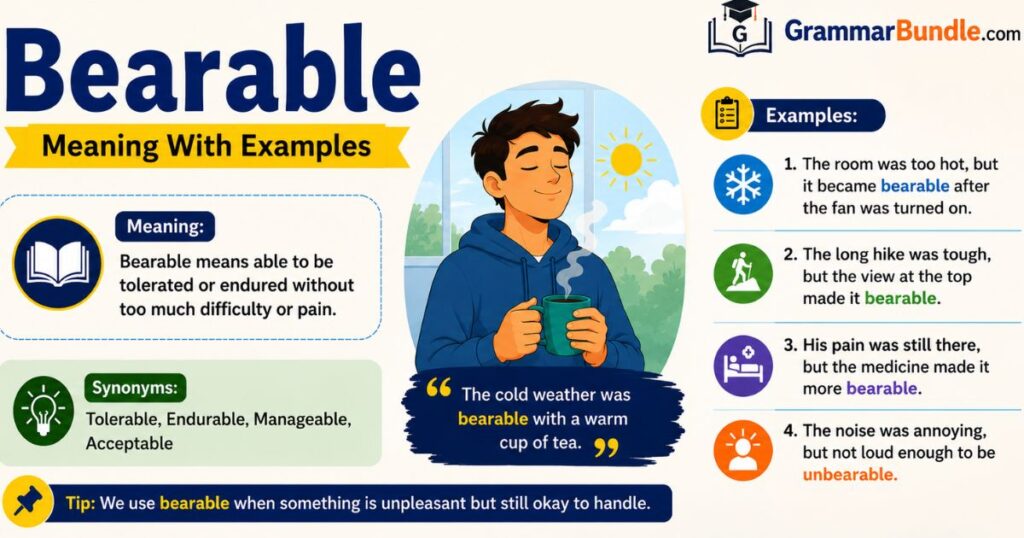
Bearable in a Sentence
Descriptive Sentences:
- The weather was frigid, but with the right layers, it became bearable.
- Despite the chaotic ambiance, the music made the environment bearable.
- Her witty remarks transformed the awkward dinner into something bearable.
Comparative Sentences:
- The pain after surgery was unbearable.
- Compared to last winter, this year’s snow is much more bearable.
- While the initial shock was harsh, the adjustment period soon proved bearable.
Conditional Sentences:
- If the workload remains light, the job will be bearable for the summer.
- Should the weather improve, the hike could be bearable after all.
- If they adjust their expectations, the situation might become bearable.
Exclamatory Sentences:
- What a relief that the delay turned out to be bearable!
- How bearable the tension became once they cleared the air!
- It’s amazing how bearable the long meetings feel with lively discussions!
Reflective Sentences:
- Looking back, those long nights studying felt bearable with friends by my side.
- In hindsight, what seemed unbearable turned out to be quite bearable.
- Reflecting on the challenges, I realize they made the journey more bearable.
Bearable vs Unbearable
| Feature | Bearable | Unbearable |
| Emotional Impact | Manageable stress | Overwhelming anxiety |
| Opportunity for Growth | Yes | Often leads to departure |
| Potential for Change | High | Low |
| Social Support | Strong | Weak |
| Duration | Temporary, often time-limited | may feel endless |
| Outlook | Hopeful, forward-looking | often hopeless |
Unbearable Meaning
Unbearable meaning refers to experiences or feelings that are too intense or difficult to handle.
Examples of Unbearable Situations:
- When you’re stuck in traffic for hours, the frustration can feel unbearable.
- Watching a loved one suffer from illness can create unbearable heartache.
- The heat of a scorching summer day makes the discomfort unbearable.
- Losing a cherished pet results in unbearable grief for many .
- The pressure of overwhelming deadlines at work can feel unbearable.
- Environmental destruction we witness can evoke unbearable sadness for our planet.
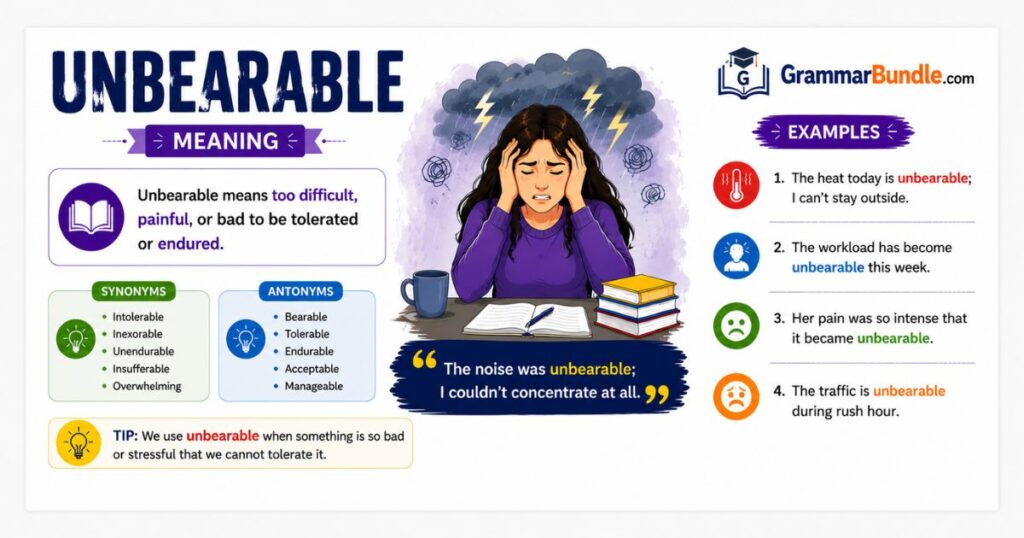
Bearable Adjective Meaning in Grammar
The word “bearable” is an adjective that describes something that is tolerable or manageable, especially when facing discomfort or hardship.
Example: “The pain was bearable after taking the medicine.”
What Does an Adjective Do?
Adjectives like “bearable” enhance our language by adding depth and detail to nouns. They allow us to convey feelings more clearly.
Bearable (adjective): Able to be accepted, endured, or tolerated without too much difficulty.
Grammar Pattern
- Part of Speech: Adjective
- Comparative: More bearable
- Superlative: Most bearable
Sentence Examples
- The weather became bearable after the rain.
- The pain was bearable, so he didn’t need medicine.
- Her workload is now more bearable than last month.
- The long journey was bearable because we had good company.
- With air conditioning, the heat is bearable.
Synonyms
- Tolerable
- Manageable
- Acceptable
- Endurable
- Livable
Antonyms
- Unbearable
- Intolerable
- Insufferable
- Impossible
- Unmanageable
Why Bareable Is Incorrect
Bareable is an incorrect spelling in standard English. The correct word is bearable.
Why Do People Spell It as Bareable?
The mistake happens because bear and bare are homophones. They are pronounced the same but have different meanings.
- Bear = to endure, tolerate, or carry
- Bare = uncovered, exposed, or without covering
The adjective bearable is formed from the verb bear (to endure). Therefore, it must be spelled with bear, not bare.
Correct vs. Incorrect
| Incorrect | Correct | Reason |
|---|---|---|
| Bareable | Bearable | Derived from bear (to endure), not bare (uncovered). |
Examples
- The pain was bearable after taking medicine.
- The weather became bearable in the evening.
- Her workload is now more bearable than before.
English Spelling Rules Behind Bearable
- When diving into the spelling of “bearable,” we can see the importance of root words in English. The root “bear,” meaning to carry or endure, gives us a clue about the word’s meaning.
- By adding the suffix “-able,” we turn the verb into an adjective, signifying that something can be tolerated or endured.
- This transformation shows how creatively English can change words to convey complex ideas in a simple form.
Root Words Matter:
Understanding the roots helps us grasp meanings.
Suffix Magic:
“-able” frequently indicates capability or suitability.
Spelling Consistency:
The word aligns with other examples like “manageable” or “readable,” reinforcing patterns in English spelling.
- comfort → comfortable
- enjoy → enjoyable
- read → readable
- bear → bearable
Words Commonly Confused With Bearable
| Confused Words | Difference |
|---|---|
| Bearable vs Bareable | Bearable is correct; bareable is a misspelling. |
| Bear vs Bare | Bear means to endure or carry; bare means uncovered or exposed. |
| Bearable vs Unbearable | Bearable means tolerable; unbearable means impossible to endure. |
| Bearable vs Tolerable | Both mean acceptable or endurable, but tolerable often refers to something merely acceptable. |
| Bearable vs Endurable | Both describe something that can be endured, though bearable is more common in everyday English. |
| Bearable vs Manageable | Bearable focuses on enduring discomfort, while manageable means easy to handle or control. |
| Bearable vs Acceptable | Bearable refers to tolerating hardship, whereas acceptable means satisfactory or suitable. |
| Bearable vs Livable | Bearable describes tolerable conditions; livable means suitable for living. |
How Social Media Spreads Spelling Mistakes
Social media has changed the way we communicate, for better and worse. It spreads spelling mistakes, sometimes faster than a meme goes viral. Here’s how:
Instant Sharing:
When someone posts a misspelled word, their followers can quickly share it. This amplifies the mistake across platforms, making it a common sight.
Lack of Editing:
The casual nature of social media encourages quick posts without much thought. Users often prioritize speed over accuracy, leading to typos that go uncorrected.
Mimicry Effect:
People tend to copy others’ mistakes, thinking that if it’s online, it must be right. This creates a chain reaction, where one error becomes a trend.
Homophones Increase Spelling Errors
Words that sound alike but have different meanings are especially vulnerable to confusion on social media. Since bear and bare are pronounced the same, many people mistakenly write bareable instead of bearable.
Grammar Tips for Beginners
Understanding grammar simple tips can set you on the right path. Here are some essential pointers for beginners to enhance your writing:
Subject-Verb Agreement:
Ensure your subjects and verbs match in number. For example, “The dog barks” versus “The dogs bark.” Always check if they agree!
Use Active Voice:
Choose active voice over passive voice for clearer sentences. “The cat chased the mouse” is livelier than “The mouse was chased by the cat.”
Punctuation Matters:
Commas, periods, and question marks help your reader follow your thoughts. Misplacing a comma can change the meaning of a sentence entirely!
Watch for Common Mistakes:
Words like “their,” “there,” and “they’re” trip many people up. Familiarize yourself with these to avoid confusion.
Break It Down:
If you’re unsure about a long sentence, break it into shorter ones. Clarity often lies in simplicity.
Read Aloud:
Hearing your writing can highlight awkward phrases or errors you might miss when reading silently.
Practice, Practice, Practice:
The more you write, the better you’ll get. Don’t shy away from making mistakes; they’re part of the learning process.
Seek Feedback:
Share your writing with friends or online communities. Fresh eyes can spot errors and offer new insights.
Easy Way to Remember Bearable Spelling
To remember the spelling of “bearable,” try these easy tips that make learning fun and effective.
- Break It Down: Split the word into syllables: “bear” + “able.” This makes it easier to visualize and pronounce.
- Visual Association: Picture a cute bear sitting on a table. This silly image helps keep the correct spelling in your mind.
- Use it in Sentences: Create simple sentences like “This workload is bearable.” Writing it in context reinforces the spelling.
- Rhyme it Out: Think of words that rhyme with “able” like “stable.” Associating them can help stick “bear” in your head.
- Practice Regularly: Repetition is key. Write the word down or say it aloud several times a day to strengthen your memory.
Common Grammar and Spelling Mistakes Like Bearable vs Bareable
Many English words are commonly confused because they sound alike, have similar spellings, or are frequently mistyped.
| Incorrect | Correct | Reason |
|---|---|---|
| Bareable | Bearable | Bearable comes from bear (to endure). |
| Alot | A lot | A lot is always written as two words. |
| Definately | Definitely | A common misspelling caused by pronunciation. |
| Recieve | Receive | Remember the rule: “I before E, except after C.” |
| Seperate | Separate | The correct spelling contains -par-. |
| Untill | Until | Until has only one l. |
| Occured | Occurred | The correct form doubles the r. |
| Writting | Writing | Drop the extra t before adding -ing. |
| Then | Than | Then relates to time; than is used for comparison. |
| Your | You’re | Your shows possession; you’re means you are. |
FAQs
- What is the difference between “bearable” and “bareable”?
Ans:“Bearable” refers to something that can be tolerated or endured, while “bareable” is a common misspelling of the former. - How do I remember the correct spelling of “bearable”?
Ans:You can remember “bearable” by associating it with the word “bear,” meaning to endure. - Are “bearable” and “bareable” interchangeable in writing?
Ans:No, they are not interchangeable. “Bearable” is the correct form, while “bareable” is incorrect. - Can using “bareable” affect my writing’s credibility?
Ans:Yes, using incorrect spelling can undermine the professionalism and clarity of your writing. - In what contexts should I use “bearable”?
Ans:Use “bearable” when describing situations, conditions, or experiences that can be tolerated or endured. - Is “bareable” ever considered correct in any context?
Ans:No, “bareable” is not recognized as a correct English word in any context. - How can I improve my spelling of similar words?
Ans:Practicing with writing exercises, using spell check tools, and reading regularly can help improve your spelling skills. - Where can I find more resources on correct English spelling and grammar?
Ans:You can find numerous online grammar guides, writing resources, and educational websites dedicated to correct spelling and grammar.
Conclusion
Distinguishing between “bearable” and “bareable” is crucial for effective communication. The correct use of “bearable” describes something that is tolerable, while “bareable” is often a common misspelling that lacks a clear definition in standard English.