
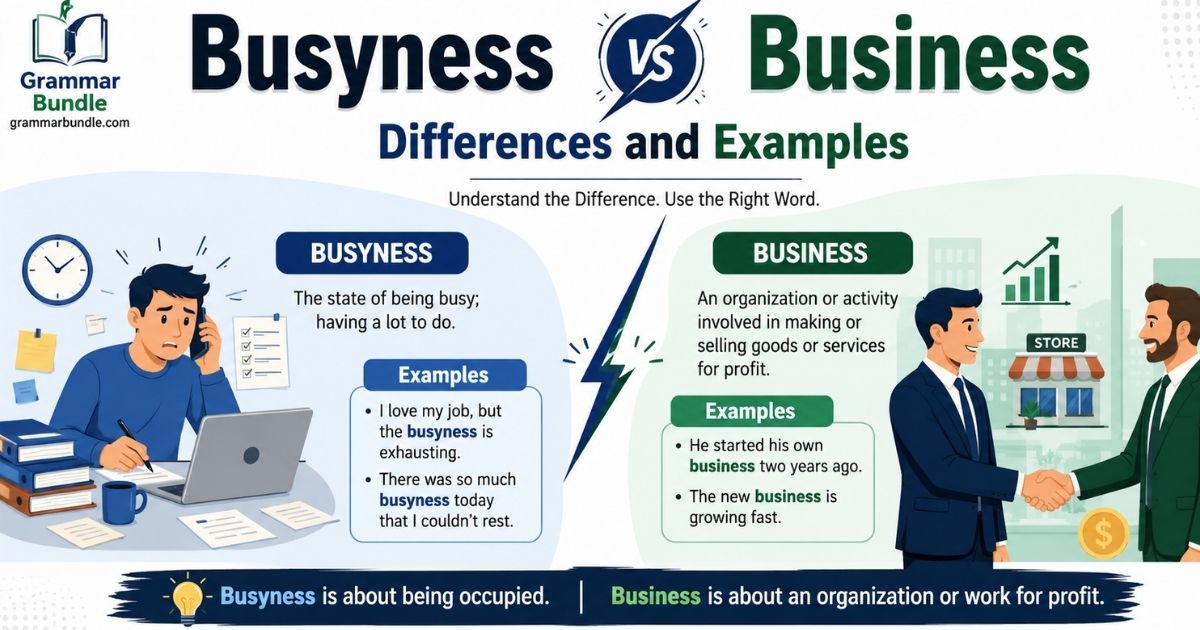
“Busyness” and “business” look and sound similar, but their meanings are different. Busyness means being busy or having many things to do, while business refers to work, commerce, or a company. Knowing this simple difference makes it easier to use both words correctly.
Busyness vs Business Meaning Explained in Plain English
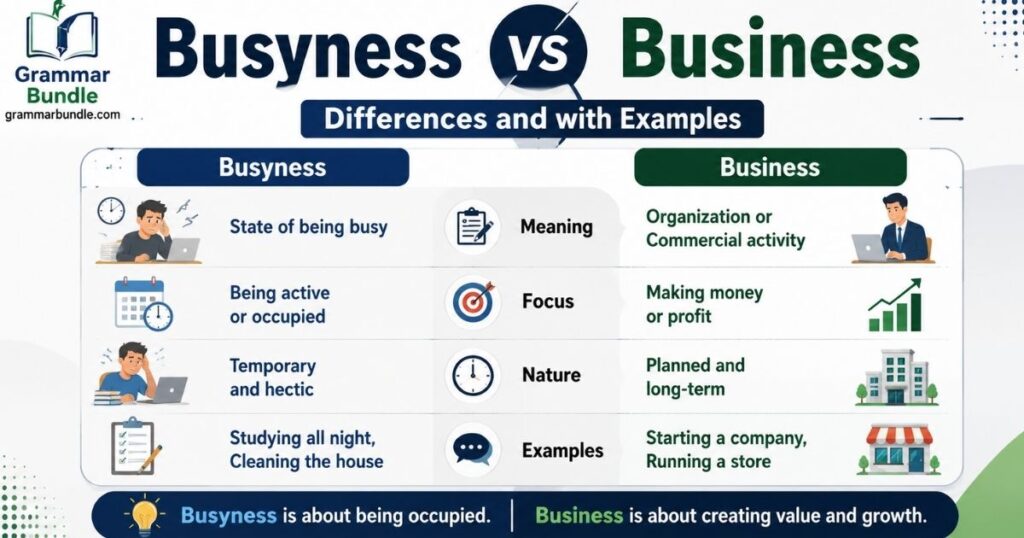
Although “busyness” and “business” look similar, they describe different ideas. Understanding their meanings makes the difference much easier to remember.
Related Articles You May Find Helpful https://grammarbundle.com/smiling-face-emoji-meaning/
What Does Busyness Mean?
Busyness refers to the state of being busy, often involving many tasks and distractions. It can describe a situation where someone is constantly occupied but may not be making real progress.
For example, you might spend the whole day checking tasks off a list but still feel that nothing important was achieved.
What Does Business Mean?
Business is more structured. It can refer to work, trade, or a company that provides goods or services. It is generally connected with specific goals, activities, or creating value.
The Simple Difference
A simple way to remember the difference is:
Busyness is like running on a treadmill — lots of movement without getting far.
Business is like driving toward a destination with a clear map — there is a purpose and a goal.
So, busyness is about being occupied, while business is about purposeful work or commercial activity.
What Is Busyness? A Clear and Human Explanation
Busyness is the state of being constantly occupied with tasks. You may stay busy all day but still feel that little has been achieved.
Related Articles You May Find Helpful https://grammarbundle.com/village-vs-subdivision/
What Does Busyness Look Like?
Imagine checking emails, attending meetings, and handling errands all day without making real progress on important goals.
It is like running on a treadmill—lots of movement, but no real progress.
Busyness vs Productivity
Many people confuse busyness with productivity. For example, a student may study for hours but only skim notes without understanding them. They are busy, but they are not learning effectively.
Recognizing the difference between being busy and making meaningful progress can help improve balance and productivity.
For a detailed definition and usage, visit a trusted source: https://wordconfusion.com/busyness-vs-business/
What Is Business? A Practical and Real-World Meaning
Simple Business Definition
Business is organized and purposeful work that involves providing goods or services in exchange for value. At its core, it connects people’s needs with useful solutions, such as a coffee shop serving customers or a company offering a new service.
What Business Looks Like in Real Life
Business appears in many forms in everyday life. A farmer selling fresh produce at a local market is running a business based on quality, trust, and exchange. Similarly, a professional offering services is involved in purposeful work that provides value to others.
Examples of Business in a Sentence
- “Every time I buy artisanal bread, I’m supporting a local business.”
- “Her consultancy provides strategic insights and helps businesses grow.”
The Key Difference in Feeling
Business is guided by clear goals and purposeful actions, while busyness can feel scattered and unproductive.
Answering emails or attending meetings may keep you busy, but business focuses on meaningful progress and results.
Carrer or Career? Easy Fix for This Spelling Mistake
Difference Between Busyness and Business (Side-by-Side Comparison)
| Feature | Busyness | Business |
|---|---|---|
| Focus | Often unfocused | Clear vision and goals |
| Productivity | Surface-level activity | Strategic actions driving growth |
| Time Management | Reactive | Proactive |
| Engagement | Often exhausted | Energized and motivated |
| Outcomes | Little to no tangible results | Measurable achievements |
| Prioritization | Tasks of little importance | Aligns tasks with objectives |
| Decision Making | Impulsive and scattered | Deliberate and informed |
Busyness often masquerades as productivity, leading individuals to fill their days with endless tasks yet achieve minimal real results. It can create a false sense of accomplishment while draining energy, leaving little room for meaningful progress.
In contrast, business implies a focused approach where time is intentionally allocated to activities that foster growth and align with a bigger picture.
Related Articles You May Find Helpful https://grammarbundle.com/seal-vs-seel/
A Simple Way to Remember
Understanding Busyness vs. Business
Busyness is the state of being overwhelmed with tasks, often leading to stress.
In contrast, business relates to the activities of making a living or managing a company.
To distinguish between the two, consider the following tips:
- Mind Your Context: If you’re feeling overwhelmed, you’re likely experiencing busyness. If you’re talking about your job or company operations, you’re in the realm of business.
- Emphasis on Intent: Recognize that busyness often leads to exhaustion, while business is about productivity and growth.
Practical Ways to Remember
To keep the words straight, visualize their usage:
- Busyness: Picture a crowded schedule filled with endless tasks.
- Business: Imagine a thriving marketplace or an office setting where plans are executed.
Using these visuals can make the difference clearer, steering the right word into your memory effortlessly.
Why People Confuse Busyness vs Business
The Illusion of Busyness
Many individuals mistakenly equate being busy with being truly productive.
This confusion arises when people fill their schedules with tasks but fail to assess their significance.
- Perception of Value: Society often rewards visible effort, not necessarily effective results.
- Social Media Influence: With the rise of social platforms, sharing busy lifestyles has become a status symbol, distorting our understanding of productivity.
The Essence of Business
On the flip side, genuine business focus centers around outcomes and strategic goals. It’s about prioritizing quality over quantity in tasks completed.
- Goal Orientation: Successful businesses track progress against specific objectives, ensuring every effort aligns with a larger vision.
- Intentionality: A significant aspect of true productivity is the ability to say no to unnecessary tasks, allowing time for what truly matters.
Related Articles You May Find Helpful https://grammarbundle.com/contractor-vs-contracter/
Busyness vs Business in English Grammar
Business and busyness are both nouns, but they have completely different meanings and grammatical uses.
Business
Business is a noun used for a company, commercial activity, work, or a matter that needs attention.
Examples:
- She owns a small business.
- He is in the business of selling furniture.
- I have some business to discuss with you.
- Mind your own business.
Grammar contexts:
- Countable: a business, two businesses
- Uncountable: Business is slow this month.
- Can appear in common phrases such as business meeting, business partner, and business trip.
Busyness
Busyness is also a noun, but it means the state or condition of being busy.
It is formed from busy + -ness.
Examples:
- The busyness of the city can be exhausting.
- I wasn’t prepared for the busyness of the office.
- The holiday season brings a lot of busyness to stores.
Grammar context:
- Usually used as an uncountable noun.
- It describes a condition or quality rather than a company or commercial activity.
Business vs Busyness
| Word | Part of speech | Meaning | Example |
|---|---|---|---|
| Business | Noun | Company, work, trade, or matter | She runs a successful business. |
| Busyness | Noun | The state of being busy | The busyness of the office was stressful. |
Easy way to remember
Business = work, company, or commercial activity.
Busyness = the state of being busy.
So, if you’re talking about a company or commercial activity, use business. If you’re describing how busy something is, busyness can be the appropriate noun.
Related Articles You May Find Helpful https://grammarbundle.com/scarey-or-scary/
How to Use Busyness and Business Correctly
Business
Use business for work, a company, or a matter.
- I run a business.
- She has a business meeting.
- His business is growing.
Busyness
Use busyness for the state of being busy.
- I dislike the busyness of the city.
- Her busyness caused stress.
- The busyness of work increased.
Remember: Business = work or company.
Busyness = being busy.
Busyness vs Business in a Sentence (Clear Examples)
Examples with “Business”
- She owns a small business.
- I have some business to finish.
- His business is successful.
- We discussed important business matters.
Examples with “Busyness”
- I dislike the busyness of the city.
- Her busyness kept her away.
- The busyness of the day was tiring.
- I enjoy some quiet after the busyness.
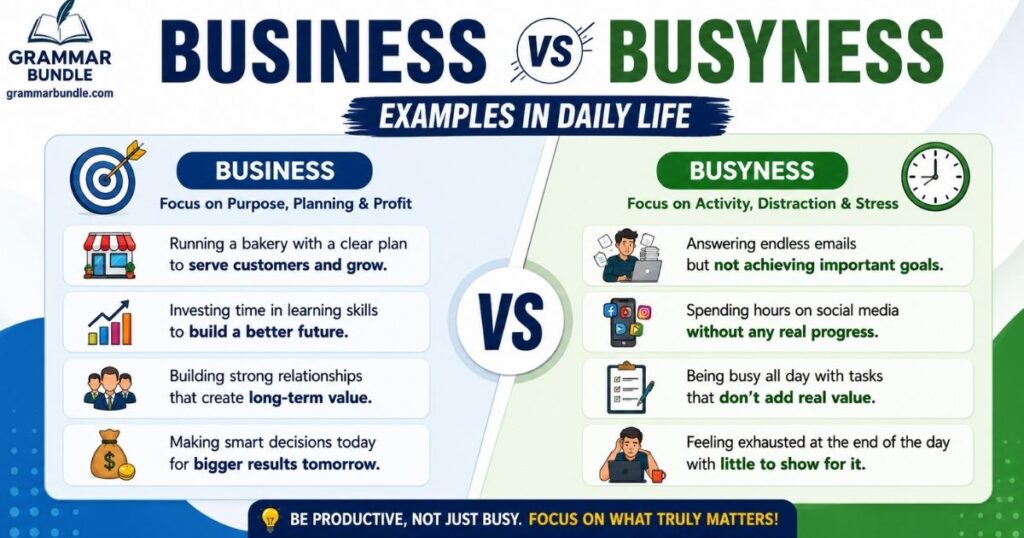
Business vs Busyness Examples in Daily Life
At Work
- Business: We discussed the business plan.
- Busyness: The busyness at work was exhausting.
In the City
- Business: He owns a business downtown.
- Busyness: I dislike the busyness of the city.
At School
- Business: She studied business at college.
- Busyness: The busyness of school kept her occupied.
At Home
- Business: We talked about family business.
- Busyness: The busyness at home made me tired.
While Shopping
- Business: She runs a clothing business.
- Busyness: The busyness of the market was noticeable.
During Travel
- Business: He traveled for business.
- Busyness: I wasn’t prepared for the busyness of the airport.
In Daily Conversation
Busyness: I need a break from this busyness.
Business: That’s none of your business.
Related Articles You May Find Helpful https://grammarbundle.com/cheer-vs-chear/
Common Mistakes in Busyness vs Business
1. Using “Busyness” for Work
❌ I have a lot of busyness to do.
✅ I have a lot of business to do.
2. Using “Busyness” for a Company
❌ She owns a successful busyness.
✅ She owns a successful business.
3. Using “Business” for Being Busy
❌ The business of the city is stressful.
✅ The busyness of the city is stressful.
4. Confusing “Business” With a Busy Schedule
❌ His business kept him occupied.
✅ His busyness kept him occupied.
5. Using “Busyness” After “For”
❌ They traveled for busyness.
✅ They traveled for business.
Simple Tricks to Avoid Busyness vs Business Mistakes
Trick 1: Look at “Busy”
If you mean being busy, think of busy + ness = busyness.
Example: The busyness of the office was distracting.
Trick 2: Think of a Company
If you mean a company, work, or trade, use business.
Example: She started a new business.
Trick 3: Ask One Question
Ask yourself: “Am I talking about work or being busy?”
- Work or company → Business
- Being busy → Busyness
Trick 4: Remember the Ending
The ending -ness often describes a state or quality.
Busy → Busyness
Happy → Happiness
Trick 5: Use the “Busy Test”
Try replacing the word with “being busy.”
If the sentence still makes sense, busyness is probably the right choice.
The busyness of the city → The city is very busy.
Business of the city → ❌ Different meaning.
Is Busyness a Real Word?
Yes, “busyness” is a real and correct English word. It means:
- The state of being busy
- Having many activities or tasks
- Constant activity or distractions
- Feeling overwhelmed by a busy schedule
“Being busy” is more common in everyday conversation, but “busyness” is also correct.
Busyness vs Business in the Workplace
Busyness may include:
- Endless emails
- Back-to-back meetings
- Constant multitasking
- Feeling rushed or overwhelmed
- Staying active without clear progress
Business focuses on:
- Clear goals
- Strategic decisions
- Measurable results
- Growth and progress
- Meaningful and purposeful work
A Quick Comparison
| Term | Focus | Outcome |
|---|---|---|
| Busyness | Multitasking | A flurry of activities |
| Business | Prioritization | Meaningful results |
Why Busyness Is Not Productivity
Being busy can feel rewarding, but it does not always mean you are effective. Busyness fills your schedule with tasks, while productivity focuses on achieving important goals and making real progress.
Key Differences
| Busyness | Productivity |
|---|---|
| Often reactive | Proactive |
| Focuses on activities | Focuses on results |
| Can lead to burnout | Encourages balance |
A Simple Example
Replying to emails all day may keep you busy, but if an important project remains unfinished, you are not being productive.
However, spending focused time completing that project leads to a meaningful result. Productivity is about results, not just staying busy.
Related Articles You May Find Helpful https://grammarbundle.com/tweek-vs-tweak/
How to Avoid the Busyness Trap
To avoid the busyness trap, start by prioritizing your tasks:
- Make a list of everything you need to do.
- Choose the top three tasks that matter most.
- Set time blocks for important tasks.
- Say no to activities that do not support your goals.
- Focus your time on what truly matters.
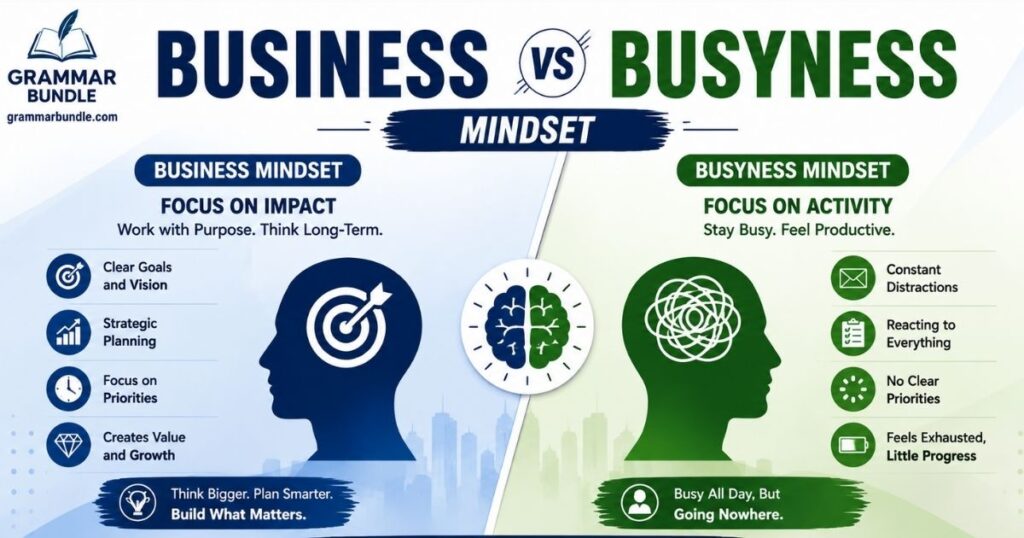
Business vs Busyness Mindset
The main difference is intention.
A busyness mindset keeps you occupied with small tasks and can leave you feeling overwhelmed. A business mindset focuses on important work that supports long-term goals.
Quick Practice Exercises
Fill in the Blank
- A focused mindset helps you prioritize __________ tasks.
- Saying no allows more time for __________ goals.
Choose the Correct Word
- A reactive/balanced mindset can lead to confusion and overwhelm.
- A business/busyness mindset focuses on long-term achievements.
Sentence Correction
Incorrect:
- “I will keep doing less important tasks instead of focusing on what I need to achieve.”
Correct:
- “I will stop doing less important tasks and focus on what I need to achieve.”
These simple exercises can help reinforce the difference between busyness and purposeful work.
Related Articles You May Find Helpful https://grammarbundle.com/grimey-or-grimy/
FAQs
1. What is “busyness”?
Ans: Busyness means being busy or occupied with many tasks and activities.
2. What does “business” mean?
Ans: Business refers to work, trade, or the buying and selling of goods and services.
3. How do “busyness” and “business” differ?
Ans: Busyness describes being occupied, while business refers to work, trade, or a company.
4. Is “busyness” correct to use in a sentence?
Ans: Yes. “Busyness” is a correct English word used to describe a state of being busy.
5. How do you spell “busyness” and “business”?
Ans: Busyness is spelled B-U-S-Y-N-E-S-S, while business is spelled B-U-S-I-N-E-S-S.
6. Can busyness be productive?
Ans: Not always. Being busy means doing many tasks, while productivity means achieving meaningful results.
7. Is busyness always negative?
Ans: No. Busyness can show activity or engagement, but too much of it can make you feel overwhelmed.
8. How can I be productive instead of just busy?
Ans: Set clear goals, prioritize important tasks, and focus on meaningful work instead of simply staying occupied.
Conclusion
Busyness and business are different. Busyness means staying occupied with many activities, while business involves purposeful work that creates value and results. Instead of simply staying busy, focus on meaningful work, clear goals, and real progress.